
By Zeng FengMyCarWhy EditorialUpdated
Used EV Battery Health: What to Check First
Used EV battery health is the decision that decides whether the price is real. Age and miles hint. A full charge on the dash does not prove capacity. A handheld lead-acid tester clamped on the under-hood posts does not either. Before you travel to see the car, ask for a dated report that names this VIN, then decide whether the remaining range still covers your commute with a reserve.
A Turkish search spike for the words for electric vehicle is interest in EVs. It is not a Turkey shopping page, and it does not pick a battery size for a US Model 3, Bolt, Ioniq 5, or Mustang Mach-E. The report on the car in front of you does.
| What you already have | What it proves | What it does not prove |
|---|---|---|
| Screenshot of 100% charge | State of charge at that moment | Remaining capacity vs new |
| Cabin range estimate after a full charge | A software guess under recent conditions | A lab capacity test |
| Passing handheld 12V tester | Auxiliary lead-acid cranking-style health | Traction pack health |
| Dated VIN-matched diagnostic with SOH and cell balance | The strongest consumer evidence most shops share | Future warranty outcomes |
| NHTSA VIN recall clear | No open safety recall NHTSA can show for that VIN | Battery state of health |
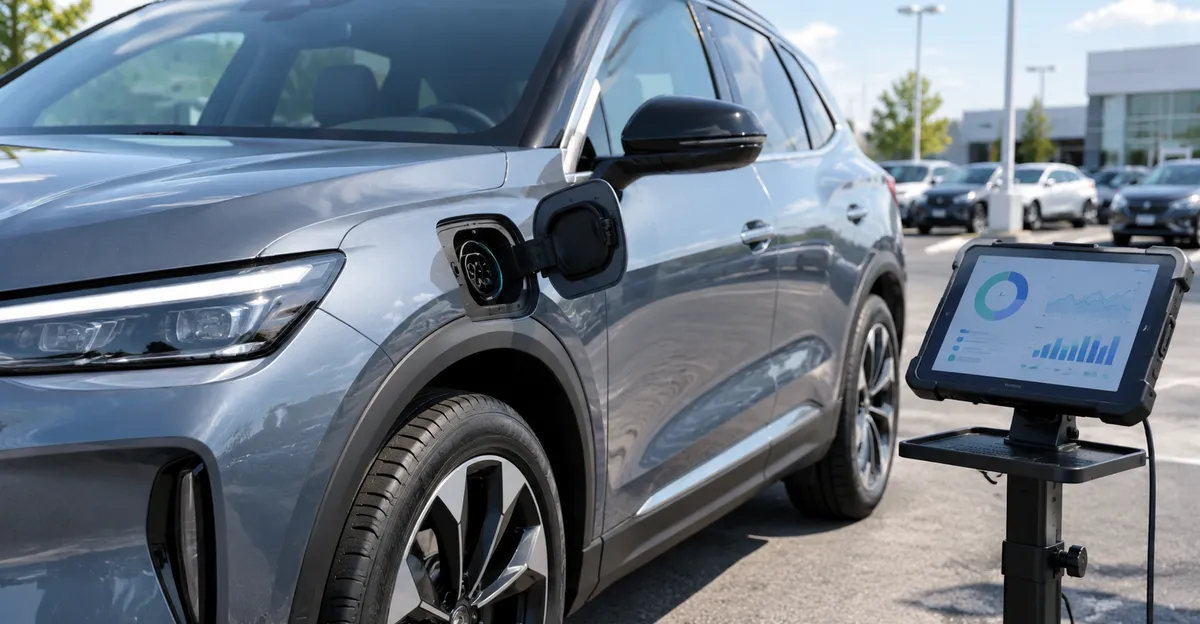
Start with the VIN, not the percentage
Ask the seller to identify the exact car before you argue about a health number. Ev.guru's used-EV buying checklist (published September 8, 2026, updated September 10, 2026) starts with the 17-character VIN, model year, trim, drivetrain, original in-service date, and mileage. Cars that share a model name can differ in battery size, AC charging limit, DC connector, approved adapters, and thermal hardware. An ad that says "up to 300 miles" is marketing language for a trim. It is not this car's original EPA range.
Collect documents that actually confirm those fields: title or registration for identity, the original window sticker or a manufacturer build record when available, and the U.S. owner's manual and warranty booklet. Put the equipment that matters to you in writing. A missing Level 2 cord is a quote. A wrong battery size is a different car.
While you are collecting identity, run a free NHTSA VIN recall check at NHTSA.gov/recalls. That step is ownership hygiene. It is not a capacity test. The full sort for open safety recalls lives on VIN recall check. Do both before you treat a battery percentage as the only risk.
Dashboard range is a clue, not a capacity test
Car and Driver's 2026 used-EV guide says a basic check is to fully charge the vehicle and look at the forecasted range. If the estimate sits near or within roughly 10 or 20 percent of the model's EPA rating, that can be a positive sign. If the estimate is nowhere near new, keep looking. The same article notes that driving style and how the car calculates range still move the number.
Recharged's September 22, 2026 article on how to check EV battery health is stricter: treat dashboard range as an initial clue. Across 2,242 Recharged Score inspections, tested remaining capacity averaged 93.9% with a median of 94.9%. Those fleet numbers are context, not a target for the car on your shortlist. The vehicle-specific result is what matters.
Use a full-charge range estimate only to spot a surprise. Then ask for a direct diagnostic or a manufacturer-supported test. Do not invent a pass line from a screenshot the seller texted last month.
What a real used EV battery health report looks like
Recharged's checklist for shoppers is the spine this page uses:
- Request a current diagnostic report. Confirm it belongs to the exact vehicle and shows when the test was completed.
- Find the state-of-health result. Read it as tested remaining capacity compared with the pack's original capacity.
- Review estimated range. Compare it with your daily driving, charging access, and seasonal needs.
- Check cell-voltage readings. Ask for an explanation if the report flags imbalance or an underperforming section.
- Review alerts and charging behavior. Confirm no battery or thermal warning is active, and that the car charges normally.
- Verify warranty terms with the in-service date, mileage, and VIN.
Voltest's VIN-report guidance adds the same matching discipline: compare the VIN on the report with the dash and the driver's door jamb, check the test date and odometer, and retest if either has moved a lot. A report from months ago describes the battery as it was then.
Ev.guru adds the method problem people skip. Keep the starting and ending charge levels, temperature or driving conditions, the tool or software, and the capacity used as the "new" reference together. A 90% from one method is not automatically the same as a 90% from another. If an OBD- or cloud-connected tool will transmit vehicle data, the owner must authorize the test. Read the privacy notice before you plug anything in.
| Report field | Good enough to negotiate | Pause the deal |
|---|---|---|
| VIN | Matches the car on the lot | Missing, cropped, or different |
| Date and miles | Recent, and close to today's odometer | Months old or many miles later |
| Method | Named tool or OEM procedure | "We checked it" with no method |
| SOH / capacity | Present with a comparison basis | A lone percentage in a text thread |
| Cell balance | Spread or pass/fail explained | Silent, or a red cell with no explanation |
| Warnings | None active; charging demo clean | Active battery or thermal alert |
A lower state of health is not an automatic fail. Recharged describes a 2021 Model 3 example at 85% SOH with about 268 miles estimated and only five millivolts of imbalance that was still assessed as well balanced. Another example, a low-mile 2023 Kia EV6, showed 100% SOH. Read capacity, usable range, and cell balance together. Then put the result next to a trip you actually take.
Sort the big pack from the 12V auxiliary battery
US shoppers mix three batteries into one panic. The traction pack moves the car. The 12-volt auxiliary battery wakes computers and closes contactors. A hybrid high-voltage pack on a Prius is a third machine with its own codes. A dark EV with a phone app that still shows a high state of charge is often the small battery. That sort lives on EV 12V battery, not on a used-pack shopping page.
A hybrid battery tester search on Trends was weak related interest for this brief. If the car is a Prius with READY complaints or a P0A80-style path, use Prius hybrid battery. Do not buy a cranking analyzer because a used EV listing said "battery health checked."
Handheld 12V tools already covered on this site — ANCEL BA101 and TOPDON BT100 on best car battery tester — stay on the lead-acid side. They do not measure high-voltage isolation or module balance. Cold-weather 12V failure patterns are on cold weather car battery. None of those pages is a substitute for a traction-pack diagnostic.
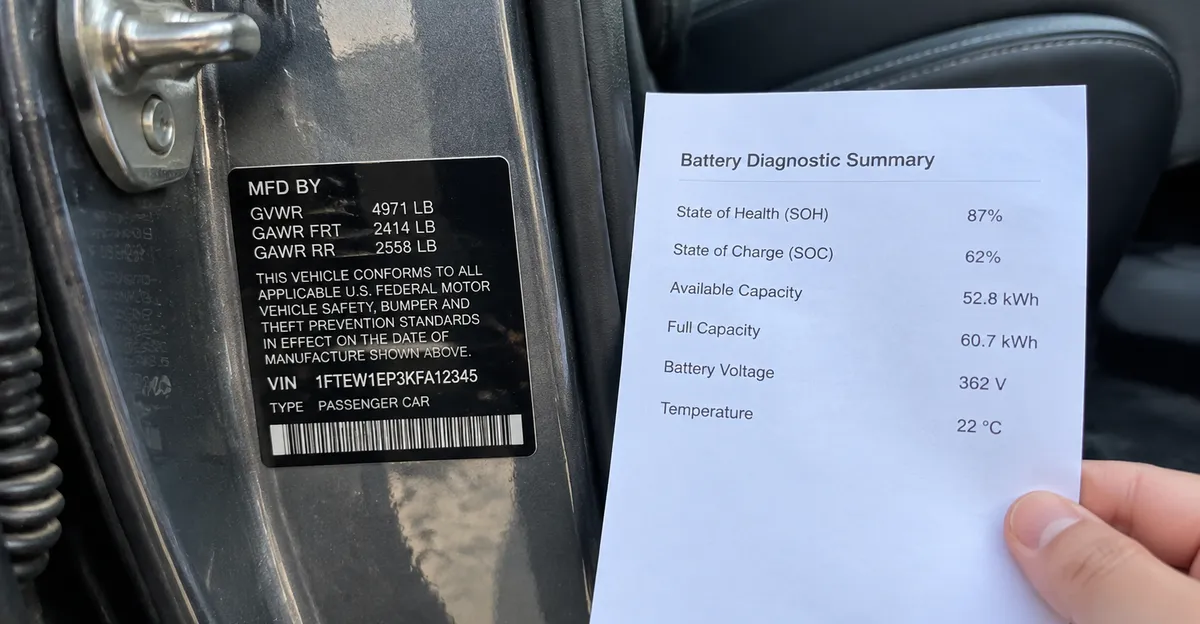
Degradation research without inventing a sentence for your car
Degradation was the strongest relative term in the Trends compare for this brief. It is research language, not the H1. Packs lose usable capacity over time with charge cycles, heat, and how often the car sat at extreme states of charge. Car and Driver notes that how fast and how often the pack was topped up can matter, and that you cannot see that history by looking at the paint.
Recharged's inspection average near 94% remaining capacity is one marketplace's tested sample, not a promise that every five-year-old EV is "fine." Recurrent and similar third-party range trackers can show model-level patterns. Use them to set expectations for a model year. Still demand a report for the VIN you are buying.
The Department of Energy notes that EV batteries are designed for extended life and that several makers offer eight-year / 100,000-mile battery warranties. Confirm remaining coverage with the maker using the VIN. Ask whether a prior module replacement restarted anything. An invoice that says "battery work" without naming modules does not prove a new pack.
Fast-charging history is supporting context. It is not a pass or fail by itself. A car with many DC sessions and a strong, balanced diagnostic can still be a buy. A car with gentle charging and an active thermal warning is not.
Put the number next to a real trip and a real charging plan
Ev.guru's planning example is the right shape even when the numbers are not yours. If documented usable capacity is 60 kWh, consumption is about 29 kWh per 100 miles, and you want a 15% reserve, you get roughly 176 miles of planning range. A regular 220-mile trip then needs a charging stop under those assumptions. Replace every input with the report and the routes you actually drive. This page does not invent an EPA rating for your listing.
Home charging is a separate gap. A Level 1 household outlet may not restore a demanding day overnight. A Level 2 cord or wall unit is a different purchase from a battery report. Sort portable J1772 kits on best portable Level 2 EV charger and BMW-specific home gear on BMW home charging only after the inlet and the pack evidence are clear. A Portuguese FindNews spike about EV purchase support is policy interest elsewhere. It does not change a US private-party battery check.
Demonstrate charging safely. Ev.guru says to inspect the inlet visually, match cords and adapters to model-year guidance, and refuse improvised adapter chains. Record starting charge, temperature, station, time, energy, and warnings for each agreed session. One short session does not certify the port forever. A repeated fault or a refused safe test should stay unresolved until diagnosed.
Price the gap, then decide
Turn each known deficiency into a quote. Missing cord, worn tires, unpaid inspection, and required home electrical work are cash, not vibes. Keep financing, insurance, registration, and tax separate. The FTC Buyers Guide on a dealer car states whether the sale is as-is or under a dealer warranty. It is not a battery report. Private-party sales do not get that federal Guide.
Move forward when identity matches, the battery evidence supports a conservative week of driving, documented charging checks finish without errors, and the full near-term cash fits. Negotiate when a measured limitation is understood and priced. Pause for a VIN conflict, an unresolved high-voltage warning, a refused inspection, or a home-charging plan that was never verified.
At handoff, confirm keys, portable EVSE, approved adapters, manuals, Buyers Guide when applicable, warranty booklet, and repair orders. Have the seller remove the car from the manufacturer account and erase profiles. Their charging payment methods must not transfer to you.
What this page will not sell you
- A handheld lead-acid tester as a used EV battery health meter.
- A jump starter as a traction-pack fix. That tool is for the 12V path on best jump starter for dead car battery.
- An Amazon ASIN for an OEM battery report. Maker diagnostics and independent EV reports are not a single universal listing this page verified for every brand.
- A Semrush volume or KD number. Trends relative figures only.
- A brand-new EV sales pitch. The job is sorting a used pack.
As an Amazon Associate, we may earn from qualifying purchases when a linked listing appears. This page intentionally has no traction-pack buy button. Specs and policies come from the named sources above. Prices and warranty language move.
Lease return, fleet sales, and private-party reports
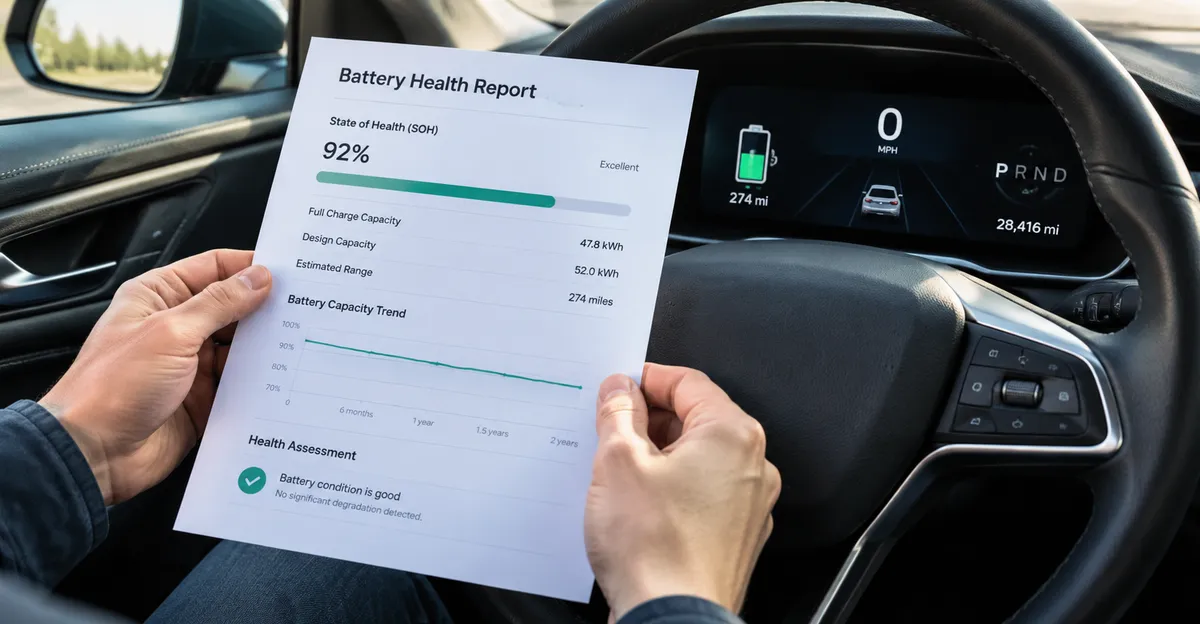
A lease return and a private Facebook Marketplace listing are not the same paperwork. Lease and certified pre-owned paths often already have a dealer or maker diagnostic in the file. Ask for a copy with the VIN printed on the same page as the state-of-health figure. Fleet and rental units may show high miles with aggressive charge cycles; demand the same report and ask how often the car sat at 100% overnight. Private-party sellers who cannot produce a report are not automatically dishonest, but you are buying uncertainty. Budget a pre-purchase inspection at an EV-capable shop that can pull pack data, not only a handheld lead-acid clamp on the under-hood posts.
If the seller offers only a screenshot of the car's own battery menu, treat it as marketing. Screenshot timestamps, software versions, and estimated range after a short drive still move with weather and recent climate use. A shop printout that names the tool, the odometer, and the VIN is harder to fake across two cars on the same lot. When two reports disagree by more than a few points, prefer the shop that can show live cell voltages rather than a single percentage.
Cross-check open safety campaigns with a free VIN recall check before you travel. A degraded pack and an open high-voltage recall are different problems; either one can change the price. Keep the battery conversation on capacity and balance. Keep the recall conversation on incomplete safety campaigns. Do not let a seller collapse both into one vague "the car is fine" sentence.
For cold-climate buyers, ask whether the report was taken with the pack warm. Cold weather car battery issues for the 12V side are separate from traction-pack state of health, but a cold pack can make range look worse on the dash during the test drive. Schedule the diagnostic after the car has been driven or preconditioned when you can. That habit does not invent a number for summer capacity; it simply keeps the test closer to how you will use the car.
FAQ
Can a handheld 12V battery tester judge used EV battery health?
No. Tools like ANCEL BA101 and TOPDON BT100 are 12-volt lead-acid analyzers. They estimate cranking health on flooded, AGM, gel, and EFB packs. They do not measure high-voltage isolation, module balance, or usable traction capacity. A passing 12V test with collapsing range still belongs at an EV-capable shop. See the EV 12V battery guide when the car is dark with a full pack reading.
Is dashboard range enough to prove used EV battery health?
No. Recharged's September 22, 2026 battery-health article treats dashboard range as an early screening clue, not capacity proof. The displayed estimate moves with recent driving, weather, climate use, tires, and software. Ask for a dated diagnostic that reports state of health, estimated range, and cell-voltage balance for that VIN.
What should a used EV battery health report include?
At minimum: the VIN, the test date, the odometer, the method or tool, a state-of-health or remaining-capacity figure, and enough pack detail to show cell balance or imbalance. Ev.guru's used-EV checklist (updated September 10, 2026) also says percentages from different methods are not automatically comparable. Match the report to the car on the lot before you trust the number.
Does battery warranty transfer on a used EV?
Often yes, but only on the terms for that VIN. The U.S. Department of Energy notes that multiple manufacturers offer eight-year / 100,000-mile battery warranties. Your duration, mileage limit, capacity threshold, exclusions, and transfer rules still come from the model-year warranty booklet and a VIN-specific confirmation from the maker. Do not assume a screenshot of a general marketing page.
Should I check NHTSA recalls when shopping a used EV?
Yes. Enter the 17-character VIN at NHTSA.gov/recalls. NHTSA's VIN tool focuses on incomplete safety recalls for many major makers over about the past 15 years. It is not a battery diagnosis, a completed-recall history, or a substitute for the manufacturer's own VIN record. Open safety recalls are separate from state of health.
What is hybrid battery tester interest doing on this page?
Very little. Hybrid battery tester sat near 7 on the Trends compare for this brief and is related context only. A Prius high-voltage pack sort lives on the Prius hybrid battery guide. A handheld lead-acid tester is still the wrong tool for an EV traction pack. Do not buy a cranking tester because a used-EV ad mentioned health.