
By Zeng FengMyCarWhy EditorialUpdated
Cold Weather Car Battery: Test, Jump, or Replace
A cold weather car battery usually fails on the morning you can least afford a no-start. The pack that cranked on a mild evening is the same pack. Cold has taken away part of its available power, and thicker oil has asked the starter for more. The decision is not "buy a jump pack because it is January." The decision is whether this battery can still pass a test, whether a jump is enough to get it to that test, or whether the case is already unsafe to charge.
Swedish search interest in vinterväglag means winter road conditions. It explains why cold-weather queries move. It is not a Sweden driving page, and it is not a tire-change page. When to mount winter tires is a separate decision on when to switch to winter tires. This page stays on the 12-volt battery and the small kit that belongs in the trunk because of it.
If the case is swollen, cracked, leaking, or frozen, do not jump it and do not bring it in the house to warm up on a heater. Replace it. Acid and a frozen case are a shop or parts-counter job with the car parked.
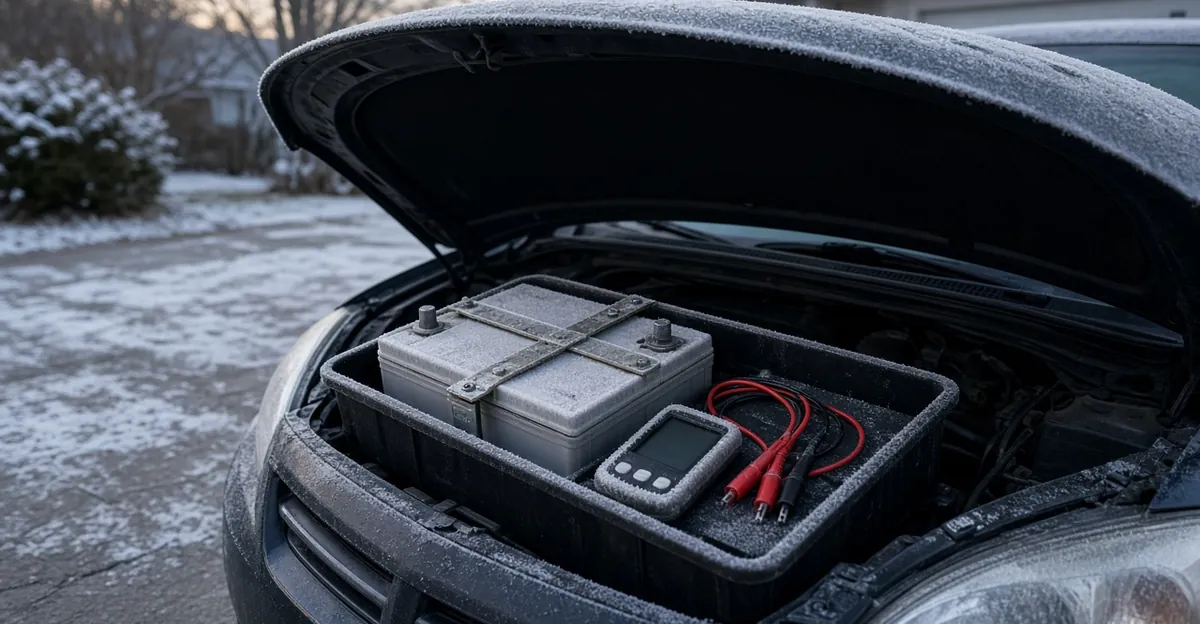
Why cold takes the start away
AAA Northeast quotes its Car Doctor, John Paul: even a good battery might lose up to 50% of its capacity when the temperature drops to zero, and even at 32°F it can take up to 30% more power to crank a cold engine. Those are his figures, not a lab result from this site. They are enough to explain a single cold morning. The battery did not "suddenly get old" between Tuesday and Wednesday. Tuesday was 45°F. Wednesday was 5°F.
Interstate Batteries describes the same pinch from the other side. Cold slows the chemical reaction inside a lead-acid battery, so the available starting power falls. Engine oil gets thicker, so the starter has to work harder. CCA, cold cranking amps, is the rating that speaks to that morning: the amps a new, fully charged battery can deliver at 0°F for 30 seconds while staying at or above 7.2 volts. Battery Council International defines that 0°F, 30-second, 7.2-volt test the same way. CCA is not a measure of how many miles you can drive with a dead alternator. It is a starting-power rating. A battery can still show a pretty open-circuit voltage and fail the moment the starter asks for current.
Interstate also separates CA from CCA. Cranking amps are measured at 32°F. Cold cranking amps are measured at 0°F. A warm-climate number on a listing is not the winter number. Match the CCA the vehicle calls for, in the owner's manual or on the old battery's label, and do not "upgrade" into a case that does not fit the tray.
Heat is the other half of the story, and it happens before the cold snap. AAA's battery-maintenance notes say extreme heat weakens batteries over time, and that the failure often shows up later, in the cold, when you finally ask for full starting power. A battery that is already three to five years old, Interstate's typical life band, is the one to test in October. Waiting for the morning it clicks is how you meet a tow truck in a parking lot.
Short trips make the deficit worse. AAA Northeast quotes Jason Carrara, senior manager of training: short local trips do not give the battery the full recharge it needs after a start. A cold start withdraws more. A two-mile drive in a rich, cold engine puts less back. The alternator is not a miracle worker on a 10-minute errand. A battery that lives on school runs all winter starts January already behind.
AAA also says a depleted battery is more likely to freeze, so a full charge matters before the cold arrives. Do not pour boiling water on a case. Do not jump a frozen battery. Charge or replace it somewhere warm only if the case is intact and a charger made for that chemistry is the tool. A frozen, bulging case is done.
| What changed overnight | What it does to the start | What it does not mean |
|---|---|---|
| Temperature down near 0°F | Less available capacity, AAA's "up to 50%" line, and a harder crank | That the alternator failed at dawn |
| Temperature near 32°F | Paul: up to about 30% more power to crank | That you must buy a new battery every frost |
| Thicker oil | Higher starter load, Interstate | That a thinner oil you were not specified to use is the fix |
| A week of short trips | Incomplete recharge, Carrara | That a highway drive will save a failed test |
| Battery older than about 3 years | Worth a test before the snap, AAA | That age alone condemns a pack that still passes |
Test before the first hard freeze
Test while the car still starts. A test on a dead car in a snowbank is a jump first and a test second, and the test is worse.
AAA Northeast's winter list says to have the battery and charging system tested by a trained technician, especially if the battery is more than three years old, and to clean corrosion and tighten the cables. Its maintenance piece says to test before winter and before summer. Members can ask for a roadside test. Everyone else can use a 12-volt analyzer at home or a parts-store tester.
Voltage alone is a weak answer. A rested battery can read in the mid-12-volt range and still collapse under the starter. The tools this site already uses for that decision:
| Tool | ASIN | What the listing is for | Not for |
|---|---|---|---|
| ANCEL BA101 | B01M0ARG3X | 12V lead-acid, about 100–2000 CCA, flooded, AGM, GEL, and EFB; state of health, state of charge, cranking and charging tests | Lithium packs, 6V or 24V, a high-voltage EV pack |
| TOPDON BT100 | B07Z67MMGC | Same 12V lead-acid band and chemistry list, if you prefer that screen | The same limits |
Enter the CCA printed on the battery, or the rating the vehicle specifies. A tester without that number is guessing. Read the result as the three-way split those listings are built for: the battery is fine, it needs a real charge, or it needs replacement. Compare the two meters on best car battery tester. This page does not repeat that buying sort. It only places the tester in the winter sequence: before the cold, or the day after a jump.
Clean the posts before you trust a "replace" reading. AAA's Car Doctor said many battery problems go away when corrosion is cleaned off and the clamps are tight. A green crust can look like a dead battery. So can a loose negative. Clean, retighten, retest. If the result is still replace, the battery is the part.
A charging-system test matters if a new or known-good battery goes flat again within days. The BA101 and BT100 listings include a charging check. A battery that passes and a system that does not is an alternator or a parasitic-draw conversation, not another battery. How age, heat, and short trips add up over years is the longer version on how long a car battery lasts.
Jump, charge, or replace
| What you already know | Do this | Do not do this |
|---|---|---|
| Lights were left on, or the car sat, and the case looks normal | Jump or charge, then test | Buy a battery before the test |
| Slow crank only on the coldest morning, tester still says good | Charge fully, clean the posts, confirm CCA meets the car | Assume the alternator died |
| Tester says replace, or the battery is old and fails a load | Replace with the correct group size and CCA | Keep jumping it all winter |
| Jumped today, dead again in two days, charging test fails | Alternator or a draw. A new battery will go flat too | A second jump pack |
| Case swollen, cracked, leaking, or frozen | Replace. Do not charge or jump | Warm it on a space heater |
| Click, no crank, and a fuel smell or a grinding starter | Stop. That is not a weak-battery morning | Another boost. See why my car won't start |
AAA's maintenance piece is direct about the myth of "drive it for an hour." A drained battery often needs a charger for several hours, sometimes a day. A 30- to 60-minute drive usually does not restore it, and running the battery flat shortens what it can do afterward. John Paul is quoted there on cycling: a battery that was allowed to die may not come back to its original capability even after a full recharge. A successful jump gets you to a charger and a tester. It is not a repair.
Replace when the test says so, when the case is damaged, or when the battery is old enough that you will not trust it through a week of nights below zero and the test is borderline. Match group size so the hold-down works. Match CCA to the vehicle, and go higher only when the tray and the terminals still fit. A bigger CCA number in the wrong case is a short waiting for a loose cable.
AGM and flooded batteries are not interchangeable just because both are 12-volt. Use the chemistry the car was built for, and tell the tester which one you clamped. EFB, common on start-stop cars, is its own setting on these two testers. Guessing "regular" on an EFB can hand you a bad replace decision.
Portable jump starter, as a trunk tool
A portable jump starter is the commercial tool people add because winter no-starts are real. It is not only a winter product. The same pack is the July tool when someone leaves a dome light on. Put it in the winter kit because the cold morning is when you are most likely to need it away from another car. Size it the way the jump-starter guide already does, on best jump starter for a dead car battery.
For most US cars and light SUVs the pack that guide lands on is the NOCO Boost GB40, B015TKUPIC. NOCO rates that model around 1000 peak amps, up to about 6.0 liters gasoline or 3.0 liters diesel. A small four-cylinder can use a smaller NOCO. A large gas engine or a diesel steps up. Do not buy the GB40 for a heavy diesel because it was on sale. The liter rating is the constraint.
NOCO's own GB40 limits matter in the cold as much as in July. The pack is for 12-volt lead-acid batteries. Jump-starting other chemistries is outside that rating. A hybrid whose small battery is flooded, AGM, gel, or EFB can be a lead-acid case. A lithium low-voltage battery in some EVs is not. If you are unsure, do not clamp it. The EV version of that limit is on EV 12V battery.
Keep the jump pack itself charged. A lithium pack that has sat in a frozen trunk all season can be the second dead battery of the morning. NOCO's instructions for storage and temperature outrank a blog. Bring the pack inside between trips if the manual says the trunk is too cold, and top it up on a schedule you will actually keep. A pack with no charge is a brick.
Cables and a donor car still work when someone can park nose to nose. A pack is the tool when you are alone. Neither one fixes a battery the tester has failed. Neither one is a space heater. Do not idle a car in a closed garage to "warm the battery."
Winter car emergency kit, kept small
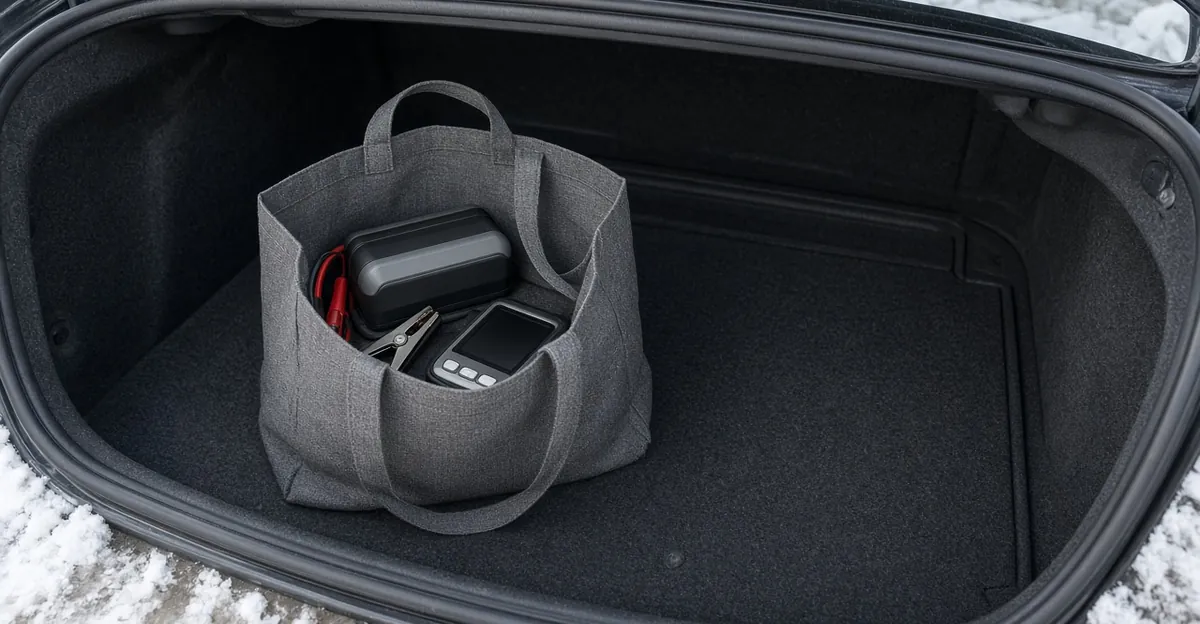
A winter car emergency kit can swallow a catalog. The battery slice of it is short. Build that slice first. Add weather gear you will actually use. A vacuum and a dash cam do not crank an engine, so they stay off this list.
| In the trunk for the battery | Why it is there | Leave it out when |
|---|---|---|
| NOCO GB40 or the size your engine actually needs | A start with no donor car | The case is frozen or the starter is grinding |
| ANCEL BA101 or TOPDON BT100 | The day-after test: replace, recharge, or charging fault | You needed a high-voltage diagnosis |
| A charger you can plug in at home, after you are off the road | AAA: a drive does not equal a full recharge | You are still on the shoulder |
| Gloves, a flashlight, and a way to call | You will be outside in the dark | They replace the test |
Tire pressure still belongs in a winter morning, because cold air drops pressure and a soft tire is its own hazard. Do that check with the gauge and the temperature rule on the winter tire page. Do not turn this battery page into a studded-tire law page.
AAA's winter driving notes also say December through March is a busy stretch for dead batteries, flat tires, and extractions. A kit that covers a dead battery and a way to be seen is the proportional answer. A kit that tries to be a mechanic's van in the trunk does not get used.
If you are stuck with the engine off and the road is safe, a jump is the battery branch. If you must run the engine for heat, AAA's winter guidance is to stay mindful of fuel and of where the exhaust is pointed. A snowbank against the tailpipe is a carbon-monoxide problem, not a battery problem. Clear it or get out.
What this page will not sell you
- A new battery with no test, because the forecast says teens.
- A jump pack as a cure for a failed state-of-health reading.
- A 12-volt tester as a verdict on an EV traction pack.
- A GB40 for a lithium low-voltage battery the NOCO page does not cover.
- Winter tires, studs, or a Swedish road-law page. One link above is enough.
- A lab claim. The 50% and 30% lines are AAA Northeast's Car Doctor, quoted from that article. They are not a measurement of your battery this morning.
As an Amazon Associate, we may earn from qualifying purchases. Specs come from the manufacturer pages and the Amazon listings linked here. Prices move.
FAQ
Why does a cold weather car battery fail on the first hard morning?
AAA Northeast's Car Doctor, John Paul, said a good battery might lose up to 50% of its capacity when the temperature drops to zero, and that even at 32°F it can take up to 30% more power to crank a cold engine. Interstate Batteries adds that cold slows the battery's chemical reaction while thicker engine oil makes the engine harder to turn. The battery is asked for more current on the morning it has less to give.
Should I test the battery before winter?
Yes, if the battery is more than about three years old or the car already cranks slowly. AAA Northeast tells drivers to have the battery and charging system tested before a cold snap, especially past three years, and its maintenance notes say to test before winter and before summer. A handheld 12-volt tester can show state of health at home. A swollen, leaking, or frozen case is not a DIY test.
When should I jump the car instead of buying a battery?
Jump when the car is only discharged: lights left on, a short sit, a slow crank that wakes up after a boost. Replace when a tester says the state of health is finished, the case is damaged, or the car dies again after a known-good charge and the charging system checks out bad. AAA says a 30- to 60-minute drive often does not fully recover a drained battery, so a jump that works is not proof the battery is healthy.
Does a portable jump starter belong in a winter car emergency kit?
Yes, as the trunk tool for a dead 12-volt lead-acid battery when no other car is nearby. The NOCO Boost GB40 is the mid-size pack this site already uses for most US cars, rated by NOCO around 1000 amps for engines up to about 6.0 liters gas or 3.0 liters diesel. It is not a winter-tire substitute, and NOCO does not rate it for lithium jump-starts.
Will ANCEL BA101 or TOPDON BT100 test an EV's big battery?
No. Both are 12-volt lead-acid analyzers. ANCEL's BA101 listing covers flooded, AGM, GEL, and EFB packs in a roughly 100–2000 CCA band, with state of health, state of charge, and cranking and charging tests. TOPDON's BT100 listing is the same class of 12-volt job. Neither measures a high-voltage traction pack. A lithium low-voltage battery in some EVs is outside both tools.
Do short trips make a winter battery worse?
AAA Northeast's Jason Carrara said short local trips are not ideal for battery life because they do not finish the recharge the start used up. Cold starts take more out of the battery, and a string of two-mile trips in January puts less back. A monthly highway run helps. It does not revive a battery a tester has already failed.