
By Zeng FengMyCarWhy EditorialUpdated
Portable Tire Inflator: 12V or Cordless?
A portable tire inflator earns a place in the trunk when the tire pressure monitoring system beeps on a cold morning, or when a slow leak leaves you five PSI low at a trailhead. The decision is not "150 PSI" on every box. The decision is power where you will stand, a gauge you trust, and whether you are filling air or repairing a puncture.
A Turkish search spike for the words for car tire is tire interest. It is not a Turkey parts page, and it does not pick a Schrader valve for a US sedan. Your door placard does.
| Job | First buy | Skip |
|---|---|---|
| Cold morning, TPMS light, tire still holds air | Portable tire inflator | Sealant sprayed into a healthy tire |
| Nail in the tread, you need to limp home | Tire repair kit or spare + shop | Hoping the compressor alone seals the hole |
| Monthly pressure check without filling | Digital tire pressure gauge | Running the compressor every time |
| Winter compound and siping | Winter tires on the switch schedule | An inflator marketed as "winter ready" |
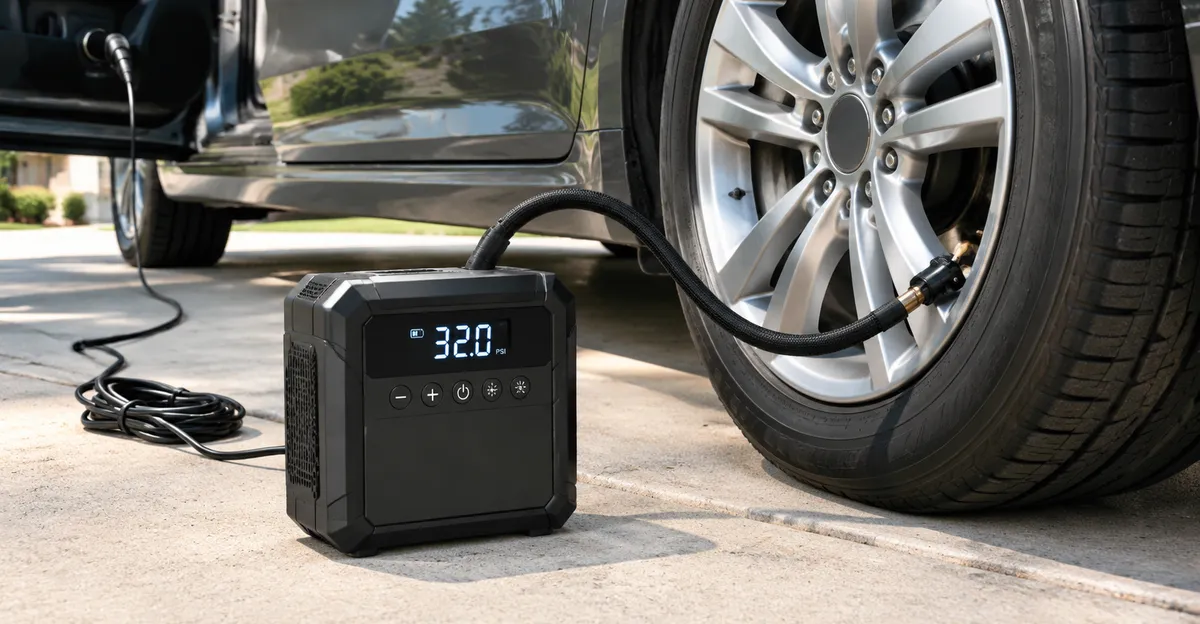
How to check tire pressure before you buy a pump
How to check tire pressure was the strongest related term on the Trends compare for this brief. Do that habit even if you already own a pump.
- Find the cold inflation pressure on the driver's door jamb placard. That number is for your vehicle's load. The big number on the tire sidewall is a maximum, not a target.
- Check when the tires are cold: sitting for a few hours, not after highway miles. Heat raises pressure and hides a soft tire.
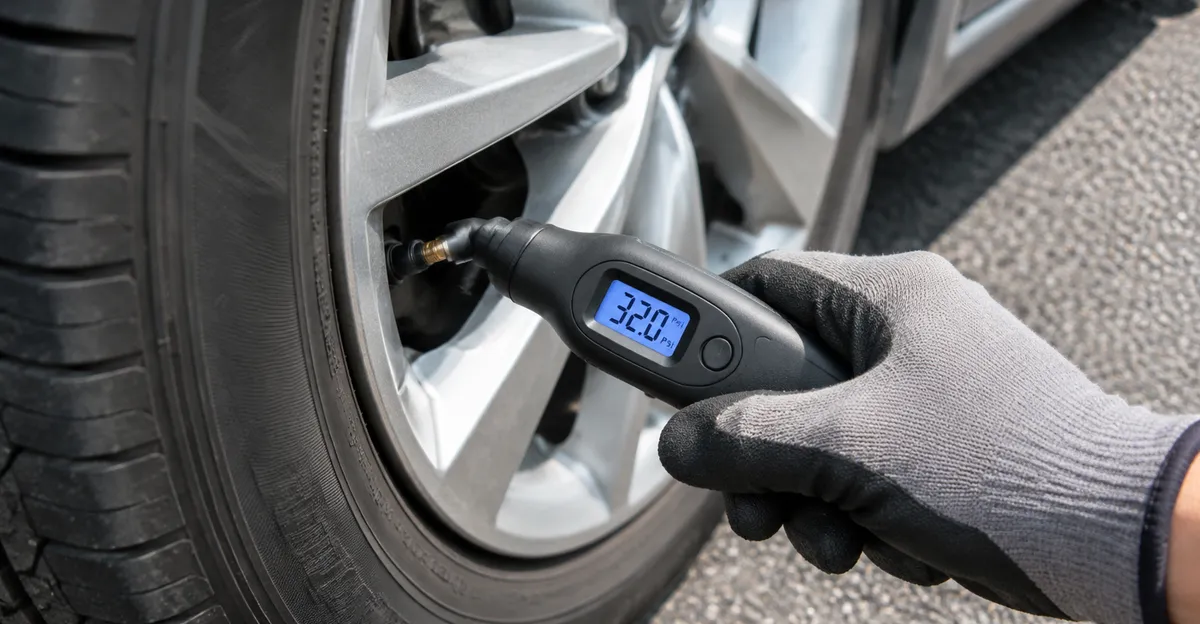
- Use a gauge you trust. Press it straight onto the Schrader valve. Listen for a short hiss, then a stable reading.
- Compare all four corners and the spare if you still carry one. Top off the low tires to the placard.
- Recheck after filling. Digital inflators can be close. A separate gauge catches a bad sensor day.
NHTSA and tire makers have repeated the cold-placard rule for years for a reason. Underinflation builds heat and shortens tire life. Overinflation from guessing "a little more" hurts the center of the tread. An inflator with auto shut-off helps only when the preset matches the placard.
Cold snaps make this louder. Air pressure drops as temperature drops, which is why a TPMS light often appears on the first hard morning. The when to switch to winter tires guide covers the ~45°F compound rule and cold-pressure top-offs. This page shops the pump. It does not re-litigate studded-tire law.
Portable tire inflator: 12V trunk pump vs cordless
A 12V tire inflator lives with the car. You plug into the accessory socket, set the target PSI, and let auto shut-off finish the corner. There is no rechargeable pack that died in the glovebox since last summer. Reach is limited by the power cord and where the outlet sits. Duty-cycle limits still apply: many manuals want a cooling break after a stretch of continuous run time.
A cordless unit lives with you. You charge it at home, carry it to the far rear tire, a bike in the garage, or a trailer tongue that sits away from the socket. The battery becomes the failure mode. If the listing says it cannot inflate while charging, believe that line and charge before the trip.
| Buying point | 12V corded (AstroAI AIRUN H) | Cordless (Fanttik X8 APEX) |
|---|---|---|
| Best fit | Pump that stays in the car | Pump you move around car, bike, balls |
| Power | 12V accessory socket | Rechargeable battery, USB-C on the Fanttik listing |
| Battery anxiety | None for roadside use next to the car | Must keep charged |
| Typical car use | Top off all four when the outlet reaches | Top off without hunting for a socket |
| Not for | Dead 12V car battery that kills the outlet | Empty pack on a dark shoulder |
| Listing checked | B07QR4Q42L | B09LXJPVTP |
The AstroAI AIRUN H is the 12V preset compressor already linked from this site's winter-tire guide. The Amazon listing describes a digital preset, auto shut-off, and a cigarette-lighter power cord for car tires. It is not marketed there as a shop compressor for heavy truck tires or large air mattresses. Confirm the live duty-cycle and fuse notes on the page before you buy.
The Fanttik X8 APEX listing titles a cordless tire inflator with LED dual screen, preset modes for bikes, motorcycles, cars, and balls, and auto stop at the selected pressure. Fanttik's own copy on that page claims a 215/55 R17 fill from 28 to 33 PSI in about 56 seconds and continuous work claims under its cooling design. Those are maker claims on the listing. This page did not run a stopwatch test. Confirm PSI accuracy notes and included adapters (Schrader, Presta, ball needle) on the live page.
Best portable air compressor for car interest was near zero on Trends and folds into the same choice: compact 12V or compact cordless for passenger tires. If you need a dual-cylinder clamp-on for light-truck tires at high volume, you are shopping a different aisle. Skip both of these glovebox units for that job.
Tire repair kit vs more air
A tire repair kit search was strong related interest. It is a different product from an inflator.
| Situation | Inflator | Repair kit / spare |
|---|---|---|
| Slow overnight loss, casing intact | Yes | Optional after you find the leak |
| Screw in the tread, tire still seated | Maybe enough to reach a shop after a plug the kit supports | Yes, if you know how to use it |
| Sidewall cut or tire off the rim | No | Spare or tow |
| Sealant-only kit in lieu of a spare | Read the maker's limits | Many shops dislike sealant in sensors |
An inflator restores pressure. It does not vulcanize a puncture. If your car deleted the spare in favor of a sealant can and a mini compressor, learn that kit before you need it at night. Buy a portable tire inflator as a better compressor only when the included unit is weak or missing. Do not spray sealant into a tire that only needed five PSI.
Best tire pressure gauge as a companion, not the H1
Best tire pressure gauge interest was weak on Trends for this brief. Still buy one if the only gauge you own is the gas-station hose.
| Gauge style | Listing | When it wins |
|---|---|---|
| Glovebox digital | AstroAI Digital Tire Pressure Gauge 150 PSI, B01J8DLGU2 | Monthly cold checks and verifying a station hose |
| Hose + bleeder | JACO ElitePro Digital 100 PSI, B07VV78RZ1 | Finer control when topping off without a compressor |
Both ASINs were already verified on the winter-tire guide. Reconfirm titles on the live Amazon pages. A gauge does not inflate. An inflator does not replace a second opinion when the TPMS and the pump disagree by several PSI.
Duty cycle, noise, and what the box will not tell you
Read the cooling rules. Corded 12V units often allow a block of continuous minutes, then a mandatory rest. Cordless packs often limit continuous run time or warn against inflating while plugged into USB. Ignoring that language is how people return a pump that smells like hot plastic.
Noise is real. Eighty-decibel-class claims on compact pumps are loud enough for a driveway at 6 a.m. Warn the house. Do not stand with your ear over the motor.
Adapters matter. Most US cars use Schrader. Road bikes often need Presta. Ball needles are for sports equipment, not tires. Keep the adapters in the same pouch as the pump. A cordless unit without its hose is a paperweight.
Power honesty matters too. A 12V pump needs a living accessory socket. If the car battery is flat, the pump that plugs into that socket is offline. That is a jump starter problem first, then air. A cordless inflator still needs a charge you remembered to give it.
Pick one, then put it where you will find it
| You | Buy | Why |
|---|---|---|
| Want the pump to live in the trunk and the car always has 12V when it runs | AstroAI AIRUN H B07QR4Q42L | No battery maintenance for roadside top-offs beside the car |
| Want one tool for car, bike, and garage corners away from the socket | Fanttik X8 APEX B09LXJPVTP | Cordless presets and auto stop |
| Only need to verify pressure | AstroAI gauge B01J8DLGU2 or JACO B07VV78RZ1 | Cheaper than a compressor when air is not the problem |
| Puncture is the actual failure | Tire repair kit or spare path | Air alone will not close a hole |
| Need winter grip | Winter tires per the switch guide | Pressure is necessary and not sufficient |
Stow the pump with the gauge, a valve core tool if you carry one, and a flashlight. Practice connecting to the Schrader valve once in daylight. The first cold TPMS morning is a bad time to learn which button sets PSI versus which button turns on the LED.
What this page will not sell you
- Winter tires, studs, or a switch-date calculator. One internal link is enough.
- A dual-cylinder truck compressor disguised as a glovebox pump.
- A tire repair kit ASIN this page did not re-verify today. Shop that product when the puncture is real.
- Invented Semrush volume or KD. Trends relative figures only.
- A claim that we timed Fanttik's 56-second fill ourselves.
As an Amazon Associate, we may earn from qualifying purchases. Specs come from the manufacturer pages and the Amazon listings linked here. Prices move.
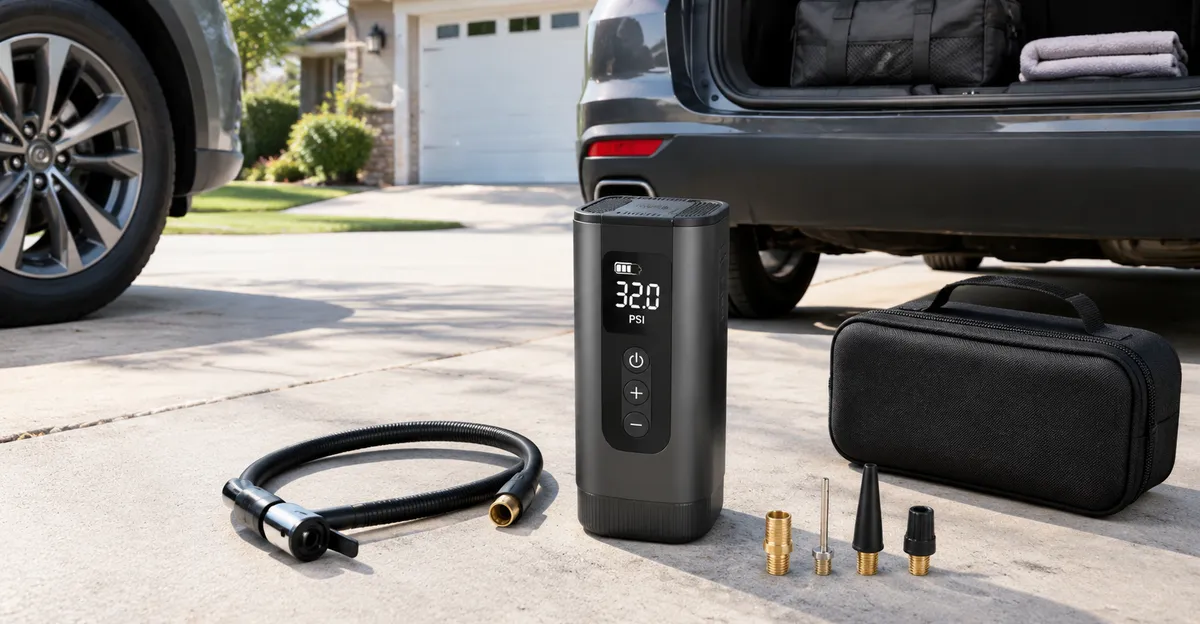
Storage, cord reach, and winter trunk habits
Put the portable tire inflator where you will actually grab it: trunk side pocket, under the cargo floor next to the jack, or a labeled pouch. A cordless unit still needs a charged battery; check the charge when you rotate seasons the same day you check the spare. A 12V unit needs a working accessory socket and a cord long enough to reach the far rear tire without stretching across a hot exhaust. Measure once before a road trip instead of discovering a short cord on a shoulder at night.
Noise and duty cycle matter more than the bold PSI number on the box. Many glovebox pumps are rated for short fills, then need cool-down. If the listing warns against continuous use past a few minutes, plan two short cycles for a very soft tire rather than one marathon that trips thermal protection. Do not sit the compressor on soft mud or deep snow where the intake packs debris. Keep the valve cap in a pocket so it does not vanish in the grass.
Winter mornings trigger many TPMS warnings from cold pressure drop, not from a puncture. Top off to the door-placard cold PSI; do not chase the sidewall maximum. If the light returns after a short drive and a verified cold fill, look for a slow leak or a damaged sensor before you buy a larger compressor. Pair the inflator with a written placard note in the glovebox so a passenger can help without guessing. When you also carry a tire repair kit, store sealant away from drinking bottles and mark the expiration date. Sealant that sat through two summers may not flow when you need it.
If you tow or haul, confirm the listing covers light-truck or trailer tires at the pressures you actually run. Many AstroAI and Fanttik class units are built for passenger cars and light SUVs. Overworking a mini compressor on a dual rear-wheel truck tire is how duty-cycle warnings become permanent failures. For those vehicles, step up to a dual-cylinder unit sold for that duty, or use a station compressor and keep the portable pump only for top-offs.
FAQ
Should I buy a portable tire inflator or a tire repair kit first?
Buy the job you actually have. A portable tire inflator restores air when the tire is low and the casing is intact. A tire repair kit is for a puncture you can plug or a temporary sealant path the maker supports. They are different products. A soft tire from a cold morning is an inflator job. A nail through the tread may need a kit, a shop patch, or a spare. Do not expect a compressor to seal a hole.
Is a 12V tire inflator better than a cordless Fanttik?
It depends where you will use it. The AstroAI AIRUN H (ASIN B07QR4Q42L) plugs into a 12V accessory socket, so there is no battery to keep charged for roadside top-offs next to the car. The Fanttik X8 APEX (ASIN B09LXJPVTP) is cordless with USB-C charging and preset modes when you need to move around the car or air a bike away from the socket. Neither is a dual-cylinder shop compressor for heavy truck or RV duty.
How do I check tire pressure before I inflate?
Read the cold pressure on the driver's door jamb placard, not the sidewall maximum. Check when the tires are cold, before a long drive. Use a trusted gauge, top off to the placard, then recheck. A portable tire inflator with a digital gauge helps, but a separate glovebox gauge is still useful for verifying a station hose. See the door-placard habit on the winter tire page for cold snaps.
Can a portable tire inflator replace winter tires?
No. Correct pressure keeps the contact patch honest. It does not add winter compound or siping. When to switch rubber is a different decision on when to switch to winter tires. Keep an inflator in the trunk for cold-morning TPMS warnings either way.
Do I need the best tire pressure gauge if I buy an inflator?
A dedicated gauge is still cheap insurance. best tire pressure gauge interest was weak on Trends for this brief, but a verified glovebox gauge such as the AstroAI Digital 150 PSI (B01J8DLGU2) or a hose-style JACO ElitePro (B07VV78RZ1) lets you confirm the inflator's reading and check tires without running the compressor. Use the placard, not the max PSI molded on the sidewall.
Is a portable tire inflator the same as a portable air compressor for a car?
For most US drivers searching either phrase, yes: a compact 12V or battery pump for passenger-car tires. best portable air compressor for car sat near zero on the Trends check and is folded into this page. Skip these glovebox units for high-volume air tools, paddleboards that need continuous high flow, or heavy-duty truck tires the listing excludes.