
By Zeng FengMyCarWhy EditorialUpdated
Best Car Battery Tester
For a typical US 12-volt car deciding replace vs recharge vs charging fault, buy the ANCEL BA101—or TOPDON BT100 if you prefer that UI. Voltage alone is not enough; a pack can read 12.6 V and still fail under crank. Skip shopping if the case is swollen, leaking, or frozen.
This guide compares those two verified DIY 12-volt testers by display style and how cranking/charging checks are presented. It is a buying map, not a lab shootout. Specs come from the manufacturer manuals and Amazon listings linked here. For age and replacement timing, see how long a car battery lasts. For a lamp that stays on while driving, see why is my battery light on. Sort a no-start first with why my car won't start.
Do you need a battery tester for this symptom?
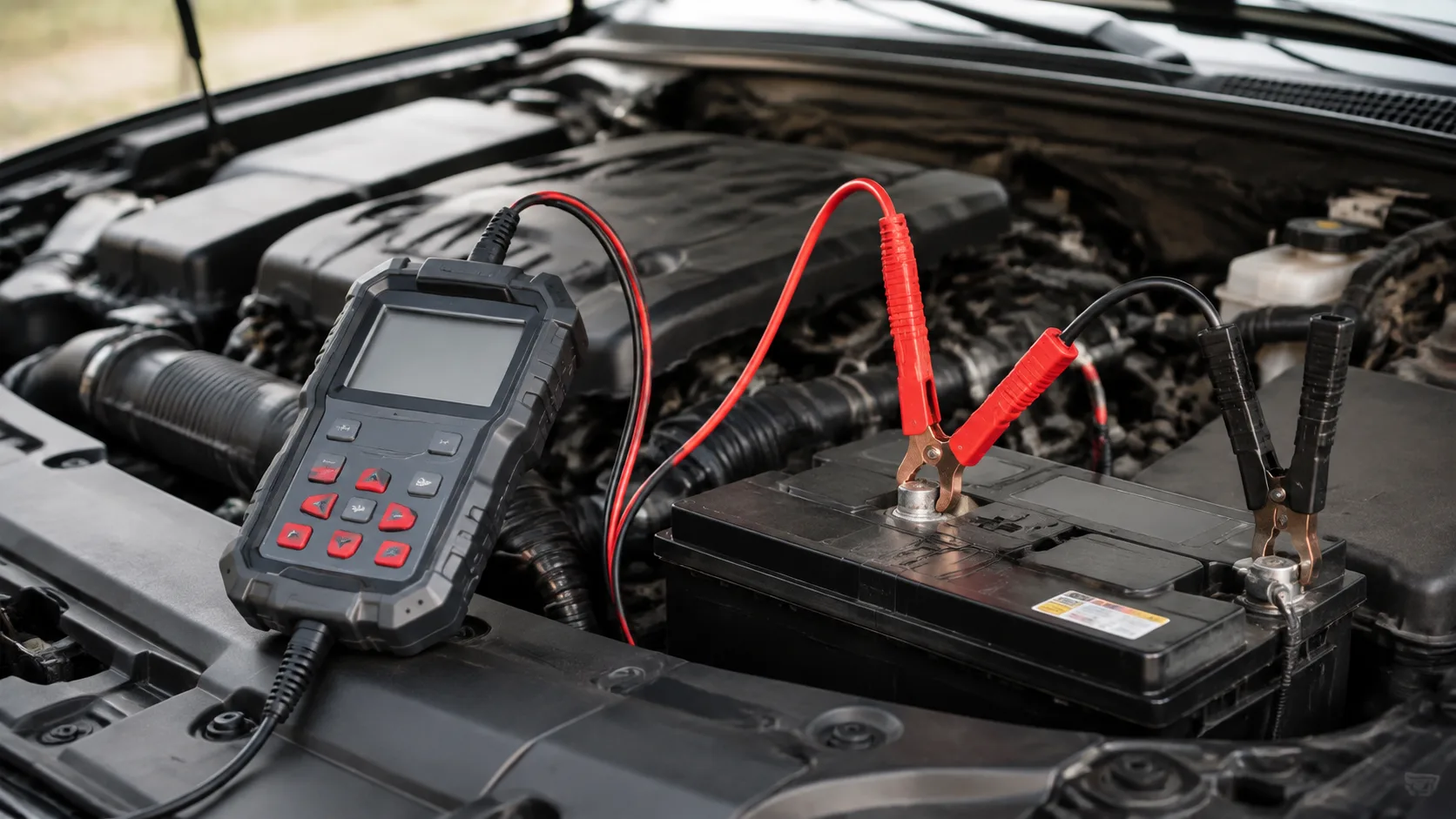
A battery tester measures the pack and, on these models, helps you check cranking and charging behavior. It does not fix a loose ground, a failing alternator diode, or a parasitic drain by itself. Do the symptom sort first:
- Slow crank after the car sat, especially in heat or after years of service → battery health test is on-point.
- Car starts after a jump, then dies minutes later with the battery lamp on → charging path first; a tester’s alternator/charging mode still helps, but do not keep driving a darkening dash.
- Rapid clicking with dim lights → jump or charge, then test; do not condemn a deeply discharged battery on one rushed reading if the tool says charge and retest.
- Swollen case, rotten-egg smell at the battery, or acid damage → stop DIY shopping; replace and inspect charging, and treat it as a safety issue.
| What you already know | Tester useful? | Better next step |
|---|---|---|
| Slow crank, battery 3–5+ years old | Yes | CCA / SOH test before buying a pack |
| Jump works, dies soon, lamp on while running | Yes (charging test) | Confirm alternator output; limit driving |
| Tool says Charge–Retest / Good, Recharge | Yes, after charge | Charge fully, retest, then decide |
| Case swollen or leaking | No | Replace; check for overcharge cause |
| Wrong lamp (check engine only) | Wrong tool | OBD2 scanner, not a battery analyzer |
What do CCA, SOH, and “load tester” mean?
Cold cranking amps (CCA) is the battery’s rated ability to deliver current at low temperature. DIY conductance testers estimate available cranking performance and compare it with the rating you enter from the label. State of health (SOH) and state of charge (SOC) are the percentage-style summaries many units show so you can separate “needs a charge” from “aged out.”
Marketing often says “load tester” for handheld conductance analyzers. They are not the same as an old-school carbon-pile load tester that draws a heavy current for seconds. For home use, conductance units such as BA101 and BT100 are the practical class: clamp on, enter rating/type, read a decision in seconds. Family Handyman–style consumer guidance makes the same split: a multimeter shows voltage; a dedicated tester adds health/CCA-style judgment.
You still must enter the correct standard (CCA, CA, MCA, JIS, and so on) and chemistry when the menu asks. Garbage in, garbage out. Read the label on the case—or the exact replacement spec in the owner’s manual—before you trust a Replace result.
A digital multimeter remains useful. Resting voltage and running charging voltage (often discussed in the mid‑13s to about 14.7 V range depending on vehicle and temperature) catch cable and alternator issues a battery-only decision can miss. Own both if you troubleshoot often; buy the battery tester first if your only question is “replace this pack or not?”
Which car battery tester should you buy?
Both models target 12-volt lead-acid batteries in the roughly 100–2000 CCA class, with battery, cranking, and charging checks. They are alternatives in the same DIY tier, not a small/medium/large engine ladder. As an Amazon Associate, we may earn from qualifying purchases. Prices move; use the live listings.
| Model | Amazon link | System | Maker highlights | Best fit |
|---|---|---|---|---|
| ANCEL BA101 | B01M0ARG3X | 12V | SOH/SOC/CCA, cranking & charging tests; Good / Recharge / Replace style results | Most US cars & light trucks; already linked from our battery guides |
| TOPDON BT100 | B07Z67MMGC | 12V | SOH/SOC/voltage/CCA-style analysis; LED status cues; compact clamps | Same DIY job with a different UI if you prefer TOPDON’s layout |
We skipped 12V/24V “pro” ASINs that resolved as multi-tool bundles or could not be cleanly verified as a single BT705-class unit at publish time. If you need 24-volt coverage, confirm a standalone listing yourself before you buy.
ANCEL BA101 — the common DIY pick on our battery guides
The ANCEL BA101 is the unit already mentioned on how long a car battery lasts and the battery warning light tools sections. The Amazon listing describes a 12V analyzer for roughly 100–2000 CCA with state of health, state of charge, voltage, CCA, plus cranking and charging system tests across flooded, AGM, GEL, and EFB types. It is not for lithium packs, and the listing points owners who need 6V or 24V toward other BA101 variants.
ANCEL’s manual result set is the practical language you will see in the driveway: Good Battery; Good, Recharge; Replace; Bad Cell, Replace; Charge–Retest. The same manual warns that an in-vehicle Replace should be confirmed out-of-vehicle after cables are disconnected, so a dirty clamp or poor terminal contact does not force a needless purchase.
Choose BA101 when you want one straightforward 12V household tester and you like a large LCD decision screen. Skip it if you specifically need 24V commercial systems or lithium house batteries—those are different tools.
TOPDON BT100 — same job, alternate interface
The TOPDON BT100 sits in the same DIY band: 12V lead-acid, about 100–2000 CCA, flooded/AGM/EFB/GEL support, with battery health, cranking, and charging checks. The listing emphasizes SOH, SOC, voltage, and related readouts, plus multi-color LED cues and reverse-polarity-minded clamps. Family Handyman has recommended this model class for homeowners who want more than a voltmeter.
Pick BT100 when you prefer TOPDON’s compact form and LED-assisted status, or when BA101 is unavailable and you still want a verified conductance tester—not a random no-name clamp meter. Skip it for 24V systems and for lithium jump starters. It is a battery and charging analyzer, not a substitute for a scan tool when the check engine light is the only symptom.
How do you test without a false “Replace”?
- Safety first: eye protection, no smoking, and keep metal tools from bridging the posts. If the battery is cracked, leaking, or frozen solid, do not clamp a tester on as your plan—replace and inspect why.
- Clean the posts or clamp on bare metal. Paint, corrosion, and side-post adapters cause nonsense readings.
- Enter the correct battery type and the rating printed on the label (CCA vs CA/MCA/JIS, and the number).
- Run the battery test. If the result is Charge–Retest or Good, Recharge, charge with a proper 12V charger, then retest before you buy a new battery.
- For cranking and charging tests, follow the on-screen prompts. Have a helper only if your cable cannot reach the driver’s seat safely; never disable safety systems to “make the test work.”
- If in-vehicle mode says Replace, disconnect and retest out-of-vehicle when the manual says so—BA101’s documentation is explicit about that confirmation step.
After any “good battery” result that still leaves you with a no-start, return to starter-circuit and immobilizer branches. After any “good battery” with a battery lamp while driving, measure charging voltage and belt condition rather than installing a second new battery for the same alternator fault.
When should you buy a jump starter or multimeter instead?
A tester answers “should this battery be replaced?” A jump starter answers “how do I leave this parking lot tonight?” They solve different hours of the problem. If you already know the pack is weak and you need roadside insurance, compare packs in best jump starter for a dead car battery. If you only need resting and running voltage and you already own a meter, you may not need a second tool today—but you still will not get SOH/CCA-style guidance from voltage alone. If the only lamp is a check engine light, buy an OBD2 scanner, not a battery analyzer.
Buy the tester when:
- Slow cranks are getting worse and the battery age is in the common three-to-five-year window discussed in consumer battery guides.
- A parts-store free test conflicts with how the car feels, and you want your own reading at home.
- You replace batteries across more than one household vehicle and want to stop guessing.
Buy diagnosis time at a shop when the pack tests good, the charging voltage is wrong, or a parasitic drain kills a new battery overnight.
When should you not buy a battery tester?
Skip mystery Amazon “1000A load testers” with no chemistry list, no CCA range, and no clear 12V automotive positioning. Skip lithium jump-pack “battery test” LEDs as a substitute for a real analyzer. Skip using an OBD2 app’s voltage tile as a CCA verdict—that is a convenience voltage, not a conductance test. Skip 24V bundle ASINs when you only own one 12V sedan and the listing is clearly two products taped together for a higher price.
Also skip replacing parts in anger after one ambiguous reading. Charge, retest, confirm out-of-vehicle when required, then buy the battery. Keep the receipt and warranty terms AAA-style guidance cares about: free-replacement periods matter more than vague pro-rated promises. Go to a shop when the case is swollen or leaking, charging voltage stays wrong after a known-good battery, or a new pack dies overnight from a parasitic drain.
Quick pick guide
- Typical US 12V car or light truck, LCD decision screen: ANCEL BA101.
- Same DIY 12V job, TOPDON UI / LED cues: TOPDON BT100.
- Need voltage only and you already own a meter: stay on the multimeter path in the battery light guide; add a dedicated tester when CCA/SOH is the open question.
- Need a boost tonight, not a measurement: best jump starter for a dead car battery.
Enter the label rating carefully. Retest after a full charge when the tool asks. Confirm Replace out-of-vehicle when the manual says the in-vehicle result can lie. A correct test is cheaper than a second battery that dies for the same alternator fault.
FAQ
Is a multimeter enough to test a car battery?
A multimeter is enough for resting and running voltage. It is not enough to judge cold-cranking ability. A battery can read about 12.6 V at rest and still fail under starter load. Use a conductance/CCA-style tester when the real question is replace versus recharge versus charging-system fault.
What does Good / Recharge / Replace mean on ANCEL BA101?
Per ANCEL’s BA101 manual, results include Good Battery; Good, Recharge; Replace; Bad Cell, Replace; and Charge–Retest. If you see Replace while testing in-vehicle, the manual says to disconnect and retest out-of-vehicle before you condemn the battery, because poor cable contact can skew the reading.
Can these testers check a lithium jump starter pack?
No. ANCEL BA101 and TOPDON BT100 listings target 12-volt lead-acid chemistries (flooded, AGM, GEL, EFB—and similar). They are not tools for lithium jump-pack cells. For roadside boost hardware, see the jump-starter guide instead.
Do I need a 12V/24V tester for a normal car?
Most US passenger cars and light SUVs are 12-volt. A 12V-only tester such as BA101 or BT100 covers that job. Step up to a verified 12V/24V analyzer only if you also maintain diesel trucks, equipment, or other 24-volt systems—and only after you confirm the exact ASIN is a single tester, not an unrelated bundle.