
By Zeng FengMyCarWhy EditorialUpdated
Best Check Engine Light Scanner
For a steady check engine light on a 1996 or newer car, buy a check engine light scanner for the job in front of you: the ANCEL AD310 is the best budget OBD2 scanner with its own screen, the ANCEL BD200 is the cheap OBD2 scanner that uses your phone, and BlueDriver is the enhanced pick for ABS, SRS, or TPMS on a supported make. A check engine light code scanner, also called a check engine code reader, only has to show the code and freeze frame. That scan tool for check engine light is the best OBD2 scanner for the money when you will not open extra modules. If the whole question is the best Bluetooth OBD2 scanner, use that guide. Read the code before you clear it. Skip a scanner first if the car will not crank or the lamp is battery or charging.
This guide compares those three verified Amazon tiers by phone dependency, enhanced modules, and how much data you need after the code number. It is a buying map, not a lab test. Feature claims come from the manufacturer and Amazon pages linked here. For a crank-but-no-fire no-start, see why my car won't start. For reduced-power messages that often ride with a MIL, see why does my car say engine power reduced. For power that falls while you are already moving, see why a car would lose power while driving.
Is an OBD2 scanner the right tool for this light?
A check engine light means the powertrain control module stored a diagnostic trouble code related to emissions or engine management. It does not automatically mean “buy an oxygen sensor,” and it is not the same as an ABS, airbag, tire-pressure, or battery lamp. If the only warning is ABS or SRS, a basic engine-only reader will not answer the question—no matter how many Amazon stars it has.
Start with symptoms and safety:
- Is the light steady or flashing? A flashing MIL with a severe misfire is a “reduce load / get it checked soon” situation so you do not cook a catalytic converter. A steady light with normal driving is still a code pull, not an emergency tow in most cases.
- Did the light appear with hard starting, stalling, loss of power, or a raw fuel smell? Note that before you clear anything.
- Is this a check-engine icon, or a battery / oil / brake / ABS icon? Wrong lamp means wrong tool path.
- Do you need the code for an emissions retest, a repair estimate, or DIY parts shopping? That decides whether freeze frame and live data matter.
If the car will not crank, an OBD2 scanner is usually the wrong first purchase. Sort battery, starter, and immobilizer branches on why my car won't start first. Scanners need key-on power and a responsive module; a dead 12-volt system will not give you a useful session.
| What you see | Scanner useful? | Better next step |
|---|---|---|
| Steady check engine, car drives normally | Yes | Read code + freeze frame |
| Flashing check engine, rough running | Yes, after you ease off | Limit driving; diagnose misfire soon |
| ABS or airbag light only | Only with enhanced support | Confirm brand coverage before buying |
| Battery / charging lamp | No (wrong tool) | Battery tester / charging path |
| No crank, dark dash | Not yet | No-start triage first |
What do OBD2, enhanced, and live data mean?
OBD2 is the standardized diagnostic connector and protocol set required on most 1996-and-newer US light vehicles. Generic Mode $03 / $07 style engine codes (P0xxx and many manufacturer P1xxx emissions codes) are what cheap readers advertise. That layer answers “why is the check engine light on?” for a large share of DIY visits.
Enhanced diagnostics means the tool speaks manufacturer-specific modules beyond the generic engine emissions path—commonly ABS, SRS, TPMS, or transmission on supported makes. BlueDriver’s product materials stress enhanced access on a named brand list. Outside that list you still get generic OBD2, which an AD310-class reader also provides. Paying for enhanced coverage on an unsupported car is how people overspend for a code they could have read for less.
Live data (PIDs) means watching sensors update while the engine runs—RPM, coolant temp, oxygen sensor voltages, fuel trims, and similar. Freeze frame is a snapshot of conditions when the code set. Both help you avoid parts roulette after you see something like a misfire or fuel-trim code. A reader that only prints P0420 and nothing else still has a job; it just leaves more homework.
Also decide phone versus standalone screen. Bluetooth dongles need a charged phone, Bluetooth permissions, and an app that stays maintained. Plug-in handhelds need no phone and work in a bright driveway without pairing. Neither format replaces a smoke machine, fuel-pressure gauge, or bi-directional factory-level tool.
Which OBD2 scanner should you buy?
These three ASINs sit in different jobs: premium Bluetooth with enhanced modules and repair reports, budget Bluetooth for generic codes and app live data, and a classic plug-in reader with its own screen. As an Amazon Associate, we may earn from qualifying purchases. Prices move; compare live listings rather than any dollar figure you remember from a roundup.
| Model | Amazon link | Form factor | Best fit |
|---|---|---|---|
| BlueDriver Bluetooth Pro | B00652G4TS | Bluetooth + phone app | Check engine plus enhanced ABS/SRS/TPMS on supported makes; repair reports |
| ANCEL BD200 | B08DFYMTS6 | Bluetooth + ANCEL app | Cheaper wireless read/clear, live data, and basic reports for generic OBD2 |
| ANCEL AD310 | B01G5EA74I | Plug-in handheld screen | Engine/emissions codes without a phone; freeze frame, live data, I/M readiness |
BlueDriver — when enhanced modules and reports matter
The BlueDriver Bluetooth OBD2 Scanner is the step-up pick in this trio when you want more than a bare P-code. The Amazon listing positions it as a Bluetooth Pro tool for iPhone and Android with check-engine coverage, repair reports, and enhanced diagnostics such as ABS, SRS, and TPMS on supported vehicles, without a subscription for those core features. Maker materials also stress North American gasoline coverage from 1996 up, with diesel and EV limits you should confirm on their compatibility chart.
Choose BlueDriver when you keep one household tool for recurring lights, you want guided repair reports, or you specifically need ABS/SRS/TPMS reads and your make is on the enhanced list. Skip it as an impulse buy if you only need a one-time emissions code, you refuse to use a phone in the driveway, or your vehicle is outside the enhanced brand list and you will never use the extra modules.
It already appears in our no-start tools list for the crank-but-no-fire branch: when the starter is healthy and you need codes before you buy parts. That is the right mental model—scan after the mechanical sort, not instead of it.
ANCEL BD200 — cheaper Bluetooth for generic OBD2
The ANCEL BD200 is the budget wireless tier: Bluetooth 5.0 adapter, ANCEL app on iOS and Android, read/clear for check-engine codes, live data, and related OBD2 functions the listing describes (including battery voltage display in the app—not a substitute for a clamp-on car battery tester). Maker pages also list DTC lookup, I/M readiness, freeze frame, and free software updates.
Pick BD200 when you want phone graphs and wireless convenience without BlueDriver’s enhanced-module pitch, and you accept that app quality—not the plastic dongle—is most of the product. Skip it if you need a tool that works with the phone dead in the cup holder, or if you need bi-directional controls and dealer-level module coding. Those jobs live in a higher price band than this guide covers.
ANCEL AD310 — plug-in reader, no phone required
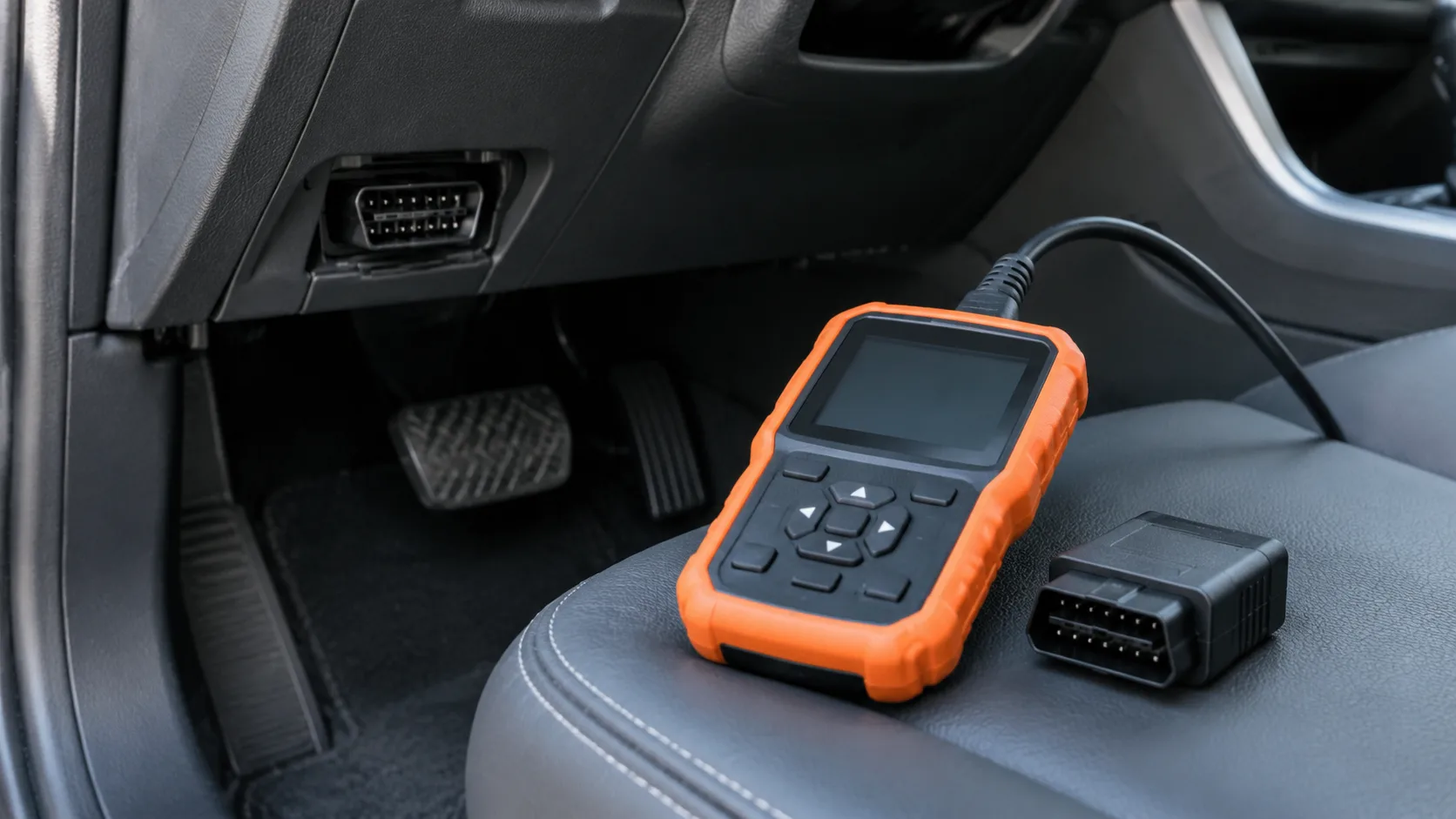
The ANCEL AD310 is the classic handheld: own screen, thick cable, powered from the OBD2 port, built to read and clear engine/emissions codes, show freeze frame, live data, and I/M readiness on most 1996-and-newer OBD2 vehicles. The listing is explicit that it does not do ABS, SRS, TPMS, transmission, or service resets.
Choose AD310 when your only question is the check engine light, you want something that works at a parts-store parking lot without Bluetooth pairing, or you are buying a glove-box spare for an emissions retest readiness check. Skip it when the lamp you care about is ABS or airbag, or when you already know you want manufacturer enhanced data and repair reports—that is the BlueDriver lane.
How do you pull a code without creating a second problem?
- Park safe, set the brake, and locate the 16-pin OBD2 port (often under the dash near the steering column; the owner’s manual shows the exact spot).
- Key on, engine off—or running if the tool’s manual allows—then plug in. For Bluetooth, pair in the app before you chase menus.
- Read stored and pending codes. Photograph or write them down, including freeze frame if offered.
- Do not clear yet. Look up the code with the freeze-frame clues (fuel status, coolant temp, speed) before you buy parts.
- After a real repair, clear, complete a drive cycle, and confirm the code stays gone and readiness monitors return as your state inspection requires.
Do not ignore a flashing MIL. Do not clear codes to pass inspection while the fault is still present. Do not assume one code means one part—P0300 random misfire and P0171 lean condition both need tests, not a shopping cart. Hybrids and late-model trucks can park the DLC in awkward places; use an extension cable only if it is a known-good OBD2 extension, not a random USB adapter.
When does a free scan or shop visit beat owning a tool?
A free auto-parts scan is enough when you need the code number once and you will hand the car to a shop anyway. Owning a scanner pays off when the light is intermittent, when you DIY sensors and need to verify the repair, or when you want freeze frame at the moment the fault returns.
Pay a shop sooner when:
- The light flashes and the engine shakes hard.
- You smell fuel, see smoke, or the car overheats.
- The code points at a high-pressure fuel system, internal engine mechanical risk, or a hybrid high-voltage subsystem.
- You need bi-directional tests, coding, or module programming.
A consumer OBD2 tool is a flashlight, not a full bay. Pair it with the symptom guides on this site rather than treating the Amazon title as a diagnosis. If the car will not crank, sort battery and starter first—or keep a jump starter for the weak-pack branch—before you order a scan tool.
When should you not buy an OBD2 scanner?
Skip no-name ELM327 clones with no clear iOS/Android support statement and a history of fake “full system” claims. Skip any listing that promises ABS/SRS on “all cars” without a brand matrix. Skip subscription-heavy apps if your only goal is read/clear and you are not willing to pay yearly for estimates—confirm free versus paid features on the live listing (we skipped FIXD-style picks here for that reason). Skip bi-directional tablets marketed for shops if you only needed P0442.
Also skip shopping while stranded in a lot at night if the car already needs a tow for a no-crank or overheating failure. Order the reader when you are home, the car is key-on capable, and you know whether you need engine-only or enhanced coverage.
Quick pick guide
- Engine/emissions code only, no phone: ANCEL AD310.
- Wireless generic OBD2 on a budget: ANCEL BD200.
- Enhanced modules + repair reports on a supported make: BlueDriver.
- No-crank or wrong warning lamp: do not start with a scanner—re-read why my car won't start, or use a battery tester when the lamp is charging-related.
Write the code down before you clear it. Match the tool tier to the modules you actually need. Confirm enhanced coverage for your VIN or make list before you stretch the budget. A scanner that sits unused because the app will not pair is not cheaper than the free code pull you skipped.
FAQ
Will any OBD2 scanner read ABS and airbag lights?
No. A basic plug-in code reader such as the ANCEL AD310 is built for engine/emissions (check engine) codes. ABS, SRS, and many transmission codes need a tool with enhanced module support for your brand. BlueDriver advertises enhanced diagnostics on a published list of makes—confirm your vehicle before you pay for that tier.
Should I clear the check engine light before I know the code?
Usually no. Read and write down the code and freeze-frame data first. Clearing the light without fixing the cause often brings the lamp back and can reset readiness monitors you need for an emissions inspection. Clear after a repair, then confirm the code stays gone.
Do I need a subscription for BlueDriver or ANCEL BD200?
BlueDriver’s Amazon listing and product pages emphasize no subscription for core scan and repair-report features. ANCEL BD200 is a Bluetooth adapter that uses the maker’s app with lifetime free software updates per the listing. Always re-check the live Amazon page and app store notes before you buy—terms can change.
Is a free auto-parts-store scan enough?
A free code pull is often enough to learn the DTC number once. Owning a reader helps when the light returns, when you want freeze frame and live data at home, or when you want to verify a repair without another store trip. It does not replace a shop smoke test, scope work, or a bidirectional tool.