
By Automotive Research TeamUpdated 2026-09-24
Why Does My Car Say Engine Power Reduced
Why does my car say engine power reduced is the question you ask when the Driver Information Center stops being polite and starts limiting the car. The pedal still moves. The radio may still play. Acceleration does not. On many General Motors vehicles the same alert reads “Engine Power is Reduced” or “Reduced Engine Power.” Ford and other makers use related limp strategies for the same job: the powertrain computer detected a fault and intentionally cut performance so you can reach help without destroying the engine.
Most consumer guides already share the same floor. CarParts.com’s ASE Master Tech article defines the message as a PCM-limited fail-safe, often tied to electronic throttle actuator control problems, pedal or throttle position sensors, circuit faults, network issues, overheating, or low system voltage. Automadesimply frames the same alert as limp mode that caps speed and power after sensor, airflow, ignition, catalytic converter, or fuel-delivery faults. Both pages agree on the first move: retrieve diagnostic trouble codes before you buy parts. This guide starts from that shared floor, then answers the decisions those lists usually leave hanging once the message is already on your cluster and you still have to choose a lane, a tow, or a shop invoice.
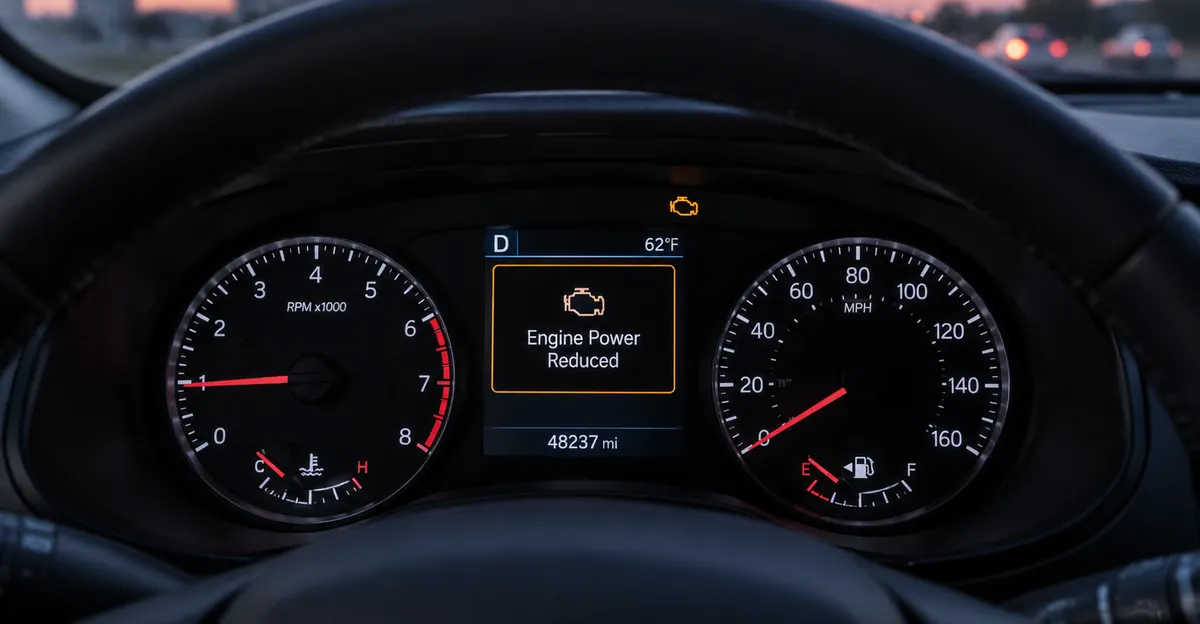
What the message means on the cluster
The text is not a suggestion. CarParts.com says Reduced Engine Power Mode can inhibit acceleration, and in some cases the PCM can cut fuel delivery enough that the vehicle becomes undrivable. Automadesimply describes the same protective limit as limp mode triggered when the ECU sees a threat to performance or temperature control. Modern cars without a cable throttle use sensors and a motorized throttle body. When those signals disagree, or when another monitored system fails hard, the computer chooses a safe power ceiling instead of letting you floor a broken system.
Open the owner’s manual section for the Driver Information Center if you have it. CarParts.com notes that GM’s cluster overview explains what the message means for a given year and model. The exact wording varies. Chevy, Buick, GMC, and Cadillac owners often see “Engine Power Reduced.” Some screens say “Engine Power is Reduced.” Other brands use different phrasing for the same fail-safe idea. The consumer job is the same either way: treat the display as computer protection, not as a random gauge glitch.
| What you see | What it usually means | First move |
|---|---|---|
| Engine Power Reduced with Check Engine light | PCM limited power after a stored fault (CarParts.com) | Scan modules; do not clear codes yet |
| Message after a restart that “fixed” it once | Temporary exit from limp; fault may still be stored | Scan before the next highway trip |
| Message plus Stabilitrak or traction alerts | Stability or wheel-speed path may be involved (YourMechanic Q&A pattern) | Scan ABS and powertrain, not throttle alone |
| Message with rising temperature gauge | Cooling protection path on some GM cars (CarParts.com) | Stop safely; check coolant when cool |
| Soft power, no DIC text | May be fuel, spark, or exhaust without limp text | Different sort tree; still scan if the light is on |
Internal links to warning lights help when several icons light at once. A Check Engine lamp, a reduced-power text line, and a stability icon are related complaints, not three unrelated shopping lists.
What to do in the first ten minutes
CarParts.com’s FAQ says you can usually drive slowly with the warning on, but it does not recommend it. Low-speed crawling is dangerous in traffic, and some vehicles shut off after entering the mode. Automadesimply warns that stalling, poor throttle response, and longer stopping distance make continued driving risky. Use that shared advice as a traffic decision, not as permission for a long commute.
- Get out of a travel lane if power collapses and you cannot keep up with traffic. Hazard lights on. Choose a shoulder, exit, or parking lot you can reach without needing a hard merge.
- Note what else is on: Check Engine, temperature, oil, Stabilitrak, battery, or ABS. Write the exact DIC wording before it disappears on a restart.
- Turn off nonessential loads. You want a calm electrical system while you decide whether the next mile is safe.
- If the car overheats, smells like fuel or burning plastic, shakes hard, or the Check Engine light flashes, stop when safe and arrange a tow. CarParts.com treats further driving in a fail-safe state as a way to add damage.
- If the car still creeps and brakes and steering feel normal, a short, low-speed trip to a nearby shop can be reasonable. A highway merge that needs full power is not.
A restart that restores power is information, not a repair. CarParts.com’s reset FAQ says the warning goes away and stays away only after the underlying problem is fixed and the codes are cleared. Automadesimply makes the same point: ignoring the warning lets problems compound. If a key cycle “fixed” the car for one errand, schedule a scan before you assume the throttle is fine.
Why does my car say reduced engine power after a restart that seemed to help
Why does my car say reduced engine power on one drive and look normal after a key cycle is one of the most confusing patterns for owners. CarParts.com’s pro tip is that clearing codes can make the message go away temporarily. A simple restart can behave the same way: the computer exits the limited mode until the same fault sets again. That is why the next decision is not “wait a week and see.” It is “capture codes while the evidence is still in memory.”
Intermittent wiring, a dirty throttle body on the edge of sticking, a weak battery under load, or a heat-sensitive sensor can all produce a one-and-done event that returns on a hot day or a rough road. YourMechanic’s owner questions about Chevy vehicles with Engine Power Reduced often mention a restart that temporarily clears the complaint, then a return of the message with traction alerts. Treat intermittents as real faults. Save freeze-frame data if your scanner offers it. Tell the shop when the message appears—cold start, after ten minutes, on a bump, in rain, or only with accessories on.
| Pattern | Likely path from fetched guides | What to tell the shop |
|---|---|---|
| Message once, gone after restart, codes still stored | Temporary exit from limp; fault retained (CarParts.com) | Scan before clearing; print code list |
| Message every time after throttle-body service | Idle relearn not completed (CarParts.com / PIP4578B example) | Ask for idle relearn, not another parts swap |
| Message with Stabilitrak / traction lights | Wheel-speed or stability path may be feeding limp behavior (YourMechanic) | Live data on wheel sensors; do not only replace throttle body |
| Message when engine is hot | Heat-related sensor, wiring, or cooling protection (CarParts.com) | Note coolant temp and time to failure |
| Message after jump-start or low battery week | Low system voltage path (CarParts.com) | Test battery and charging before TAC parts |
Common causes behind the Driver Information Center text
CarParts.com and Automadesimply both start with electronic throttle and related sensors, then widen the list. Neither page claims one part fits every car. Year and model change which fail-safe strategy the PCM uses. Use the table as a sort, not a shopping cart.
| When it happens | Likely cause | First check |
|---|---|---|
| Sudden cut with TAC / pedal correlation codes | APP or TP sensor disagreement, dirty or failed throttle body (CarParts.com) | Scan P2135, P2138, P2101 family; inspect TB and pedal connectors |
| After cleaning or replacing the throttle body | Idle position not learned (CarParts.com lists P2176 and PIP4578B-style guidance) | Perform the OEM idle relearn procedure |
| Soft power with airflow or fuel-trim codes | MAF, air filter, vacuum leak, fuel delivery (Automadesimply) | Inspect filter and intake boots; watch fuel trims |
| Sulfur smell, rattle, catalyst efficiency codes | Restricted catalytic converter (Automadesimply) | Scan P0420-class codes; do not keep flooring it |
| Message with overheating | Cooling protection on some GM vehicles (CarParts.com) | Coolant level when cold; look for leaks |
| Message with dim lights or recent battery issues | Low voltage battery or failing alternator (CarParts.com) | Load-test battery; measure running voltage |
| Diesel Duramax with MAP or intake notes | Application-specific TSB paths (CarParts.com examples) | Look up TSBs for the VIN before guessing sensors |
CarParts.com walks through the TAC layout that GM popularized after cable throttles: dual accelerator pedal position sensors tell the PCM what you want, dual throttle position sensors report what the plate is doing, and a motor in the throttle body moves the plate. When those signals disagree, Reduced Engine Power Mode is a common outcome. Dirt on the throttle plate, a failing motor, damaged wiring, or a bad connector can all look like “the throttle body is bad” on a code list even when the real fault is a broken wire two inches from the plug.
Automadesimply’s broader list still belongs in the conversation: clogged air filter, bad MAF, worn plugs or coils, catalytic converter damage, and low fuel pressure can all provoke limp behavior on some vehicles. Those faults are more familiar to drivers who already read about losing power without a DIC line. When the cluster explicitly says Engine Power Reduced, still start with the code family, not with a parts-store throttle body.
How to tell this message from ordinary power loss
A related guide on this site sorts why would my car lose power while driving when the complaint is soft acceleration without a specific reduced-power text line. That article’s floor is fuel, air, spark, exhaust restriction, and limp mode as a pattern. This article’s job is narrower: the car already named the fail-safe on the cluster.
Use the message as your first branch. If Engine Power Reduced is present, assume computer-limited power until a scan proves a mechanical starvation story instead. If there is no DIC text and the engine revs freely but feels weak, you may still be in a fuel or exhaust problem without the same TAC code family. Both paths still deserve an OBD-II scan. The difference is which questions you ask the technician first.
Stabilitrak or traction lights change the branch again. YourMechanic answers on Chevy vehicles with Engine Power Reduced plus Stabilitrak warnings often point owners away from endless throttle-body replacements and toward live wheel-speed data, harness inspection, and ABS module paths. If a shop has already replaced the throttle body more than once and the message returns with stability lights, ask for a data-stream diagnosis before authorizing another TAC part.
What you can check safely before you authorize parts
Shop pages agree that codes come first. CarParts.com lists a long set of generic TAC-related OBD-II codes, including P2135, P2138, P2101, P2176, and related pedal and throttle circuit codes. Automadesimply highlights P1516, P2138, P0101, and P0420 as examples of families you may see. Those numbers are starting points. They are not a complete diagnosis. GM’s exact definition for a code can differ from the generic SAE text, which is why CarParts.com tells readers to consult factory information for the vehicle.
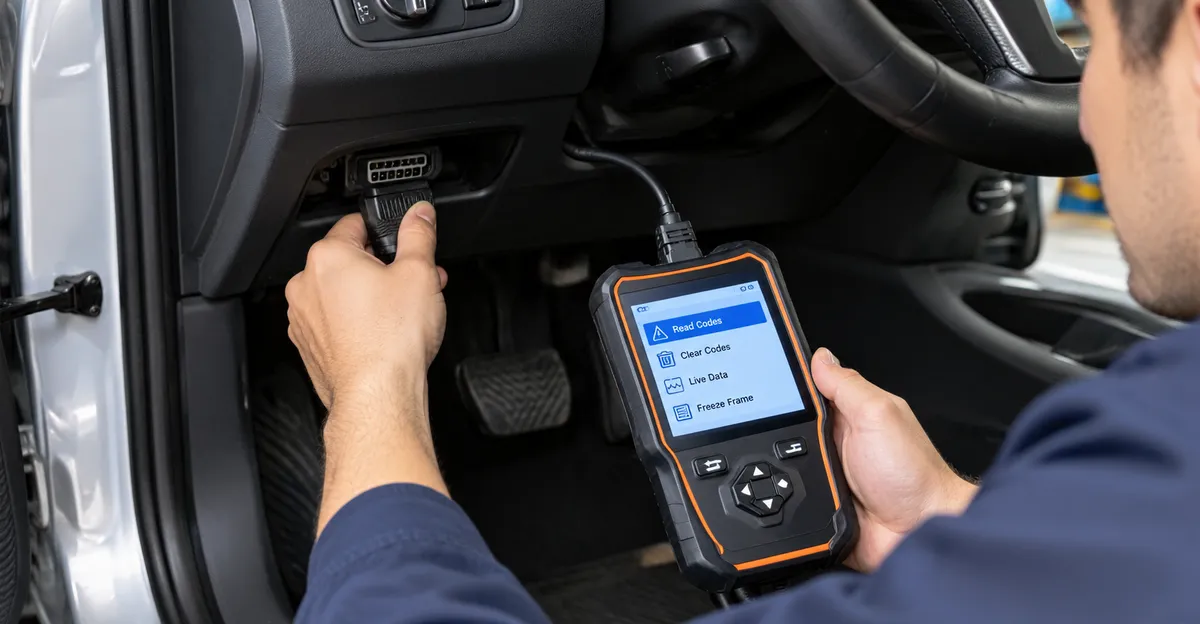
A free code read at many U.S. auto-parts stores is enough to capture pending and stored codes. It is often not enough to watch live APP and TP sensor agreement while you wiggle a harness. If the complaint is intermittent, tell the shop you need live data and a freeze frame, not only a printed code. Clearing codes at the parts counter before you save them is how you erase the only evidence of a heat-related fault.
Owner-level checks that do not require rebuilding the throttle:
- Confirm oil and coolant levels when the engine is cold. CarParts.com notes low oil or coolant can contribute on some vehicles, and Automadesimply lists low oil among possible limp triggers.
- Look for obvious disconnected connectors at the throttle body and pedal after recent under-hood work.
- Check whether the battery is original-age and whether the car needed a jump recently. CarParts.com lists low-voltage batteries and failing alternators among triggers.
- Look up technical service bulletins for your VIN. CarParts.com cites examples such as MAP connector issues on certain diesels, fan-clutch shorts on older midsize SUVs, and idle-relearn guidance after throttle-body service. A dealer or independent shop with a repair database can pull the correct bulletins faster than a generic web search.
Do not spray throttle cleaner into a running engine as a first experiment if you do not know the OEM procedure. Cleaning can help a dirty plate. On many GM vehicles, skipping the idle relearn afterward can put you right back into Reduced Engine Power Mode. That is a procedure problem, not proof that the new part failed.
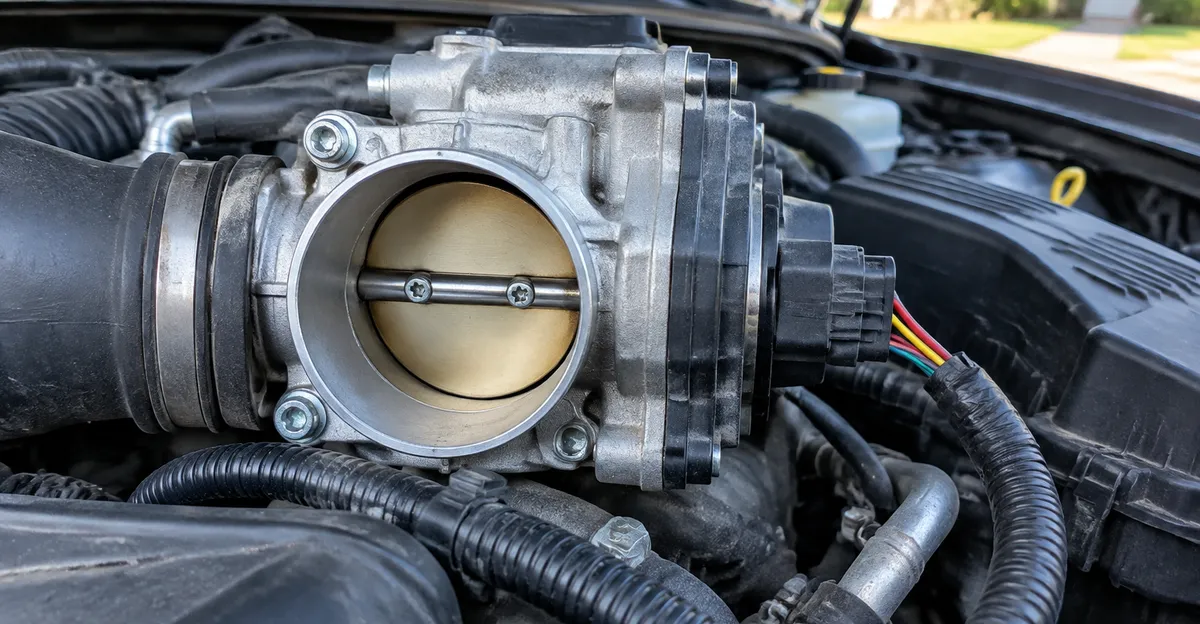
Should you clean the throttle body or scan first
This is the decision most cause lists raise and then leave hanging. Automadesimply lists cleaning the throttle body among common repairs. CarParts.com treats throttle-body dirt and TAC faults as frequent triggers, then insists on DTCs and factory information before DIY deep dives. The practical order for a U.S. driver is:
- Scan and record every code from powertrain and, if available, ABS or chassis modules.
- Search TSBs for those codes and for “Reduced Engine Power” on your year, make, and model.
- Only then decide whether a careful throttle-body cleaning is a reasonable first service, a pedal or throttle sensor test is next, or the codes point somewhere else entirely.
If the only stored code is an idle-learn or throttle-range code after recent cleaning, ask for the relearn before you buy another throttle body. If correlation codes point at APP versus TP disagreement, a shop should compare live sensor percentages, not guess. If battery voltage is low, fix charging first. CarParts.com’s community and FAQ material repeatedly show voltage and wiring issues masquerading as throttle failures.
Cost ranges in published guides are wide on purpose. CarParts.com notes a throttle position sensor replacement can range from a low parts-only figure up into several hundred dollars depending on the vehicle, while an alternator path can stretch much higher once labor is included. Automadesimply cites a broad band from roughly $150 to over $2,500 depending on the failed system. Treat those as published ranges, not a quote for your VIN. Ask the shop for a diagnostic fee, a written code list, and a repair estimate that names the test that justified the part.
What to tell the shop so you do not buy the wrong part
Write four facts before you authorize a throttle body:
- Exact DIC wording and which other lights were on.
- Whether a restart temporarily restored power.
- Speed, temperature, and road condition when the message appeared.
- Recent work: battery replacement, throttle cleaning, tune-up, or under-hood collision repair.
Then ask three questions:
- Which codes and freeze frames are stored, and did you scan ABS as well as the engine module?
- What live-data test separates a bad throttle body from a wiring or pedal sensor fault?
- If you replace or clean the throttle body, is an idle relearn included?
YourMechanic’s Suburban case where a throttle body was replaced repeatedly while Stabilitrak warnings continued is the cautionary story. Codes that “always say throttle body” still need a data-stream confirmation. A reputable shop should be willing to explain the test, not only the part number.
If the car cannot safely leave the parking lot, tow it. CarParts.com prefers a tow to the repair facility over extended low-speed driving. Automadesimply’s stall and cascade-damage warnings point the same way for highway speeds and busy intersections.
Mistakes that turn a warning into a bigger bill
Clearing codes and driving away without a repair is the most common expensive mistake. CarParts.com says the reset is temporary until the fault is fixed. Automadesimply says limp mode exists because a component is already threatening normal operation.
Buying a throttle body because a forum thread matched your model year is the second. TAC codes are common on GM trucks and cars, but CarParts.com’s list of causes includes circuits, PCM or network issues, cooling, diesel-specific TSBs, and charging faults. A parts cannon without live data is how you pay twice.
Ignoring Stabilitrak or ABS lights that appear with the message is the third. Traction and stability systems can reduce engine torque as part of their control strategy. YourMechanic’s traction-control explanation for reduced-power phases is the reason a wheel-speed sensor can look like an engine problem from the driver’s seat.
Skipping the idle relearn after throttle service is the fourth. CarParts.com calls out that failure mode explicitly. If the message began the day after a cleaning, tell the shop that timeline before they sell you another body.
FAQ
why is my car saying engine power reduced
CarParts.com’s ASE Master Tech guide treats the Driver Information Center message as the powertrain control module intentionally limiting performance after it detects a system fault. On many GM vehicles the same fail-safe is called Reduced Engine Power Mode. Scan for codes before you replace a throttle body or pedal sensor, because wiring, battery voltage, cooling, and other systems can set the same display.
Can I keep driving with Engine Power Reduced on the dash?
CarParts.com says you can usually creep at low speed, but it does not recommend treating that as normal driving. Extremely low speeds are risky in traffic, and some vehicles shut down after entering the mode. Automadesimply adds that stalling, weak throttle, and longer stopping distance make continued highway travel unsafe. Tow when you cannot keep up with traffic, when temperatures climb, or when other lights escalate.
How do you clear or reset Engine Power Reduced?
CarParts.com is clear that the message is not cleared by a button or a key cycle alone. You fix the fault that set the codes, then clear the codes. Clearing first without a repair often brings the message back on the next drive. After throttle-body cleaning or replacement on many GM vehicles, an idle relearn is also required or the mode can return.
Is Engine Power Reduced the same as losing power with no message?
Not always. A soft pedal with no Driver Information Center text can still be fuel, spark, or exhaust restriction, which is a different sort tree from a computer-forced limit. When the cluster displays Engine Power Reduced, treat it as protective limp behavior first, then use codes to decide whether the throttle actuator, a sensor, wiring, or another system is the trigger.
Engine Power Reduced on the cluster is a computer decision, not a mystery. Match the pattern to a short, safe next trip or a tow. Scan before you spend. Separate TAC and wiring faults from charging, cooling, and stability paths. Then give the shop a timeline and a code list that makes the next test obvious.