
By Zeng FengMyCarWhy EditorialUpdated
EV 12V Battery: Dark Car, Charged Pack
The car is dark, the doors are stubborn, and the phone app still shows a high state of charge. That pattern is often an EV 12V battery problem: the small auxiliary pack failed to wake the computers, so the high-voltage contactors never closed. Sort that before you pay for a traction-battery tow, buy a scanner, or clamp a pack onto the wrong post.
An EV 12V battery and the high-voltage pack do different jobs. The big pack moves the car. The auxiliary battery powers locks, screens, safety modules, and the relays that connect the big pack. Auto Training Centre treats a no-start, a flickering dash, several warning lights at once, electronic glitches, and dead keyless entry as auxiliary-battery clues. Reduced range, charging errors, isolation faults, and power limits point at the high-voltage pack. A weak 12V system can also invent false trouble codes, so a parts list built from a dark-car scan is a bad first purchase.
Use the next ten minutes to pick a lane:
| What you can already see | Likely lane | First move |
|---|---|---|
| Dark screens, weak locks, app still shows charge | 12V auxiliary | Find the manual’s 12V jump post. Leave orange cables alone |
| Car drives, range collapsed, power is limited | High-voltage pack | Stop driving if it feels unsafe. A 12V jump pack will not restore range |
| Charge port will not wake, car is plugged in | 12V first, then charging | Unplug. A dead auxiliary pack can block the port even when the cord is fine |
| Car wakes after a 12V boost, then dies again within days | Auxiliary battery or the DC-DC converter that refills it | Test the 12V pack, then have the converter checked if a known-good battery dies again |
| Only a check-engine light, and the car goes to Ready normally | Not a jump-pack problem | Wake the car, then read codes. A scanner is a later tool |
If the engine-start sort on a gas car is the habit you already know, the same calm order lives on why my car won't start. On an EV the “crank” you are listening for is a wake-up, a Ready light, and contactors, not a spinning starter.
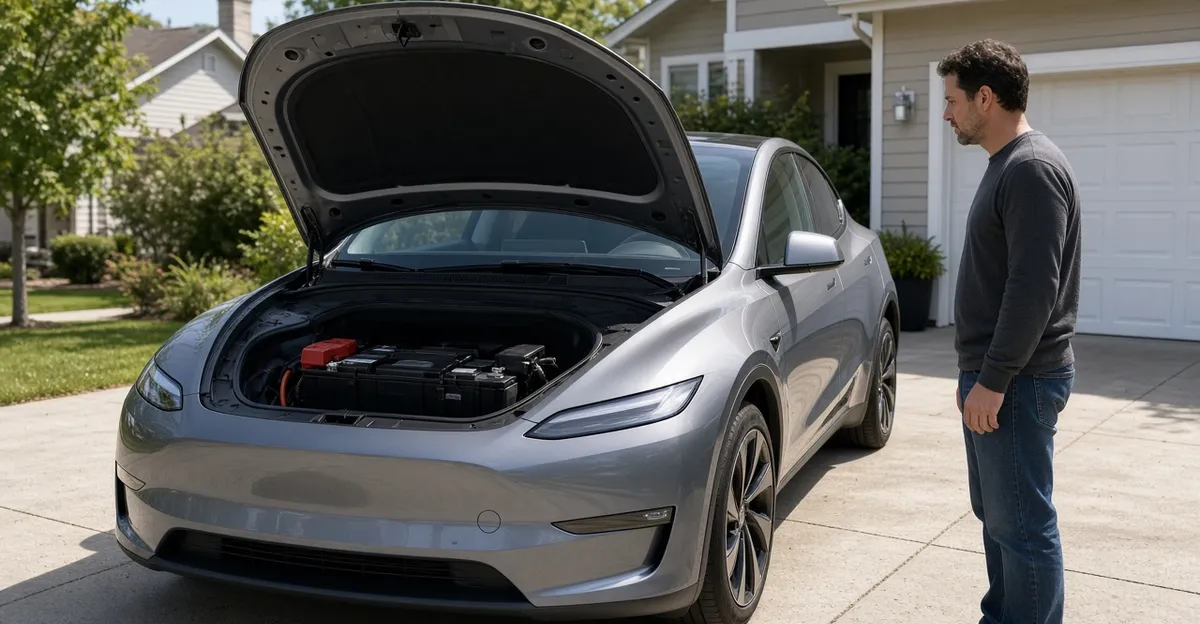
Is a dark EV a dead 12V battery or the high-voltage pack?
Decide with symptoms you can see without opening a high-voltage cover.
12V lane. The cabin is asleep or confused. Interior lights are dim or flickering. The key fob stops working, door handles stay flush, or the charge-port door will not release. Several warning messages appear together, including ones that do not match how the car was driving yesterday. NexDrive’s maintenance notes list screen errors, weak lighting, slow windows, and accessory faults as reasons to test the auxiliary battery and then verify charging. Midtronics adds the charge-port version of the same failure: some cars need a healthy 12V supply before they will talk to a charger, so a “charging problem” can still be the small battery.
High-voltage lane. The car still wakes, shifts, and drives, and the complaint is miles, power, or a charging fault that persists after the 12V system is clearly alive. Isolation warnings and propulsion limits belong here. A jump pack on the auxiliary posts will not refill a depleted traction pack or clear an isolation fault.
Both can be true later, and only one of them is true tonight. A car that will not wake is a 12V job until a successful wake proves otherwise. A car that wakes and then shows a real range or isolation problem is a shop job. Guessing the expensive pack first is how an auxiliary-battery job becomes a flatbed to the dealer.
Age is a hint, not a verdict. NexDrive cites an average auxiliary-battery life of about 3 to 5 years, the same window many gas-car batteries occupy, and notes that heat, short trips, and time spent sitting all shorten it. A two-year-old pack can still be flat after a month in a hot airport lot. A six-year-old pack that still wakes the car every morning is not automatically scrap until you measure it. For the age-and-heat pattern on ordinary 12V batteries, see how long a car battery lasts.
Why a full charge still leaves the car asleep
The high-voltage pack does not feed 12V accessories directly. A DC-DC converter steps pack voltage down and refills the auxiliary battery while the car is operating. Auto Training Centre describes that converter as the reason a failed refill shows up as a low-voltage failure even when the traction pack is charged. There is no alternator in the gas-car sense. When the car is off, the small battery is on its own, feeding modules that never fully sleep.
That is why a night on a home cord can end with a dead car. Tomorrow’s Technician (Andrew Markel, May 24, 2023) notes that in most cases the low-voltage battery is not charged while the high-voltage pack is plugged into a wall charger. The app percentage can be honest and the morning still goes nowhere. Unplug before you jump. NexDrive says an emergency start is performed when the vehicle is not recharging.
If the big pack itself is the thing that needs an overnight fill at home, that purchase is separate. See related charging gear for the cord that feeds the traction pack. It does not wake a flat auxiliary battery, and this page does not shop that cord.
A resting-voltage check helps only after you know the chemistry. NexDrive says a healthy auxiliary battery, vehicle off, often reads about 12.4 to 12.7 volts. Treat that window as a lead-acid-style screen. Lithium low-voltage packs sit on a different curve, and a lead-acid “good” number can mislead you. If the reading is far below the manual’s spec, you have a reason to jump or tow. If the reading looks fine and the car still will not wake, clean the posts the manual exposes and recheck before you condemn the pack. A battery warning light on a car that does wake is the same charging question in a milder form: the DC-DC path, not a bigger traction battery.
Chemistry is the fork that general articles skip past. NexDrive’s jump-start article describes the auxiliary battery as the familiar lead-acid type used in gas cars. The same company’s maintenance article says many auxiliary packs are lithium-ion and are sized for accessories rather than for cranking a starter. Both sentences cannot be your car. Tesla’s Model Y DIY page makes the split official for that model: lead-acid on vehicles built in Shanghai before about October 2021 and in Fremont before about December 2021, and lithium-ion after those approximate dates. Tesla tells you to confirm which pack you have under Controls, Software, Additional Vehicle Information. Midtronics says the same pattern is spreading, including some Tesla and newer BMW low-voltage batteries, and that a lead-acid unit in a lithium application can damage the charging circuit.
Read the label, the parts catalog, or that software screen before you buy a jump pack or a tester. The tool has to match the battery that is actually in the car.
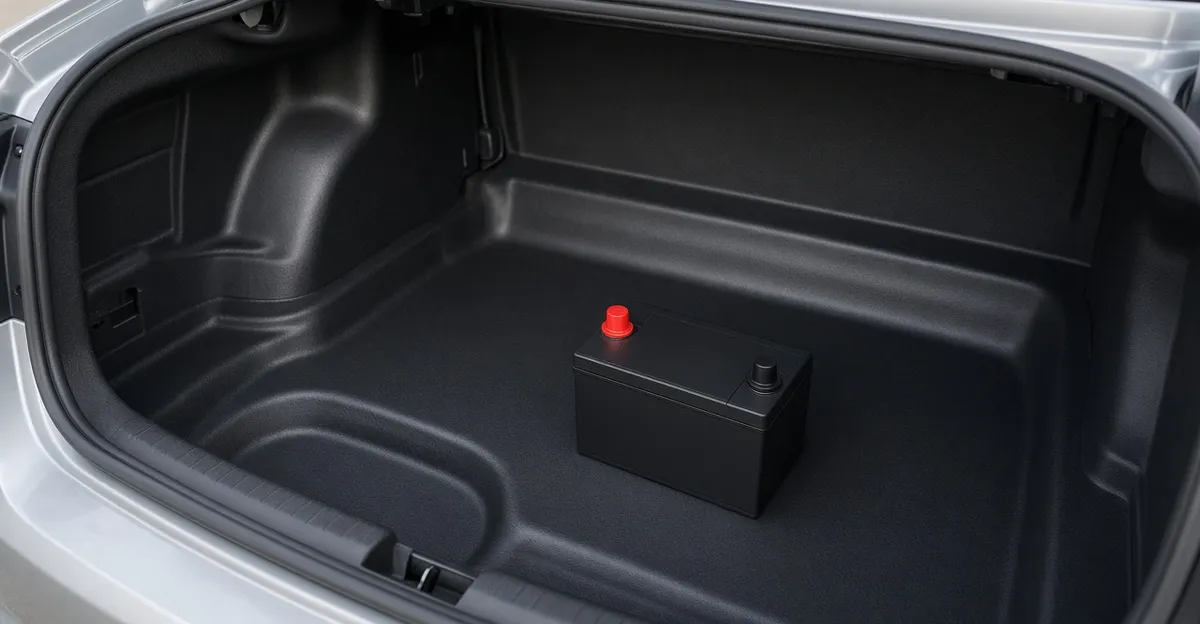
Which 12V post is safe, and which orange cables stay untouched
Orange cables, orange connectors, and orange covers mark the high-voltage section. NexDrive tells owners never to approach, touch, or disconnect them. A 12V jump uses the auxiliary battery or the jumper terminal the manual draws. It never uses the traction pack.
Stop and call a tow or the automaker’s roadside service when any of these are true:
- You cannot find a labeled 12V positive post or the manual’s jump diagram.
- The only cables you can see are orange.
- The battery case is cracked, leaking, swollen, or frozen. Hyundai’s 2025 SX2 EV jump-start chapter says not to jump a frozen battery, and to wear eye protection because lead-acid cells can vent hydrogen and acid.
- The car is still plugged in. Unplug and stow the cord first.
- You would have to pry interior trim, cut a cable, or defeat a service disconnect to reach “something that looks like a post.”
Where the post sits is model-specific. NexDrive lists the motor compartment, under the rear seat, the trunk, and a remote terminal under the hood. Hyundai’s SX2 EV chapter puts the jumper terminal in the motor compartment, under a front-trunk battery cover and a fuse-box cover. Tesla’s Model Y page starts with a separate “open the hood with no power” procedure, because the frunk latch itself needs 12V. A 2023 shop article on Tomorrow’s Technician described a pair of wires behind a Tesla front tow-hook cover that only release the hood. Those wires are not the charge point. Tesla’s current Model Y page then sends you to a chemistry-specific post under the hood. If a video and your manual disagree, the manual in the car wins.
Polarity and the negative landing point also follow the picture, not a habit from a gas sedan:
- Hyundai’s SX2 EV sequence connects positive to the red jumper terminal, and the negative lead to a chassis ground far from the battery. It tells you not to land the negative clamp on the discharged battery’s negative post, because the spark can be dangerous on that layout.
- Tesla’s Model Y lithium procedure uses a positive jump post under a red cover and a specified negative post (a HEPA-filter bolt on many cars, or a post under the black frunk trim on vehicles built after about February 2025). The lead-acid procedure on the same page lands on the battery posts themselves, and it warns you to keep the positive clamp off the tie-down bracket.
- NexDrive’s general hybrid/EV article also lands the negative clamp on unpainted metal, not on the dead battery.
Those three sources agree on one decision and disagree on the exact bolt. Match the drawing for your VIN. If you do not have it, do not average the articles.
Other rules that show up on the OEM pages:
- Use a 12V supply only. Hyundai says not to push-start the car.
- Keep the clamps from touching each other or any metal except the points in the diagram.
- Turn accessories off, set Park, and set the parking brake.
- An EV is a poor donor. NexDrive says you cannot jump an EV or hybrid from another EV. Tesla says Model Y must not be used to jump another vehicle, because that can damage it. A gas car is the donor only when your manual draws that hookup.
- After a successful wake, leave the car in Ready and drive long enough for the DC-DC converter to refill the auxiliary battery. Hyundai’s chapter says at least 30 minutes, and as long as 60 if the 12V battery was completely flat. NexDrive says at least 20 minutes. Use the number in your manual. A 30-second Ready light is not a recharge.
- If a few attempts fail, stop. Hyundai sends that car to a dealer. Repeated jumps cook contactors and hide a converter fault.
Hybrid jump starter for the auxiliary battery
A portable jump starter is the roadside tool when you are alone, the auxiliary battery is 12V lead-acid, and the manual shows a post you can reach. A hybrid dies in a lot the same way: the traction battery was fine, and the small 12V starting battery was not. The buy is still a 12V pack with polarity protection, sized for that chemistry, carried charged.
| Situation | Portable pack | Gas donor car | Tow or automaker roadside |
|---|---|---|---|
| Manual shows a 12V lead-acid post, you are alone | Best fit | Nobody to ask | If you cannot reach the post |
| Manual draws a donor-car diagram and a gas car is there | Still reasonable, and kinder to the electronics | Allowed by that diagram | If the cars would have to touch, or the posts are unclear |
| Low-voltage battery is lithium-ion | Only a supply the manual allows | Only if that manual says so | When the label and the diagram disagree |
| Another EV is the only “donor” nearby | Use your own pack on your own posts | Do not use the EV as a donor | Call roadside |
| Orange cables are the only thing you can find | Stop | Stop | Yes |
Tomorrow’s Technician prefers a dedicated pack with electronic protection against surges and reversed clamps, and advises against using another car. NexDrive’s jump article allows a gas car and also describes a portable pack. NexDrive’s maintenance article prefers an emergency starting device because reverse-polarity protection can save the electronics. Hold both ideas at once: a donor car is legitimate when the manual draws it, and a protected pack is the better thing to own if you park alone.
Is a NOCO jump starter the right pack?
For a 12V lead-acid auxiliary battery, the household pick on our battery guides is the NOCO Boost GB40. NOCO’s GB40 support page says Boost jump starters are compatible with a hybrid’s starting battery when that battery is 12V lead-acid: wet-cell, gel, AGM, maintenance-free, EFB, and calcium types. The same answer frames that use as a 12V system on a gas or diesel hybrid. Read it narrowly. It is a yes for a hybrid whose small battery is one of those lead-acid types. It is not a blanket yes for every battery-electric car, and it is a no when you are unsure.
The GB40 user guide limits the product to 12-volt lead-acid batteries. It tells you to confirm voltage and chemistry before you connect, and it says jump-starting other chemistries may cause injury, death, or property damage. If the label says lithium, or Tesla’s software screen says lithium-ion, leave the GB40 in the store. Use the external supply your manual names, or roadside service.
Use the pack the way NOCO and the car manual overlap:
- Vehicle in Park, parking brake on, accessories off, charge cord disconnected and stowed.
- Confirm the posts against the manual’s drawing. Identify orange cables and stay off them.
- Connect the red clamp to the designated positive post. Connect the black clamp to the negative point the manual names, which may be a chassis ground rather than the battery negative.
- Press the power button. NOCO’s GB40 jump-start steps say a white Boost light means the pack sees the battery and is ready, and a red error light means the clamps are reversed. Fix the clamps. Do not defeat the light.
- Wake the car the way you normally do. NOCO says some vehicles need the pack connected for up to 30 seconds, and it caps you at five attempts inside 15 minutes, then a 15-minute rest. Tesla notes the screen can take several minutes. Wait. Do not rapid-fire the start button.
- Once the car is awake and you no longer need the external supply, disconnect negative first, then positive, and put the covers back.
- Drive on the manual’s clock so the DC-DC converter can refill the auxiliary battery. Recharge the GB40 when you get home. NOCO is explicit that Boost jump-starts and does not charge the car battery. A flat pack in the trunk is a brick.
Skip manual override on this job. NOCO’s override note says holding the override button disables all safety features so the pack can fire into a battery below about 2 volts. That mode is the wrong way to “make it work” when you might be on the wrong post or the wrong chemistry. If the white light never comes on, stop and get a tow.
Engine-liter ratings on the GB40 box describe cranking a gas or diesel engine. An EV wake-up is a different load: computers and contactors, not a starter motor. Do not shop a larger pack because a marketing photo shows a truck. If the household also has a gas car or a diesel, size that second job on best jump starter for a dead car battery, where GB20, GB40, and GB70 are compared by engine size. One GB40 can be the EV lead-acid kit and the normal-car kit. It cannot be the kit for a lithium low-voltage battery.
As an Amazon Associate, we may earn from qualifying purchases. Prices move. Use the live listing.
| Tool | Amazon | Use it when | Leave it when |
|---|---|---|---|
| NOCO Boost GB40 | B015TKUPIC | 12V lead-acid, AGM, gel, or EFB auxiliary battery, and the manual shows a 12V jump post | Lithium low-voltage battery, unknown chemistry, or no labeled post |
| ANCEL BA101 | B01M0ARG3X | After a wake-up, you need a lead-acid health reading before you buy a replacement | The auxiliary battery is lithium, or you are trying to judge the high-voltage pack |
| TOPDON BT100 | B07Z67MMGC | Same 12V lead-acid question, and you prefer TOPDON’s layout | Same limits as the BA101 |
What a 12v battery tester car reading means here
That reading answers one question: is this 12V lead-acid auxiliary battery ready to be trusted, recharged, or replaced? It does not see inside the high-voltage pack.
The two units already on our tester guide cover that 12V job. The ANCEL BA101 and the TOPDON BT100 are conductance-style analyzers for 12V flooded, AGM, gel, and EFB batteries. Our best car battery tester page compares the screens. Both are the wrong tool for a lithium low-voltage EV battery and for the cells inside a lithium jump pack.
Use a tester after the car is safe and awake, or on a battery you can reach with the manual’s procedure:
- Eye protection on. No sparks, no smoking, no work on a frozen or leaking case.
- Clamp on bare metal at the posts the manual allows. Paint and loose terminals invent a “replace” result.
- Enter the chemistry and the rating printed on the label. AGM and flooded are not interchangeable, and Midtronics warns that the wrong chemistry in an EV can overcharge or undercharge because the DC-DC profile is specific.
- If the tool says charge and retest, charge with a method the manual allows, then retest. A single reading on a deeply discharged pack is a reason to refill, not an automatic new battery.
- If the car still will not stay awake with a known-good auxiliary battery, the DC-DC converter or a parasitic draw is the next test. That is a shop with EV-capable equipment. NexDrive says repeated auxiliary failures are a reason to verify the charging system, and that check can involve the high-voltage side. You still do not open orange connectors in the driveway to “see.”
A multimeter remains useful for the 12.4 to 12.7 volt screen NexDrive quotes, on a lead-acid pack, vehicle off. It will not estimate cold-cranking ability. Buy the BA101 or BT100 when the real question is replace versus recharge. Skip both when the label says lithium.
After the car wakes, replace it or send it in
A successful jump is information. The auxiliary battery was low enough that external 12V power let the contactors close. It does not prove the battery will hold, and it does not prove the DC-DC converter is healthy.
Replace the auxiliary battery when the age, the test, and the label agree, and keep these EV-specific traps in view. Midtronics documents the failures shops see:
- Some cars need a memory saver or a continuous 12V supply during the swap so modules, including the battery-management system, do not lose configuration. Others tolerate a full power loss. The service procedure for your VIN is the only list that matters. Midtronics notes that some platforms want as long as 15 minutes after shutdown before you disconnect power.
- Some cars require the new battery to be registered so the DC-DC converter stops using the old battery’s adaptation. Skip that step and the new pack can be undercharged.
- The replacement has to match group size, voltage, and chemistry. A parts-store flooded battery in an AGM spot, or any lead-acid battery in a lithium spot, is a charging-system fault waiting to happen. Tesla’s lead-acid replacement note says a different model of lead-acid battery requires a gateway configuration change on the screen.
- Airbag, ABS, and high-voltage warnings can appear after the swap even when the parts are right. They are often low-voltage dropout codes. Clear them with a scan tool after you confirm the car boots and the charge port works. Driving away on a dark charge port is the comeback Midtronics describes.
A scanner is a second-step tool. Buy one when the car wakes, Ready is stable, and lamps remain. The BlueDriver Bluetooth Pro is the phone-app unit on our check-engine scanner guide when you want enhanced modules on a supported make. The ANCEL AD310 is the inexpensive plug-in engine-code reader on the code-reader guide. Neither one tests the auxiliary battery, and neither one belongs in the cart while the dash is still black. False codes from a weak 12V system are exactly why Auto Training Centre says to prove voltage before you chase high-voltage parts.
Send the car in, on a flatbed if it will not wake, when:
- The chemistry is lithium and you do not have the manual’s power-supply procedure.
- A correct lead-acid replacement was registered and the car still will not stay charged.
- Orange-cable warnings, isolation faults, or a hot smell show up. Get out and call roadside. Do not keep boosting.
- The charge port stays dead after a known-good 12V battery and a known-good cord.
- You would have to remove high-voltage covers to “get a better look.”
Shops that work on EVs every week are the right counter for converter tests and battery registration. A general gas-car bay can still load-test a conventional AGM if the pack is out of the car and the chemistry matches the tool. Ask who will register the battery before you leave it.
If the car will sit for weeks, a maintainer is a different product from a jump pack. NOCO points charging and storage maintenance to a Genius-style charger, which we compare on best portable car battery charger. Hyundai’s SX2 EV jump chapter says not to recharge the battery while the vehicle’s battery cables are connected. That is a reason to read the charging chapter before you clamp a tender onto an installed pack. A tender left on the wrong chemistry, or on a car that is also trying to manage that battery, can fight the DC-DC converter. When the manual is silent, a charged jump pack for the next dead morning is the smaller risk, and a shop can maintain the car if it will sit all season.
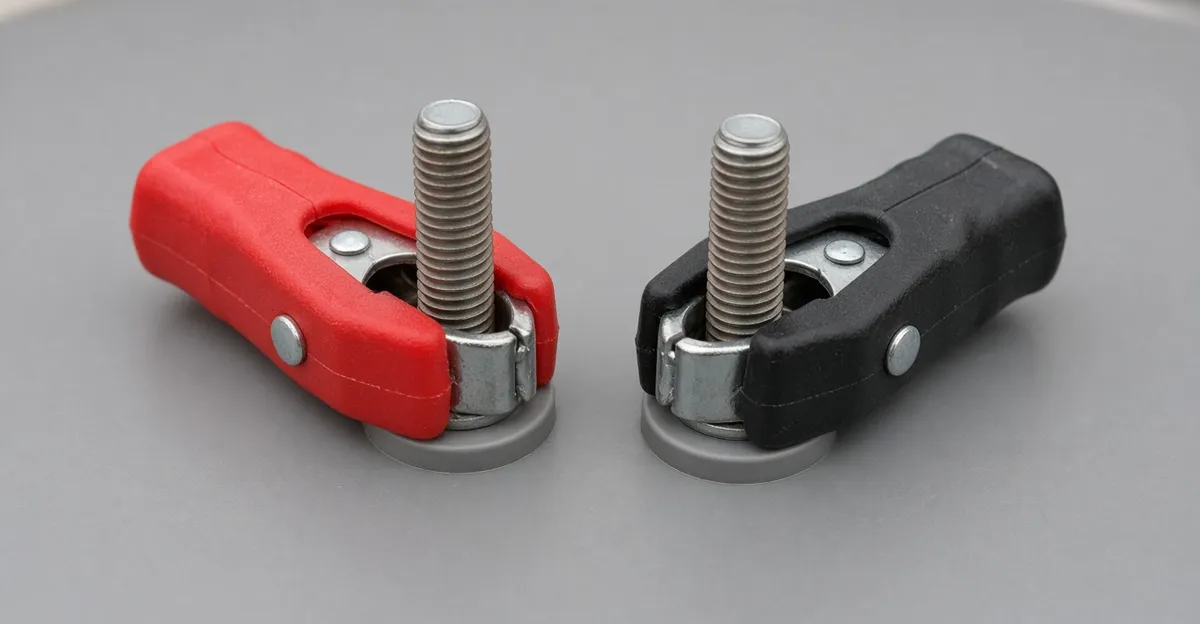
What to buy for this 12V job
- 12V lead-acid, AGM, gel, or EFB, and you want one pack in the trunk: NOCO Boost GB40. Charge it before you need it.
- Same chemistry, and the question is replace versus recharge: ANCEL BA101, or TOPDON BT100 if you want that screen.
- Car wakes, lamps stay on: BlueDriver or the AD310 tier, after the 12V system is stable.
- Lithium low-voltage battery, or you cannot find the post: no Amazon add-to-cart. Use the manual’s supply or automaker roadside.
- The app is low and the car still wakes: the traction pack needs energy. Home charging for that pack is a different aisle from this 12V kit.
- A gas car in the same driveway also needs a boost kit: size that engine on the jump-starter guide. Keep this page’s chemistry rule for the EV.
Confirm the label, unplug the car, and use only the 12V posts in the drawing. A charged GB40 and a BA101 or BT100 cover the lead-acid version of this failure. They are the wrong money if the small battery is lithium or the big pack is the thing that actually failed.
FAQ
Can a full high-voltage battery still leave an EV dark?
Yes. The high-voltage pack moves the car, and the 12V auxiliary battery wakes the computers and closes the contactors that connect that pack. Auto Training Centre describes a no-start, flickering dash, and dead keyless entry as 12V symptoms, while reduced range and isolation faults point at the high-voltage pack. A phone app can show a high state of charge while the car still will not go to Ready.
Should I boost an EV with another car or a portable pack?
Follow the jump diagram in your owner’s manual. Hyundai’s 2025 SX2 EV chapter shows a 12V donor-car hookup at the motor-compartment jumper terminal. Tesla’s Model Y DIY page assumes an external low-voltage supply, such as a portable jump starter, and says Model Y must not jump another vehicle. NexDrive says not to use another EV as the donor. If the manual’s picture is missing, stop and call for a tow.
Will a NOCO Boost GB40 jump a lithium low-voltage battery?
No. The GB40 user guide limits the pack to 12-volt lead-acid batteries and says jump-starting other chemistries can cause injury, death, or property damage. The GB40 support page allows a hybrid starting battery only when that battery is 12V lead-acid, such as flooded, AGM, gel, or EFB. Tesla’s Model Y page splits lead-acid and lithium-ion procedures. Read the label or the vehicle-info screen before you buy.
Can a handheld 12V tester judge the big EV pack?
No. ANCEL BA101 and TOPDON BT100 are 12V lead-acid analyzers. They estimate cranking health on flooded, AGM, gel, and EFB batteries. They do not measure high-voltage isolation, module balance, or a lithium low-voltage auxiliary battery. A passing 12V test with collapsing range still belongs at an EV-capable shop.
Why is the car dead if it stayed plugged in overnight?
Plugging in fills the high-voltage pack. Tomorrow’s Technician notes that the low-voltage battery is often not charged during that session, so the car can still be dark in the morning. NexDrive says an emergency 12V start is done with the vehicle not recharging, so unplug before any jump. Home AC charging gear does not replace the auxiliary battery.
Wrap
Sort the dark car as a 12V auxiliary failure when the big pack still shows charge and the cabin will not wake. Jump only the manual’s 12V posts, with a lead-acid pack such as the GB40 when the label matches, then prove the battery with a 12V tester or replace it under the car’s registration rules. Leave orange cables, lithium low-voltage packs, and traction-pack repairs to the procedure and the shop that match that hardware.