
By Zeng FengMyCarWhy EditorialUpdated 2026-10-03
How to Clean Car Windows Without the Guesswork
how to clean car windows starts with one sorting question: is the haze oily film on the inside, road film on the outside, or mineral water spots that a normal wipe will not touch? Spray-and-hope with a kitchen glass spray usually fails because those three problems need different chemistry, different towel discipline, and different stop points. Chemical Guys frames automotive glass as layered contamination—road film, exhaust residue, bug splatter, water minerals, and silicone overspray—not a flat kitchen pane. Clay & Coat and Daily Car Tips land on the same practical sequence: cool glass in the shade, ammonia-free cleaner, towel first inside the cabin, two towels every pane, glass last after wax and dressings. Use that sequence, then decide which side the streak is on, whether the inside film is oil or fog, how hard the water spots really are, when vinegar is a waste of time, and when a mild abrasive or a shop should finish the job.
Cabin glass overlaps other care pages on this site. Moisture that beads after a clean belongs with how to stop car from fogging up. Broader cabin smell and surface work lives on how to freshen car interior. Failed film that leaves adhesive haze is a different job on how to remove a tint from a car window. Ownership and cabin-care hubs also list under Buying, title & care.
Sort the Haze Before You Buy Another Bottle
Do not start with a new brand of spray. Start with which problem you actually have, because each bucket has a different next move.
| What you see | Likely bucket | First check | Do not do yet |
|---|---|---|---|
| Milky haze worse at night or low sun, finger smears oil | Interior oily film | Clean from inside with towel-applied ammonia-free cleaner | Blast household ammonia spray at the glass |
| Gray film outside that returns after rain | Exterior road film | Rinse grit, then two-towel glass cleaner | Dry-wipe dusty glass with one towel |
| White rings that vanish when wet, return when dry | Surface mineral deposit | Dedicated glass water-spot remover on cool glass | Scrub hard with kitchen cleanser |
| Spots still visible when wet; fingernail catches an edge | Etched mineral | Mild glass abrasive after chemistry fails | Move abrasive paste onto paint |
| Wet sheen that reforms with breath or rain while driving | Condensation / HVAC | Climate controls after glass is clean | Keep wiping wet fog with a sleeve |
Chemical Guys separates interior contamination (plastics off-gassing, skin oils, dressing residue) from exterior road film and mineral spotting. Two Bucket Club’s wet-glass test is the fork for spots: if they disappear when wet and return when dry, chemistry can win; if they stay visible when wet, you are dealing with etch. Write down which row matches before you open a bottle. That sentence is what keeps you from chasing the wrong side of the glass for twenty minutes.
If the cabin also smells musty or the vents blow stale air, glass cleaning alone will not fix the source—pair the glass pass with the freshening sequence after the panes are clear.
How to Clean Car Windows From Inside
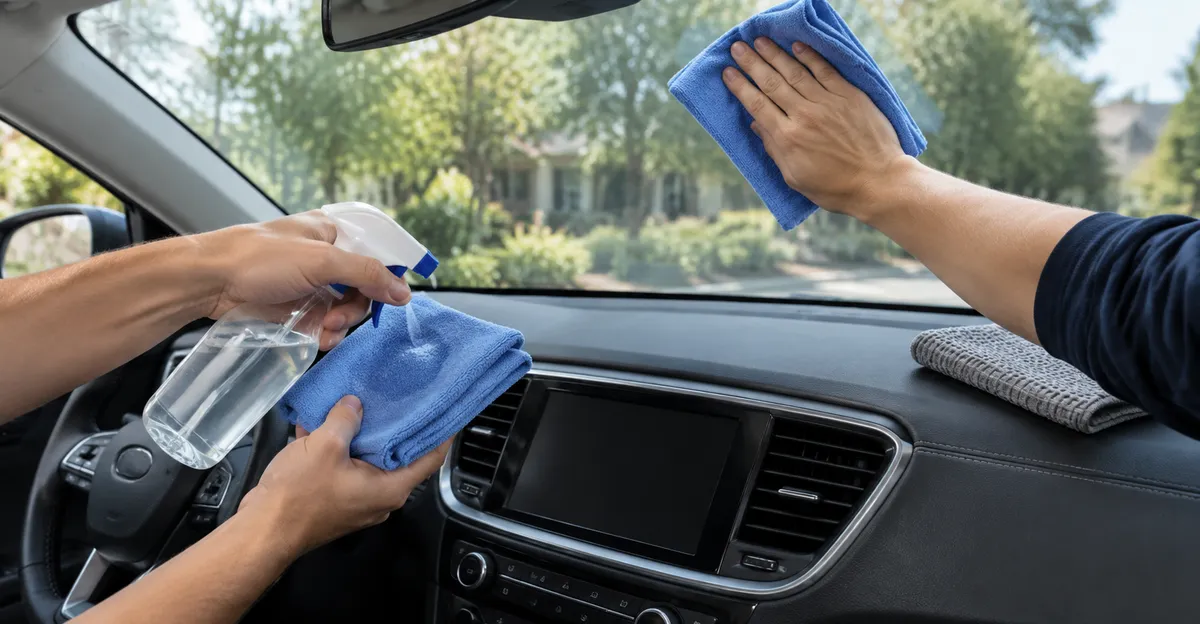
how to clean car windows from inside is where most DIY jobs fail, because the windshield angle, the oily film, and overspray onto the dash stack against you. Chemical Guys is blunt: never spray glass cleaner directly onto interior glass. Mist travels past the pane onto the dashboard, navigation screen, and door panels. Clay & Coat repeats the same rule for a second reason—spraying the towel controls how much product hits the glass and stops puddles that dry into streaks.
Work in this order:
- Park in shade or a garage. Cool glass. Hot glass flash-dries cleaner into residue before you finish a wipe.
- Vacuum or dust the glass edges and defroster vents so grit does not ride under the towel.
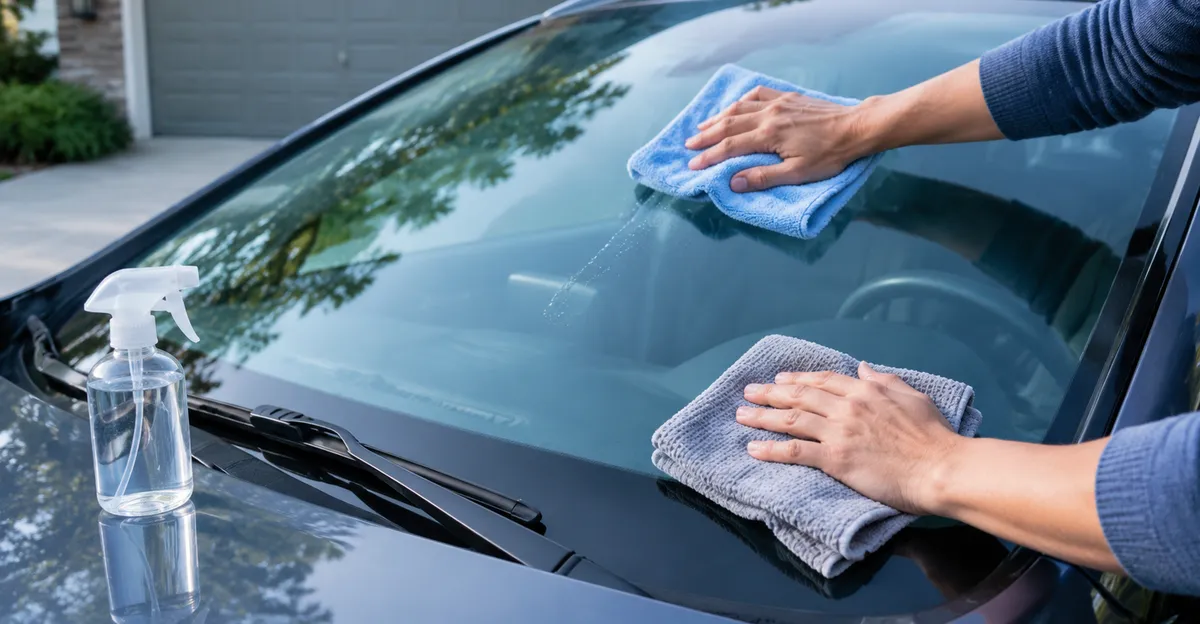
- Fold a clean microfiber—waffle weave if you have it—into a thick pad. Mist ammonia-free automotive glass cleaner onto the towel until it is lightly damp, not dripping.
- Wipe the interior windshield and side glass in straight overlapping strokes. Chemical Guys prefers straight lines over circles because circles leave swirl patterns in leftover product.
- Immediately switch to a second, completely dry microfiber and buff until the towel glides with almost no drag. Clay & Coat calls this the step most people skip and the one that actually removes film.
- Reach the center of the windshield from both the driver and passenger sides. Chemical Guys suggests a pivoting detail tool or a tightly folded towel worked in an arc when the steering wheel and dash block a clean pass.
Daily Car Tips adds a side-window detail that matters for the top edge: roll each side window down about an inch, clean the strip that normally hides in the door seal, then raise the glass. That band collects a thick rim of grime that smears upward the first time you use the window after a “finished” clean.
Interior film is not the same as fog. After the glass is optically clear, if moisture still beads in rain or with passengers, sort climate controls on the fogging guide instead of spraying more cleaner. If the haze returns within days and you smoke in the car or use heavy silicone dressings on the dash, expect a shorter interval—Chemical Guys notes that oily cabin residue rebuilds on interior glass between washes.
Tinted rear and side glass needs the ammonia-free rule even more tightly. Chemical Guys warns that ammonia degrades window tint films over time—bubbling, discoloration, and adhesive breakdown. That risk is about film (aftermarket tint and similar coatings), not factory-dyed privacy glass. Keep the same towel-first method so cleaner does not drip into the door card or onto film edges.
How to Clean Car Windows Without Streaks
how to clean car windows without streaks is less about finding a magic bottle and more about removing the failure modes that leave film behind. Chemical Guys, Clay & Coat, and Daily Car Tips converge on the same stack: shade, light product load, two towels, opposite wipe directions, glass last.
Two towels, not one overloaded rag
Daily Car Tips explains why a single towel almost guarantees streaks: once the cloth is damp and loaded with lifted grime, it stops absorbing and starts pushing residue around. Towel one applies cleaner and lifts contamination. Towel two—bone dry—buffs the pane clear. Chemical Guys says the second towel lifts what the first leaves behind. If the dry towel starts to drag or smear, flip to a fresh face or grab a third towel. Do not keep polishing with a dirty damp cloth and blame the cleaner.
Opposite directions tell you which side failed
Clay & Coat’s professional habit is simple: wipe the inside in one direction and the outside in the other—horizontal inside and vertical outside, or the reverse. When a streak appears later, its orientation tells you which face still has film. Without that trick you wipe the wrong side repeatedly. Chemical Guys uses the same idea with vertical exterior passes and horizontal interior passes so you can spot which pane still needs a buff.
Conditions and sequence that kill streaks
| Mistake | What happens | Fix |
|---|---|---|
| Direct sun / hot glass | Cleaner flash-dries into uneven residue | Shade, cool glass, buff immediately |
| Too much product | Towel cannot lift the surplus in one pass | Light mist on the towel |
| Dirty or shared towels | Paint, wheel, or dressing residue smears onto glass | Glass-only microfibers |
| Paper towels | Lint and light scratching | Waffle-weave microfiber |
| Glass cleaned early | Wax and tire dressing overspray the panes | Clean glass last |
| Household ammonia cleaner | Tint haze risk; wrong chemistry for road film | Ammonia-free automotive glass cleaner |
Jalopnik’s exterior advice matches the cool-glass rule and adds a low-chem option some detailers use: a damp synthetic leather cloth followed by a dry microfiber, still out of the sun. The principle is the same—controlled moisture, then a dry buff—not soaking the pane and walking away.
Inspect at an angle in natural light when you think you are done. Straight-on viewing hides haze that headlights will explode at night. If a faint line remains, identify the side with the direction trick, then one more dry-buff pass with a clean towel usually finishes it.
Outside Glass: Rinse, Edges, Then the Two-Towel Pass
Exterior panes carry grit. Chemical Guys says rinse exterior glass with clean water before any towel work so you are not dragging abrasive dust across the surface. For a full wash day, Jalopnik starts with a proper hand wash and rinse so soap film is gone before glass cleaner goes on.
Then:
- Mist ammonia-free glass cleaner on large panes (windshield, rear glass) or onto the towel for small side panes and mirrors so overspray does not hit seals and fresh wax—Chemical Guys splits those two application habits by pane size.
- Wipe top to bottom in straight overlapping lines so dissolved dirt moves downward instead of across a clean zone.
- Buff immediately with the second dry towel.
- Drop each side window slightly and clean the lower edge near the seal where road film concentrates, then raise the glass. Chemical Guys flags that strip as the most contaminated and most often skipped section.
Save exterior glass for after paint, wheels, and dressings if you are doing a full detail. Chemical Guys’ “clean glass last” rule exists because tire shine and spray wax land as a new film on finished glass. If you only came out to fix windows, still wipe any fresh overspray off neighboring paint with a separate towel so you do not recontaminate the pane you just cleared.
Mirrors count as exterior glass. Treat them with the same two-towel method; a streaked mirror is a safety problem in rain, not a cosmetic footnote.
How to Clean Water Spots on Car Windows
how to clean water spots on car windows is a mineral problem, not a fingerprint problem. Two Bucket Club cites U.S. Geological Survey hardness bands: soft water leaves little mineral; hard and very hard water leave more calcium and magnesium per evaporated drop. Sprinklers that hit the same windshield every morning, and washes that air-dry in the sun, are the classic U.S. driveway offenders.
Decide deposit versus etch first
Two Bucket Club’s ten-second checks:
- Wet the glass. Spots that vanish wet and return dry are surface deposits.
- Drag a fingernail lightly across a dry spot. A faint catch, or a spot that stays visible when wet, points to etching.
Chemical Guys adds a feel check on dry glass: light spots feel smooth as faint white rings; heavier deposits feel slightly rough; etched spots feel embedded. Severity chooses chemistry versus abrasion. Do not start with a glass polish paste on fresh rain spots.
Mildest effective ladder
- Wash and dry the glass so you are working on mineral, not grit (Two Bucket Club; Chemical Guys).
- Cool shade. Hot glass will not let remover dwell.
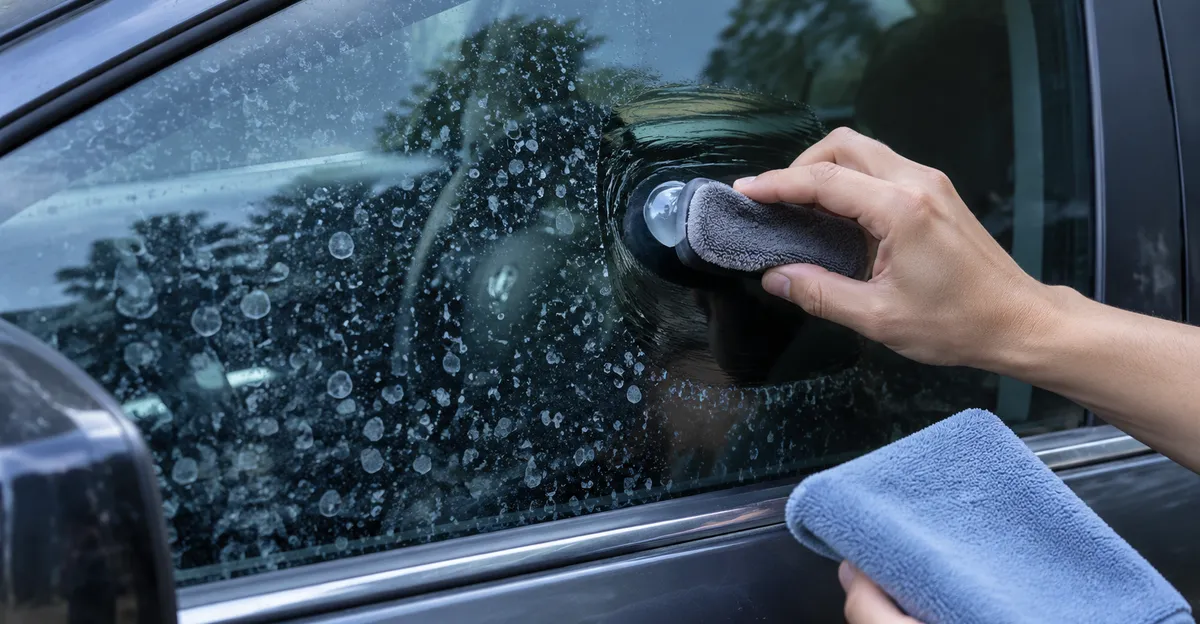
- Apply a dedicated automotive glass water-spot remover per the label, section by section. Chemical Guys recommends firm work with an applicator, dwell without letting the product fully dry, then wipe with straight overlapping passes—not circles that redistribute residue.
- Reassess wet. What remains is likely etched.
- Only then use a mild glass abrasive or cerium-oxide style glass polish on glass only, light pressure, small sections, stop when the spot lifts. Two Bucket Club is strict: glass abrasives stay off paint, off aftermarket tint on the interior face, and off hydrophobic-coated glass you do not want to strip. Test a lower corner first.
- Finish with ammonia-free glass cleaner and the two-towel streak-free pass so remover residue does not become the new “streak.”
Vinegar shortcuts circulate online. Two Bucket Club allows that diluted white vinegar can soften light fresh deposits but calls it weak versus a purpose-made remover, useless on etch, and risky if it runs onto paint or bare metal. My Detail Buddy’s consumer write-ups often mix equal parts white distilled vinegar and distilled water with a short dwell for light spots—if you try that path, keep it on glass, rinse or wipe thoroughly, and do not treat it as a cure for summer-long sprinkler etch.
Stop the spots from coming back
Prevention is mostly about evaporation. Two Bucket Club: dry glass instead of air-drying, wash out of direct sun or in the evening, and move the car out of sprinkler range. Chemical Guys adds that a glass-specific protectant or ceramic glass coating after a clean can help water bead and leave less mineral behind—follow the product’s tint and curing notes, and do not coat over dirty glass. If your municipal water is very hard, prompt drying matters more for you than for a friend in a soft-water town; USGS hardness is geography, not bad technique.
Wiper blades that dragged across mineral can streak the driver’s side even after the glass looks better. Two Bucket Club says clean the blades and replace them if the rubber edge is ragged before you blame the new cleaner.
What to Buy—and What to Leave on the Shelf
You do not need a full detailing cart for clear glass. You do need the right category of products.
| Keep | Why | Skip or limit |
|---|---|---|
| Ammonia-free automotive glass cleaner | Tint-safe; built for road film and cabin oils (Chemical Guys) | Standard household ammonia glass sprays on tinted panes |
| Two clean waffle-weave microfibers dedicated to glass | Absorb and buff without lint (Daily Car Tips; Chemical Guys) | Paper towels; towels already used on wheels or dressings |
| Glass water-spot remover | Targets calcium/magnesium deposits (Two Bucket Club) | Expecting ordinary glass cleaner to dissolve hard-water rings |
| Mild glass abrasive (only after chemistry fails) | Levels etched mineral on hard glass | Using that paste on paint or interior tint film |
| Optional glass protectant after a full clean | Helps shedding between washes (Chemical Guys) | Coating dirty or still-spotted glass |
Cost ranges vary by brand and store. Treat shelf prices as approximate—glass cleaners, towels, and removers commonly sit in low tens of dollars each at U.S. auto parts retailers, but your total depends on what you already own. Do not invent a “pro kit” you do not need: many streak complaints disappear after towel discipline and shade alone.
If you are mid cabin detail, finish mats, plastics, and dressings first, then glass. That order matches Chemical Guys and keeps silicone mist off a finished windshield. Interior glass that stays cloudy after a correct two-towel pass may still have smoke film or heavy off-gassing residue—repeat once with fresh towels before escalating to specialty film removers, and pair with the freshen guide if the cabin smell is the real complaint.
When Cleaning Is Not Enough
Stop DIY escalation when:
- Etched spots survive chemistry and careful mild abrasion, or the windshield pits scatter night glare into a safety problem—ask a glass or detailing shop about machine polishing or replacement.
- Aftermarket tint is peeling, bubbling, or purple. Cleaning will not restore failed film; removal is a separate process on the tint guide.
- Cracks, stone chips, or delaminating glass edges are the visibility issue—not haze.
- You need abrasives near painted pillars and cannot mask reliably—paint damage costs more than a detailer’s hour.
- Fog returns instantly with passengers after the glass is clean—that is HVAC and moisture management, not another bottle of cleaner.
Night driving is the honest QC. If oncoming headlights still bloom through a haze after a careful inside-and-out pass, recheck the interior film with a fresh dry towel at an angle before you buy a stronger chemical. Many “permanent” haze complaints are leftover product or the wrong side of the glass.
For routine cadence, Chemical Guys’ consumer guidance is exterior glass with every full wash and interior glass about every two to four weeks depending on how fast cabin film rebuilds. Shorten that if you smoke, use heavy dressings, or park under trees that drop sap onto the windshield. Lengthen it only when inspections stay clear—not because a calendar app said so.
Clear glass is a visibility and safety result, not a show-car trophy. Sort the bucket, protect tint, use two towels, treat minerals as minerals, and stop when the next step risks the paint or the film. That decision stack is the job; the cleaner is only the tool that sits inside it.
FAQ
how to clean car windows from inside
Chemical Guys says never spray glass cleaner directly onto interior glass—mist lands on the dash, screens, and door panels. Mist an ammonia-free automotive glass cleaner onto a clean microfiber towel, wipe the glass in straight overlapping strokes, then immediately buff with a second dry microfiber until the glass feels frictionless. Clay & Coat adds the same towel-first rule to control product and stop puddles that dry into haze.
Why do my car windows still streak after I clean them?
Chemical Guys lists the usual causes as cleaning in direct sun (cleaner flash-dries), skipping the second dry towel, using a dirty towel, applying too much product, or finishing glass before wax and dressings overspray the panes. Clay & Coat notes that a single damp towel stops absorbing and starts smearing. Fix the side first with opposite wipe directions inside versus outside, then rebuff with a clean dry waffle-weave towel.
Will vinegar remove water spots from car windows?
Two Bucket Club says diluted vinegar can soften light, fresh mineral deposits but is weak compared with a dedicated glass water-spot remover, does nothing for etched spots, and should not run onto paint, trim, or bare metal. Prefer a glass-specific remover on cool glass in the shade, then finish with an ammonia-free glass cleaner.
Can I use household glass cleaner on tinted car windows?
Chemical Guys warns that ammonia degrades window tint film with repeated use—bubbling, discoloration, and adhesive breakdown. Many cars have aftermarket film or tinted panes where an ammonia-free, tint-safe automotive glass cleaner is the safer default. Factory-dyed privacy glass is not the same as peelable film, but ammonia-free cleaner still avoids unnecessary risk to seals and any film that is present.
Is fog on the glass the same as dirty interior film?
No. Condensation is moisture you clear with climate controls; oily interior film is contamination from plastics off-gassing, skin oils, and dressing residue. Chemical Guys treats that film as a cleaning job. If the glass beads with moisture and your finger smears a clear streak, sort HVAC habits with the fogging guide after you clean the film.