
By Zeng FengMyCarWhy EditorialUpdated 2026-10-03
How long does it take to align a car
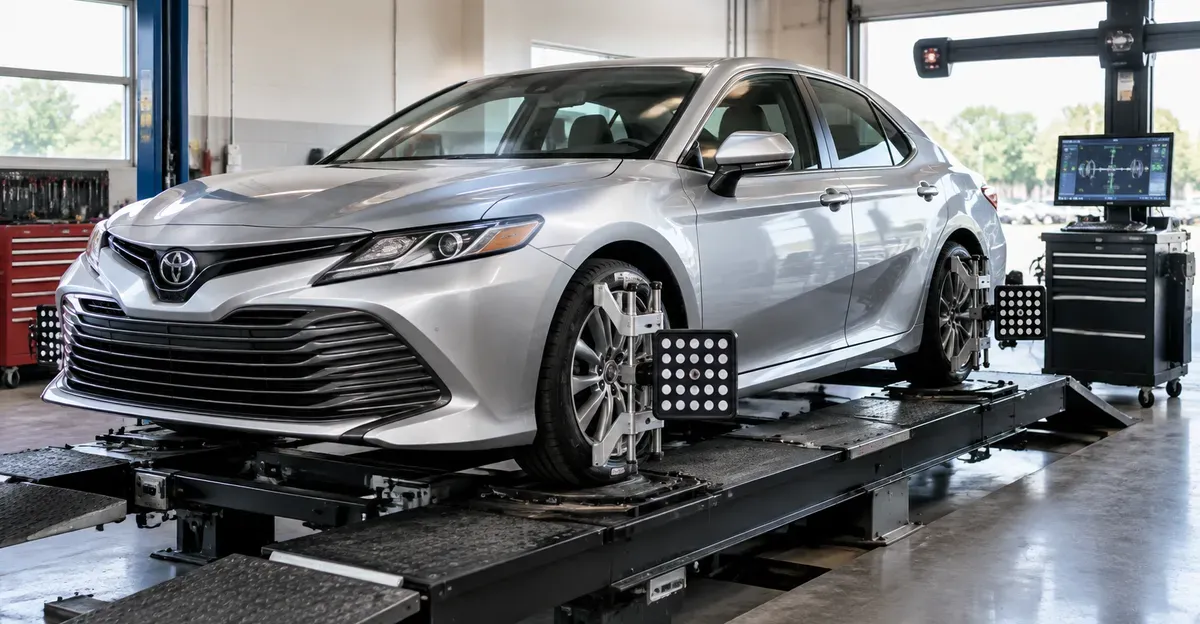
How long does it take to align a car depends on which clock you start. Firestone Complete Auto Care’s service page puts most wheel alignment jobs at about 60 minutes, with the caveat that your vehicle and any extra repairs can stretch the visit. AutomotiveGrid’s timing guide lands a clean job nearer 30 to 60 minutes of hands-on work, with a front-end pass often around 30 minutes and a four-wheel pass nearer 45 to 60. Tire Advise’s shop-facing table stretches a typical passenger-car four-wheel rack visit to about 45 to 75 minutes, then adds check-in so total shop time often sits near 60 to 90 minutes. This page is general education for ordinary U.S. drivers planning a wheel alignment appointment. It is not a quote for your VIN, ZIP code, or shop. Rules and equipment vary. Confirm timing when you book.
Two decisions settle most of the stress before you hand over the keys. First, are you timing the alignment rack or the full errand including the wait for that single specialty bay? Second, is the suspension healthy enough for the angles to hold, or will the tech stop mid-job for a repair approval? Confusing those clocks is why a “one-hour” promise becomes an afternoon, or why a lunch-break walk-in fails on a Saturday.
Which Clock Are You On?
Most answers mix three timers. Name yours before you block the calendar.
| Clock | What it measures | Typical planning range |
|---|---|---|
| Rack / technician time | Sensors on, angles measured, adjustments made, final printout | ~30–60 minutes clean (AutomotiveGrid); ~60 minutes average (Firestone); ~45–75 minutes four-wheel on a compact/midsize car (Tire Advise) |
| Total visit | Arrival through checkout | Often ~60–90 minutes with check-in (Tire Advise); walk-in wait for the rack can add 30–60 minutes (Car Service Land) |
| Scope-expansion calendar | First stop through parts approval and re-align | Hours to another day when tie rods, ball joints, or ADAS calibration enter the ticket |
The question people type into Google is usually the rack clock. The question that ruins a workday is the visit clock. The question that blows a tire budget is the scope-expansion clock—paying for fresh rubber that an uncorrected pull eats in a few thousand miles.
Alignment is not tire balancing. Firestone’s FAQ is blunt: alignment sets wheel angles; balancing distributes weight around the tire and wheel. A steering-wheel shake that appears at one highway speed is often a balance story first. Sort that against car shakes when braking before you book the wrong bay. Alignment is also not a state safety inspection—those follow their own inspection visit clocks.
How Long Does It Take to Do a Car Alignment by Type
How long does it take to do a car alignment once the car is on the rack is mostly a function of alignment type and vehicle class. Use the table as a planning baseline—not a promise for your shop’s bay on a Friday.
| Job type | Typical rack time | Source baseline |
|---|---|---|
| Two-wheel / front-end | ~30–45 minutes | AutomotiveGrid; Car Service Land; MT-RSR |
| Four-wheel (cars / SUVs) | ~45–60 minutes (AutomotiveGrid / Car Service Land) or ~60–90 minutes (MT-RSR) | Chain “about an hour” messaging (Midas, Pep Boys, Meineke via Car Service Land; Firestone ~60 minutes) |
| Full-size truck / heavy duty | Often toward ~50–80+ minutes on rack; heavy-duty ranges near 90–120 minutes | Tire Advise; MT-RSR |
| Luxury / European | Often ~60–90 minutes on rack | Tire Advise |
| With one-side tie rod replacement | Roughly ~90–150 minutes on rack | Tire Advise |
| With control arm / ball joint work | Roughly ~2–4 hours | Tire Advise |
| Lifted / modified | Roughly ~75–120 minutes on rack, sometimes longer total | Tire Advise; AutomotiveGrid |
Car Service Land’s practical note matters for day planning: the gap between a two-wheel and four-wheel job is often nearer 15 minutes of rack time than a full hour. Book the same appointment window either way unless the shop quotes otherwise. Many modern cars need a four-wheel check because the rear thrust line steers the car even when the rear has limited adjustability. Measuring the rear still finds bent parts and thrust-angle problems when the axle itself cannot be adjusted.
What the bay minutes actually buy
Tire Advise’s step list is a useful map of where the clock goes on a proper job:
- Check-in and vehicle inspection (about 5–15 minutes)—tire pressures, obvious damage, customer symptoms.
- Mount sensors or imaging targets (about 5–10 minutes).
- Roll compensation and initial readings (about 5–10 minutes).
- Suspension play checks with the car at ride height (about 5–15 minutes)—this is where the timeline branches.
- Adjustments (about 15–30 minutes)—often rear reference first, then front toe and any adjustable camber or caster.
- Final verification and before-and-after printout (about 5–10 minutes).
- Optional road test.
MT-RSR’s process summary matches that shape: inspection, mount and measure, adjust, verify. Modern imaging racks can complete a full scan in under five minutes; the slow work is inspection, freeing seized hardware, and centering the steering wheel so the printout matches how the car drives.
Anything under about 30 minutes for a four-wheel alignment on a late-model car should raise quality questions, per Tire Advise. An eleven-minute “alignment” that leaves a harder pull is a checkbox, not a geometry correction.
What to Decide Before You Leave the Driveway
The unanswered questions after the usual “alignments take about an hour” advice are decision questions. Answer them at home.
1. Is this rack time or door-to-door time?
Ask the shop which clock their “one hour” means. AutomotiveGrid warns that a car can sit half a day while the alignment itself takes 45 minutes—schedule, inspection queue, or wait list. Car Service Land’s common mistake section is the same: the hour starts when the car hits the rack, not when you park.
2. Do you already suspect worn parts?
Firestone’s service page says worn or damaged suspension or steering parts may require repair before alignment can be completed. Clunks over bumps, visible play, a bent wheel after a curb, or a car that sits low on one corner are flags. Tell the advisor when you book. Car Service Land’s planning tip for high-mileage cars is to leave a two-hour buffer and go in the morning so you are not forced into a rushed repair approval at closing time.
3. Two-wheel or four-wheel—and who decides?
Do not assume the cheaper front-only coupon matches your suspension design. AutomotiveGrid notes that many cars with independent rear suspension need a four-wheel check. Ask what your vehicle’s manufacturer procedure calls for before you lock a 30-minute mental model.
4. Same day as new tires?
AutomotiveGrid says the alignment itself still takes about 30 to 60 minutes after new tires, but mounting and balancing can add another 30 to 60 minutes, so a combined appointment often lands nearer one to two hours. MT-RSR is blunt: new tires do not fix bad angles—align before or with the install so you do not eat the new tread. If you are buying a used car, tire wear patterns and alignment history belong in the same checklist as mileage—see what is good mileage for a used car.
5. Does your car have ADAS cameras or radar?
Car Service Land and AutomotiveGrid both treat post-alignment camera or radar calibration as a separate clock that can add roughly 30 minutes to an hour or more on vehicles with lane-keeping, adaptive cruise, or automatic emergency braking. Ask before you book whether that calibration is included, optional, or handled at a dealer. Do not invent a nationwide mandate—ask for your VIN’s procedure.
6. Can you afford a fail on the tire calendar?
If the inner edges are already bald, alignment protects the next set, not the current one. Firestone lists uneven or rapid tire wear as a classic alignment symptom. Budget tires and time as a pair when the printout shows big red numbers.
Appointment vs Walk-In: The Rack Is the Bottleneck
Alignment is not an oil-change throughput product. Car Service Land’s appointment guide explains the structural reason: a dedicated alignment rack, a trained tech, and about an hour of bay time. Shops can absorb several oil changes for every alignment slot on the same footprint. When the rack is booked, it is booked.
Their walk-in math is practical: if three cars are already scheduled and you arrive without a slot, you can wait hours for a one-hour service. Mid-morning weekday appointments tend to match the published hour. Saturday walk-ins and end-of-day bookings are where “about an hour” turns into a two-hour visit or a Monday callback.
Firestone’s blog-style alignment article notes you do not strictly need an appointment, but that alignments are not an in-and-out service—angles, vehicle condition, and rust-belt seized bolts all stretch the clock. Treat walk-in as an emergency fallback, not the plan.
Decision rule:
- Book an appointment when your schedule is rigid, when you are pairing tires and alignment, or when the car may need parts.
- Walk in only when you called ahead for current rack availability and you have half a day of slack.
- Drop off when the car is older, modified, or ADAS-equipped and you want the shop free to expand scope without you hovering.
Quick-lube chains built for 15-minute oil changes typically do not offer alignment at all, per Car Service Land. Plan on a full-service tire shop, independent, or dealer bay—not a drive-through oil lane.
What Stops the Clock Mid-Job
A healthy planning number assumes the suspension can hold an adjustment. These are the usual branch points.
Worn steering or suspension parts
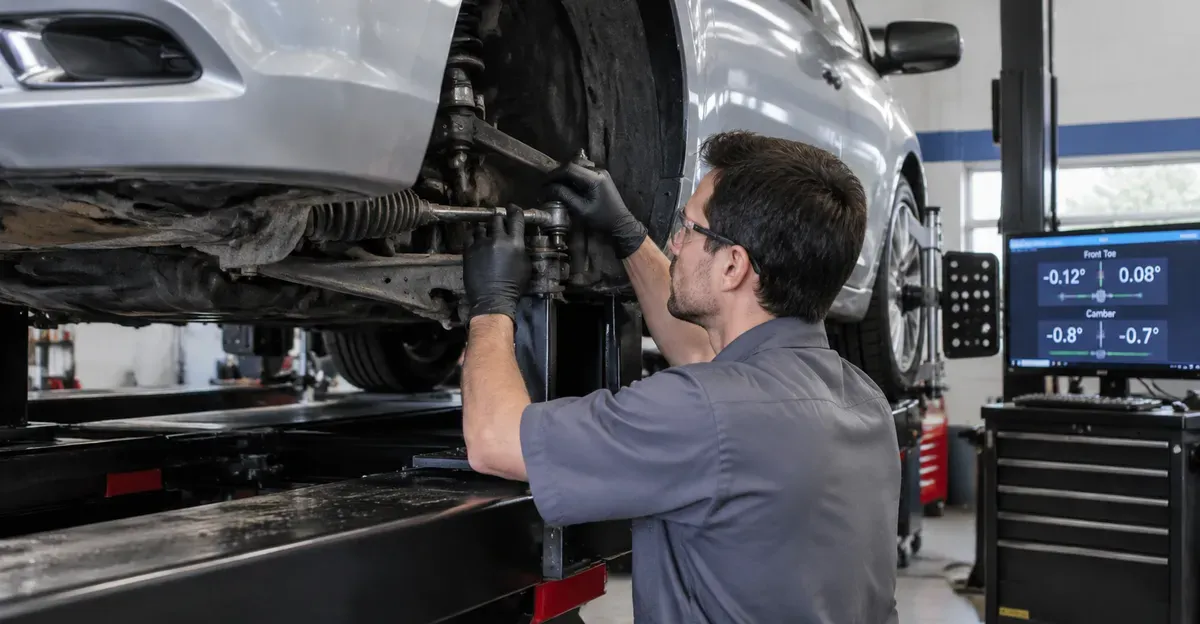
Tire Advise treats play in tie rod ends as the number-one reason an alignment will not hold. Firestone refuses to treat damaged joints as “align and hope.” Replacing a tie rod or ball joint turns a one-hour geometry job into a repair visit that Tire Advise maps nearer two to five hours depending on the parts. Ask for measured play, photos, and a written estimate before you approve.
Rusted or seized adjusters
AutomotiveGrid and Car Service Land both flag salt-belt seized bolts. Penetrating fluid, heat, or hardware replacement can turn a ten-minute toe tweak into a 45-minute fight at one corner. MT-RSR budgets about 10 to 20 minutes extra per corner when fasteners fight back, and adds 30 to 45 minutes beyond standard time for older trucks.
Bent wheels or structural damage
An alignment cannot straighten a bent control arm, knuckle, or wheel. AutomotiveGrid’s rule: reduce symptoms maybe; restore geometry no. The honest stop is repair first, align second.
Modified ride height
Lift kits, lowering springs, and adjustable coilovers change the factory range. AutomotiveGrid and Tire Advise both add time for setting ride height and repeating measurements. Lifted trucks often sit at the long end of Tire Advise’s table.
ADAS calibration
After the physical angles change, some vehicles need camera or radar recalibration so lane-keeping and related aids still aim correctly. Treat that as a named add-on on the estimate, not a surprise at checkout.
Shop queue and equipment
Older laser-clamp systems take longer to set up than modern 3D imaging racks. MT-RSR claims up-to-date imaging can cut total time by roughly 30% or more versus older methods. Ask what equipment they run if two shops quote the same price and wildly different wait times.
Same-Day Combos and What to Ask at the Counter
Bundling services saves a second trip only when the clocks are quoted separately.
| Add-on | Extra time pattern | Why it matters |
|---|---|---|
| Mount + balance new tires | Often +30–60 minutes (AutomotiveGrid); MT-RSR puts rotation/balance/new tire adds near +15–30 minutes each | Alignment minutes stay similar; the appointment does not |
| Tire rotation only | Often toward the lower add-on band | Cheap to combine if the car is already on a lift |
| Suspension repair first | Hours, not minutes | Do not pay for an alignment that cannot hold |
| ADAS calibration | Often +30–60+ minutes | Confirm equipment and price before approval |
Counter questions that protect your day:
- Is the quoted hour rack time or ready-for-pickup time?
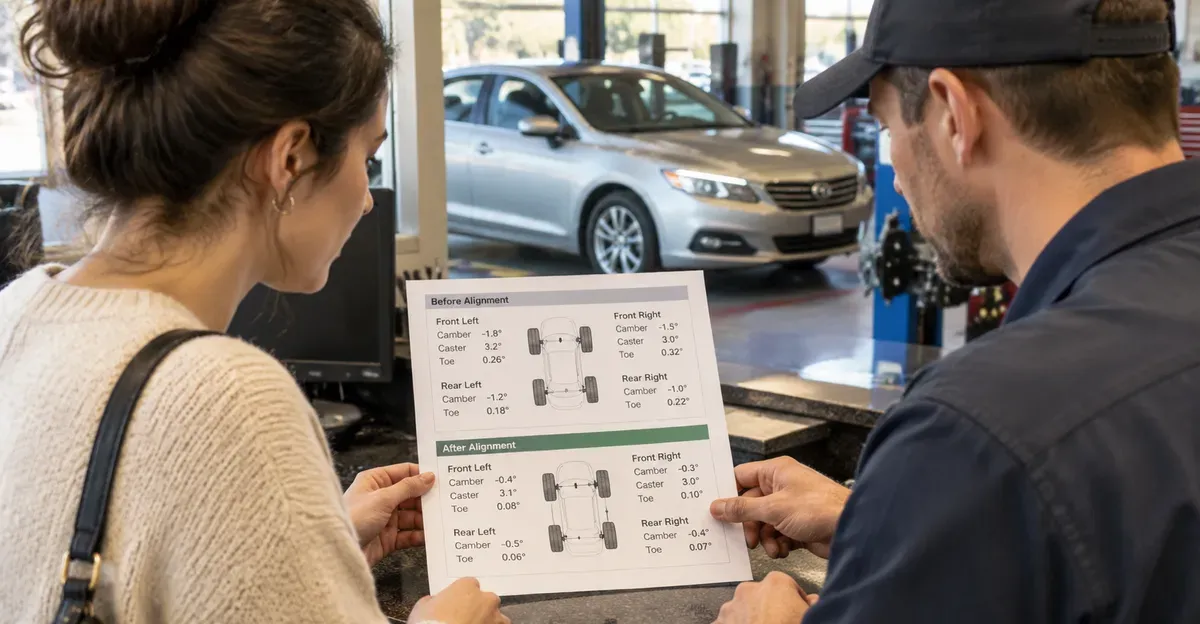
- Will I get a before-and-after printout?
- What happens if you find a worn tie rod—repair here today, or hold the car?
- Does my VIN need ADAS calibration after alignment?
- Are tire pressure and a steering-wheel-centered road check included?
A printout with green final numbers and a crooked steering wheel on the road test is an incomplete job. AutomotiveGrid lists centering the wheel as a required step, not a cosmetic extra. Ask them to fix the centering before you leave.
Match your situation to a clock before you book. The ranges below are planning aids, not a promise for your VIN.
| Your situation | Clock to trust | First move |
|---|---|---|
| Healthy car, booked midweek morning | Rack ~45–75 minutes; visit ~60–90 | Confirm printout and wait-in lobby |
| Walk-in Saturday | Visit clock (wait + rack) | Call for rack queue; expect extra 30–60+ minutes |
| Pull + clunk over bumps | Scope-expansion | Book morning buffer; approve inspection before alignment |
| New tires same day | Combined 1–2 hours | Quote tires and alignment as separate lines |
| After curb or pothole | Inspection first | Bent parts may block alignment |
| ADAS-equipped late model | Rack + calibration | Ask about calibration gear and fee at booking |
| Used-car purchase with feathered tread | Align before blaming the seller’s “fresh tires” story | Pair with a deeper used-car mileage and inspection check |
| Highway shake only, tracks straight | Maybe balance, not alignment | Sort via shake diagnosis |
Ownership paperwork, registration, and care errands live under Buying, title & care. Alignment is a shop clock inside that care column—not a body-panel symptom on the car map.
How to Keep the Visit Inside the Quote
Prep does not invent a 15-minute four-wheel alignment. It keeps you on the published rack clock.
Firestone recommends checking alignment about every 6,000 miles or at least yearly, and after curb or pothole hits, or when installing new tires. Their symptom list—pulling, off-center wheel, uneven wear, certain-speed vibration, squealing in turns, loose feel—is your pre-call script.
Home prep from AutomotiveGrid and Tire Advise:
- Set all four tires to the door-jamb pressure (unequal pressure mimics a mild pull and skews readings).
- Remove heavy trunk cargo that changes ride height.
- Tell the shop about recent impacts, aftermarket wheels, lift or lower kits, and any steering or suspension work.
- Mentally separate alignment from balance so you do not argue the wrong repair.
- Arrive with time to approve a parts find without abandoning the car on the street.
If the advisor offers a suspiciously short four-wheel slot on a complex modern car, ask what steps they skip. Tire Advise’s quality red flag is simple: sub-30-minute four-wheel jobs on late-model cars deserve skepticism.
FAQ
How long does it take to get a car aligned?
How long does it take to get a car aligned end-to-end is the visit clock. Firestone’s consumer answer is about an hour for most services. Tire Advise’s passenger-car band of roughly 60 to 90 minutes total with check-in is a realistic door-to-door plan when you have an appointment and no parts surprises. Add wait time without a booking, and add repair time if the suspension fails the pre-check.
Does every shop take the same time?
No. Chain pages summarized by Car Service Land (Midas, Pep Boys, Meineke) cluster around one hour of service time. Independent shops using older equipment or handling lifted trucks may quote longer. Always ask for that location’s current estimate for your vehicle class.
Should I wait or drop the car off?
For a clean midweek appointment on a known-good car, waiting is fine. For high-mileage, ADAS, or noisy suspension, drop off with a phone number so the shop can pause for approval without a lobby standoff.
Can I drive on a bad alignment until the appointment?
A mild pull on a flat road may be drivable to the shop. AutomotiveGrid’s stop list—sudden hard-to-control steering, rapid air loss, sharp pull after an impact, exposed tire cords, clunking suspension—means you should not treat the delay as optional. Unsafe cars are not a scheduling problem; they are a safety stop.
Will alignment fix a crooked steering wheel by itself?
Only if the tech centers the wheel while setting toe. Demand the road-test check. Numbers alone are not the whole job.