
By Zeng FengMyCarWhy EditorialUpdated
Battery Terminal Cleaner: Spray, Brush, or Kit?
A battery terminal cleaner is the right buy when the car cranks slowly, the headlights sag at idle, or you can see white, blue, or green crust on the posts. It is the wrong buy when the case is swollen, leaking, or frozen. Spray dissolves acid. A brush cuts the crust the spray leaves behind. A kit adds protector and washers so the job does not repeat next month.
Decide the job before you click. Light dust on an otherwise tight clamp is a spray-and-wipe morning. Caked clamps that will not wiggle off the post need chemistry plus a shaped brush. Recurring crust after a recent clean is a charging-system or cracked-case problem, not a bigger can.
As an Amazon Associate, we may earn from qualifying purchases. Specs below come from the live Amazon listings and from Interstate Batteries, Family Handyman, CRC, and NAPA how-tos fetched for this page. Checked 2026-11-24. Prices move.
If the car will not crank at all, sort the sound on why my car won't start before you shop foam. A battery lamp while driving is why the battery light is on, not a terminal brush. Age and climate still set how long the pack lasts on how long a car battery lasts.
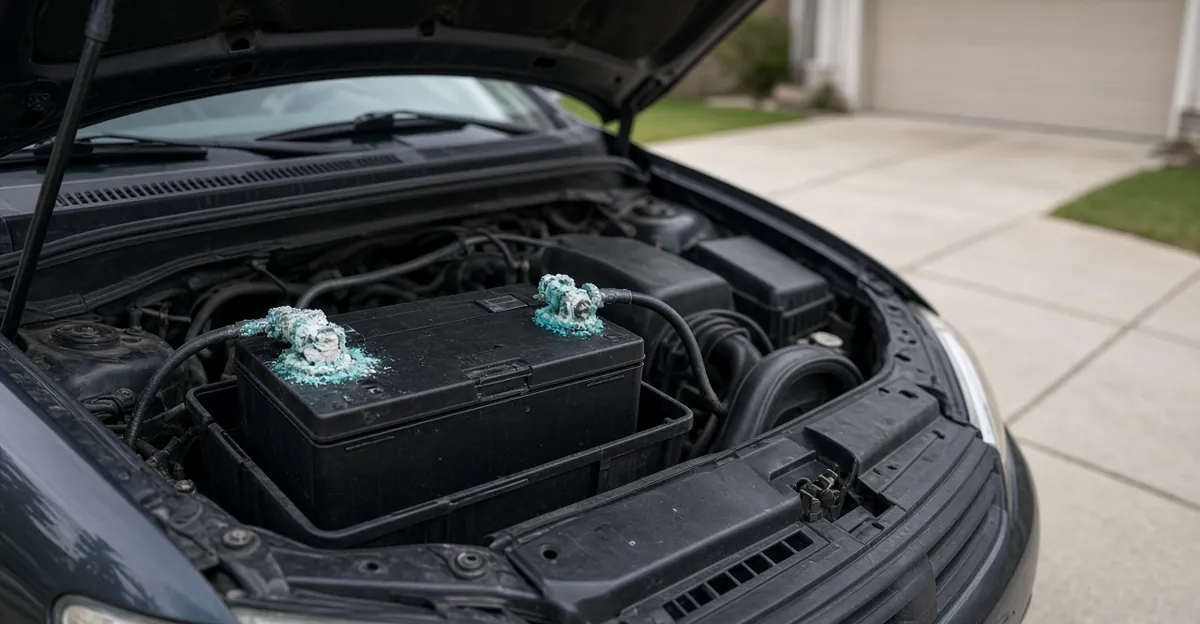
Should you buy a battery terminal cleaner for this job?
Buy cleaner when you can see crust, when a clamp is warm after a start, or when a slow crank improved after you wiggled a cable. Interstate Batteries says too much buildup can keep the car from starting and recommends checking corrosion about every six months. Family Handyman’s Bob Lacivita adds the part that matters on a slow crank: the corrosion you cannot see, packed between the clamp and the post, can starve the starter even when the outside looks only dusty.
Do not buy cleaner as the tool that cranks a dark parking lot tonight. That is a jump starter or jumper cables. Do not spray a cracked, swollen, or leaking case. Replace that battery.
| What you see | Buy | Skip |
|---|---|---|
| Thin white film, clamps still tight | Spray cleaner, then protector | A four-way reamer you will not use |
| Blue-green crust, slow crank, posts intact | Spray plus a post-and-clamp brush, or a kit | Baking soda alone if the crust is caked in the clamp |
| Clamp will not tighten; lead is pitted or rotten | Replacement terminals or cables | Another can of foam |
| Case swollen, leaking, or frozen | New battery after a tester check | Any cleaner |
| Battery lamp on while driving | Charging-system diagnosis | Terminal spray as the only step |
| Car sits for weeks after you clean | Battery maintainer | Repeating a clean every weekend |
Interstate Batteries is clear that corrosion itself does not prove the battery is bad. It often means the pack recently discharged and recharged, sometimes while hot under a tight hood. Clean first. Then test. A shiny post on a three-year-old battery in July heat is still a candidate for a load test, not a trophy.
Battery terminal cleaner spray vs baking soda
A battery terminal cleaner spray is an aerosol that neutralizes acid, foams the crust, and rinses off. CRC’s how-to for its Battery Cleaner with Acid Indicator describes yellow foam that turns pink where acid is present; you keep spraying until the foam stays yellow, then wipe and dry. The CRC 05023 11 oz listing was in stock on Amazon US when checked, sold by Amazon.com, with that acid-indicator job in the title.
The NOCO Remove E403S 14 oz listing is a larger foam cleaner without the pink detector. It tells you to spray on and rinse off terminals, cables, hold-downs, and battery boxes. Use it when you already know the crust is acid and you want more ounces than CRC’s 11 oz can. NOCO’s E404 acid-detector can was temporarily out of stock on the same check, so this page does not send you there.
Baking soda is the grocery version of the same chemistry. Family Handyman’s formula is one tablespoon of baking soda in two cups of hot water. Interstate Batteries uses baking soda and distilled water on a brush and warns you not to mix it on the battery case itself. Both sources tell you to keep the mix out of vent caps and fill holes. The fizz is the acid neutralizing. It is not proof the posts are clean inside the clamp.
| Neutralizer | What it does | What it will not do |
|---|---|---|
| CRC 05023 foam | Color-change acid map, then rinse | Cut a fused clamp off a post |
| NOCO E403S 14 oz | Larger foam can, spray-on / rinse-off | Show you where acid still sits |
| Baking soda + water | Cheap neutralize for light crust | Store as a labeled aerosol in the trunk |
| Coke or soda pop | Interstate Batteries says skip it | Leave sugar residue in the tray |
Interstate Batteries is blunt: never use Coke. The sugar and dye leave a gummy film, and any cola that reaches the cells upsets the chemistry inside. Baking soda is the kitchen substitute. Spray is the labeled substitute. Neither replaces a brush on a clamp that has welded itself to the post.
Rinse is part of the spray. CRC and NOCO both tell you to rinse after the foam works. Family Handyman wants you to flush without splashing paint. Catch runoff with a pan if you can. Do not flood an under-hood fuse box. Dry the case completely. Moisture left on the top of the battery is a new leakage path.
Battery post and terminal cleaner brush
A battery post and terminal cleaner brush is the shaped tool NAPA wants you to own: a female cup of bristles for the post, a male cone for the inside of the cable clamp, usually with a cap so the dirty end does not shred a glovebox. A battery terminal cleaner brush in that shape beats a random wire brush because it matches the taper of a top post instead of flattening it.
NAPA’s how-to is the short version: female end on the posts, male end in the cable ends, several passes, then wipe and dry. Family Handyman allows 120-grit sandpaper in a pinch and immediately warns you not to remove too much lead. Over-sanding a post is how a clamp sits loose next week.
Two live brushes on this check:
The Lisle 11120 listing is the classic plastic-body brush: internal bristles for posts, external bristles for clamps, a high-impact case that the maker says will not weaken in cleaning solutions. Amazon.com was selling it when checked. It is the cheap, correct shape for most top-post cars.
The Steelman 77042 listing is a heavier post-and-terminal cleaner with steel bristles, an acid-resistant case, a storage cover, and explicit top-post and side-post language for cars and marine batteries. Lisle reviewers often point people at this class of brush when a bargain cup rolls over on the first twist. Pay the extra dollars if you have side terminals or you destroy a $9 brush every oil change.
Do not wire-brush a live connection. Family Handyman’s safety note is to eliminate sparking: never use a wire brush on terminals and posts while they are still connected. Neutralize first. Disconnect negative, then positive. Then twist the brush.
A toothbrush or nylon dish brush is fine for the plastic case and the tray. It is not a substitute for the metal cup on the lead. Interstate Batteries still wants you to scrub the metal even when you cannot see crust, because the film you miss is the film that heats the clamp.
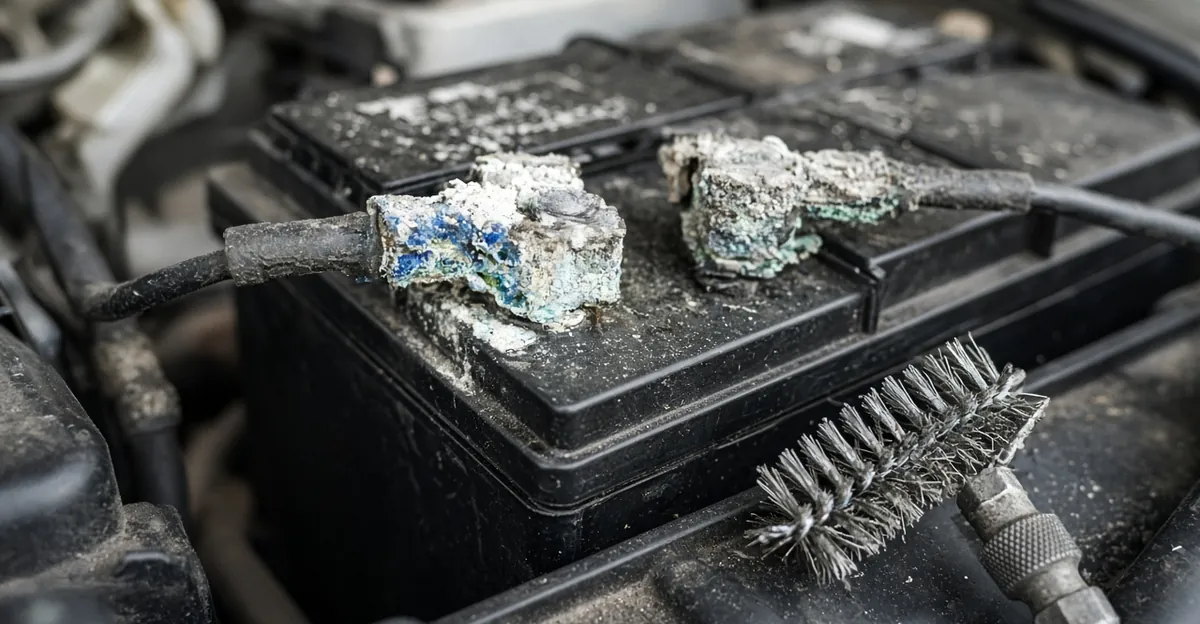
Battery terminal cleaner tool
A battery terminal cleaner tool in the four-way sense is not a brush. It is a small casting with a tapered reamer for the inside of the clamp, sized post cleaners for positive and negative tapers, and often a tiny brush under a cap. NAPA’s “male and female with a cap” advice is this family. Family Handyman lists “battery terminal cleaning tool or sandpaper” as the metal step after chemistry.
The Steelman 42004 listing is a 4-way tool: a 6-bladed tapered reamer for clamps, angled post cleaners, and a wire brush under the opposite cap. The copy is for most top-post automotive and marine batteries. It is not a side-post bolt cleaner. If your battery uses a GM-style side bolt, this SKU is the wrong aisle.
Use a four-way tool when the crust is inside the clamp and a brush only polishes the outside. The reamer restores the taper so the clamp bites again. Stop when the lead is bright. A few extra turns remove metal you needed for a tight fit.
A battery terminal puller is a different tool. Family Handyman says do not twist a frozen clamp off the post. Pry and twist is how people crack a case. If the clamp will not lift after you loosen the bolt, buy a puller or leave it to a shop. Cleaner foam will not break a welded clamp.
Sandpaper is the emergency substitute, not the plan. 120-grit on a stuck film works. It also dishes a post if you keep going. The four-way tool exists so you stop at “bright,” not “smaller.”
Which car battery terminal cleaner should you buy?
These US Amazon listings were for sale when checked on 2026-11-24. Confirm the live title, size, and “in stock” line before you click. Aerosol cans are often non-returnable under hazmat rules. The CRC and NOCO spray pages said so.
Best battery terminal cleaner
“Best” here is the product that matches the crust you have, not a trophy SKU.
| Product | Amazon | Type | Best fit |
|---|---|---|---|
| CRC 05023 Battery Cleaner w/ Acid Indicator, 11 oz | B000CIRTY0 | Spray; yellow foam turns pink on acid | Default car battery terminal cleaner spray; see where acid still sits |
| NOCO Remove E403S, 14 oz | B003VARC8Y | Spray; foam, no color detector | Larger can when you already know it is acid crust |
| NOCO NCP2 M401 kit | B009LWZPAI | 1 oz cleaner, 1 oz NCP2 protector, metal brush, two washers | One-box clean-and-protect; top-post and side-post on the listing |
| Lisle 11120 battery brush | B0009OMY92 | Male/female bristle cup | Cheap top-post brush if you already own spray |
| Steelman 77042 post and terminal cleaner | B00MHT1X94 | Steel-bristle brush, cover, top and side | Heavier brush; side-post cars |
| Steelman 42004 4-way tool | B07DBZP9Y7 | Reamer + post cleaners + cap brush | Inside of a top-post clamp that a brush cannot reach |
CRC 05023 — acid-indicator spray
The CRC 05023 listing is an 11 oz tech-grade battery cleaner with acid indicator. CRC’s own blog says shake, spray on terminals and cable ends, wait a minute or two, and keep spraying until the foam stays yellow. Then rinse, dry, disconnect if you still need to scrub, and protect. That color change is the reason to pick CRC over a larger can with no detector.
Choose it for a first clean when you are not sure how far the acid crept across the tray. Skip it as the only SKU if the clamp is fused; you still need a brush or the four-way tool after the foam.
NOCO E403S — larger foam, no pink map
The NOCO E403S listing is a 14 oz Remove spray. The page claims it instantly neutralizes, dissolves, and removes corrosion from terminals, cables, hold-downs, and boxes, then rinses. There is no acid-detector language on that SKU. Buy the extra ounces when you have several batteries (mower, tractor, a second car) and you already know the crust.
NOCO M401 — the clean-and-protect kit
The NOCO M401 listing is the one-box answer: 1 oz cleaner, 1 oz NCP2 corrosion-preventative spray, a metal brush, and two oil-based felt washers for top or side posts. Amazon’s Choice sat on this kit when checked. Reviewers on that page warn the 1 oz cleaner is a one-job bottle. Believe them. If you clean two cars and a lawn tractor, add CRC or E403S for volume and keep M401 for the protector, washers, and brush.
NCP2 on that listing is an oil-based preventative the maker says does not dry or evaporate. That is the “seal it after you clean it” step Interstate Batteries and NAPA both want, sold as a kit instead of a separate protector can.
Lisle 11120 and Steelman 77042 — the brushes
Buy Lisle 11120 when the battery is a normal top-post and you already have spray. Buy Steelman 77042 when you want a cover, heavier bristles, and side-post language on the box. Both are reusable. Both get filthy. The cap or cover is not a gimmick; NAPA called that out for a reason.
Steelman 42004 — the four-way tool
Buy the Steelman 42004 when the clamp’s inside is the failure, not the visible snow on top of the battery. Top-post only on the listing. Pair it with spray. A reamer on dry acid dust just smears it.
Cleaning battery terminals
Cleaning car battery terminals is a short sequence: protect your eyes, neutralize acid, take the ground off first, scrub the hidden faces, dry, protect, then put the positive clamp back first. The remaining choice is only when the spray happens.
CRC sprays foam while the cables are still on, reads the pink-to-yellow change, rinses, then disconnects if the crust needs a brush. Interstate Batteries and Family Handyman want a memory saver on, then the negative cable off, then chemistry and a brush. Both orders work if you do not spark a tool across a live positive. Family Handyman’s hard line is the one to keep: do not wire-brush a connected post.
Practical order that respects both:
- Engine off. Keys out. Parking brake on. Glasses and gloves on. No smoking, no grinder nearby. A battery can vent hydrogen. Interstate Batteries names hydrogen gas as a common corrosion source, not a puddle of liquid acid.
- Look at the case. Swollen, leaking, or a rotten smell is a replacement, not a clean. See how long a car battery lasts and test before you spend another hour on crust.
- If radio codes or window indexes matter, connect a memory saver as Interstate Batteries and Family Handyman describe.
- Spray CRC or NOCO on the crust, or brush on baking soda mix. Wait the minute the can asks for. CRC’s foam should go yellow and stay yellow.
- Disconnect negative (−) first, then positive (+). If a clamp is frozen, stop twisting. Use a puller.
- Brush or ream the posts and the insides of the clamps until the lead is bright. Several passes. Then rinse residue and dry with a clean rag.
- Felt washers on the posts if you bought the kit. Reconnect positive first, then negative. Tighten until the clamp does not spin; do not crush the lead.
- Protector spray or a thin coat of petroleum jelly on the outside of the assembled joint. Interstate Batteries is specific about dielectric grease: cake it on after you reconnect to seal the joint. Do not put a grease film between the post and the clamp, where metal needs to touch metal.
Work outside or with the garage door open. Keep mix out of vent caps. Interstate Batteries says brush away from raised caps and holes. Family Handyman says if you have a non-maintenance-free battery with fill caps, keep soda out of the cells and top off with distilled water only if the manual allows it.
Cleaning corroded battery terminals
Cleaning corroded battery terminals is the same sequence with more patience. Heavy blue-green crust is usually copper in the clamp reacting to hydrogen, per Interstate Batteries. White crust is often lead, zinc, or aluminum. The color does not tell you the battery is good or bad. The color tells you which metal is being eaten.
Caked corrosion needs foam, a wait, a brush, and sometimes a second spray. NOCO’s E403S page is a spray-on / rinse-off claim; reviewers on similar foams still pick up a brush. Believe the crust, not the marketing. If the clamp is thin, green inside the cable, or the bolt threads are gone, stop cleaning and replace the terminal.
A warm clamp after a start is a clue Family Handyman uses: current is turning to heat at a bad joint. Clean the hidden face. If the clamp still heats after a bright, tight connection, the cable is the part.
Cleaning battery terminals with baking soda
Cleaning battery terminals with baking soda is the grocery path when you do not want an aerosol. Family Handyman’s mix is one tablespoon of baking soda in two cups of hot water, in a plastic cup, not on the case. Interstate Batteries mixes soda and water in a cup or on the brush and applies it slowly. Use a plastic brush on the case. Use the metal terminal brush on the posts after the fizz dies down.
Do not dump a box of dry soda on the battery and hose it. You want a controlled neutralize, a rinse, and a dry top. Keep the mix off paint. Flush immediately if you splash. Then protect the joint the same way you would after CRC: washers, a tight clamp, protector on the outside.
Baking soda will not map leftover acid the way CRC’s pink foam does. If the tray still looks suspicious after a soda clean, a can of 05023 is the follow-up, not a second box of soda.
Cold weather makes a dirty connection louder. A weak pack that still started in October fails in January. Clean the posts if they are crusty, then test. See cold weather car battery. Cleaning is not a winter-capacity upgrade.
When cleaning is not the fix
Skip the aisle, or stop mid-job, when:
- The case is swollen, cracked, leaking, or frozen. That is a battery, not a brush.
- The clamp is pitted, split, or the nut will not hold torque. Family Handyman sends those to a terminal replacement, not another rinse.
- Corrosion returns in days. Interstate Batteries flags overcharging, a failing battery, or a crack near a post. Test the charging system. A battery tester answers replace versus recharge. A maintainer answers a car that sits; it will not float a bad cell. See best car battery maintainer.
- The battery lamp is on while you drive. Clean terminals will not fix an alternator. See battery light.
- You needed a start tonight. Foam does not crank. Use a jump starter.
- The battery lives in the trunk or under a seat and you cannot isolate the terminals safely. Leave it to a shop.
- You were about to pour soda pop on the case. Interstate Batteries already closed that shortcut.
Hybrid and EV 12-volt packs still corrode at the small battery. They also have high-voltage orange cables you do not touch. If the 12-volt battery is not in an obvious under-hood tray, read the manual. This page shops lead-acid terminal care, not a traction-pack procedure.
A memory saver is not optional on cars that lose throttle adaptations or throw a light after a disconnect. Family Handyman treats that as a real drivability issue, not a clock reset. If you do not own a saver and the manual is stern, do not pull both cables for a 20-minute clean. Spray, rinse, and brush only what you can reach with the ground still attached is a worse spark risk. Better to wait for a saver or a shop.
Quick pick guide
- See the acid, want a color change: CRC 05023 B000CIRTY0.
- Need a larger foam can, no detector: NOCO E403S B003VARC8Y.
- Want cleaner, brush, protector, and washers in one box: NOCO M401 B009LWZPAI.
- Top-post brush only, already own spray: Lisle 11120 B0009OMY92.
- Heavier brush, top and side posts: Steelman 77042 B00MHT1X94.
- Inside of a top-post clamp is the problem: Steelman 42004 B07DBZP9Y7.
- No crank tonight: jump starter, then clean later.
- Unknown health after a clean: battery tester.
Clean the hidden face of the clamp. Protect the outside of the joint. Test the pack if the crust keeps coming back.
FAQ
Do I disconnect the battery before I spray a battery terminal cleaner?
Follow the can, then disconnect before you scrub metal. CRC’s own how-to sprays the foam on first, waits for the color change, and rinses before the wrench comes out. Interstate Batteries and Family Handyman still want the negative cable off before you work the posts with a brush, so you do not spark a tool across a live clamp. Spray to neutralize. Disconnect to scrub. Never wire-brush a connected post.
Is baking soda as good as a commercial battery terminal cleaner spray?
For a thin crust, yes. Family Handyman’s mix is one tablespoon of baking soda in two cups of hot water. A labeled spray such as CRC 05023 adds an acid-indicator foam that turns pink on contact, which baking soda will not do. Heavy, caked corrosion still needs a brush after either chemistry. Do not pour soda mix into vent caps.
Do I need a memory saver to clean terminals?
Use one if you care about radio presets, window indexes, or keep-alive data. Interstate Batteries and Family Handyman both treat a 9-volt memory saver as part of the job because a disconnect can wipe modules. Many older cars only lose the clock. If the owner’s manual warns about memory, plug in a saver before the negative cable comes off.
Will a battery terminal cleaner brush fit a side-post battery?
Only if the listing says so. The Steelman 77042 brush and the NOCO M401 kit both list top-post and side-post use. The Steelman 42004 four-way tool is written for top-post clamps and posts. A male/female top-post brush will not ream a GM-style side bolt. Look at the battery before you click.
When should I replace cables instead of cleaning?
Replace when the clamp is pitted, cracked, or will not tighten, or when the copper inside the cable is green and powdery after you pull the clamp. Family Handyman notes that corrosion you cannot see inside the terminal can overheat a clamp even when the outside looks only dusty. Cleaning shiny lead will not restore a rotten cable.