
By Zeng FengMyCarWhy EditorialUpdated 2026-10-04
What Is a Transfer Case on a Car
What is a transfer case on a car is the wrong first question if you do not yet know whether your vehicle even has one. Start with three sorts: badge and manual language (4WD, 4x4, AWD, or none), whether you have a floor lever or dash dial for drive modes, and whether the noise or leak you feel shows up only when that system is working. Wikipedia defines the part as an intermediate gearbox that moves power from the transmission to the driven axles on four-wheel-drive, all-wheel-drive, and other multi-axle machines. That definition only matters once you know you are sitting on that hardware.
This guide walks the decisions a US driver actually faces: how to confirm the part exists, how it differs from the transmission and the differentials, when part-time 4WD must stay off dry pavement, how to separate transfer-case symptoms from axle noise, when to tow instead of nurse the truck home, how fluid service usually gets skipped at oil changes, and how to read a repair-versus-replace quote without inventing a nationwide fixed price.
Does Your Vehicle Even Have a Transfer Case?
Skip the glossary until you clear this gate. A plain front-wheel-drive sedan with no AWD badge almost never has a transfer case. A rear-wheel-drive car without a second driven axle is the same story. VehicleBar states the contrast plainly: a rear-wheel-drive vehicle with no 4WD capability has no transfer case at all—only a differential at the driven axle. CarTreatments places transfer cases on trucks, SUVs, and off-road vehicles from makers such as Jeep, Ford, Toyota, and GM, and on some crossovers with longitudinal layouts that feed AWD.
Use checks you can finish in the driveway:
- Read the window sticker, build sheet, or owner's manual for 4WD, 4x4, AWD, or AutoTrac-style language.
- Look for a floor-mounted transfer-case lever, or a dash dial or buttons labeled 2H, 4H, 4L, AWD, or Lock.
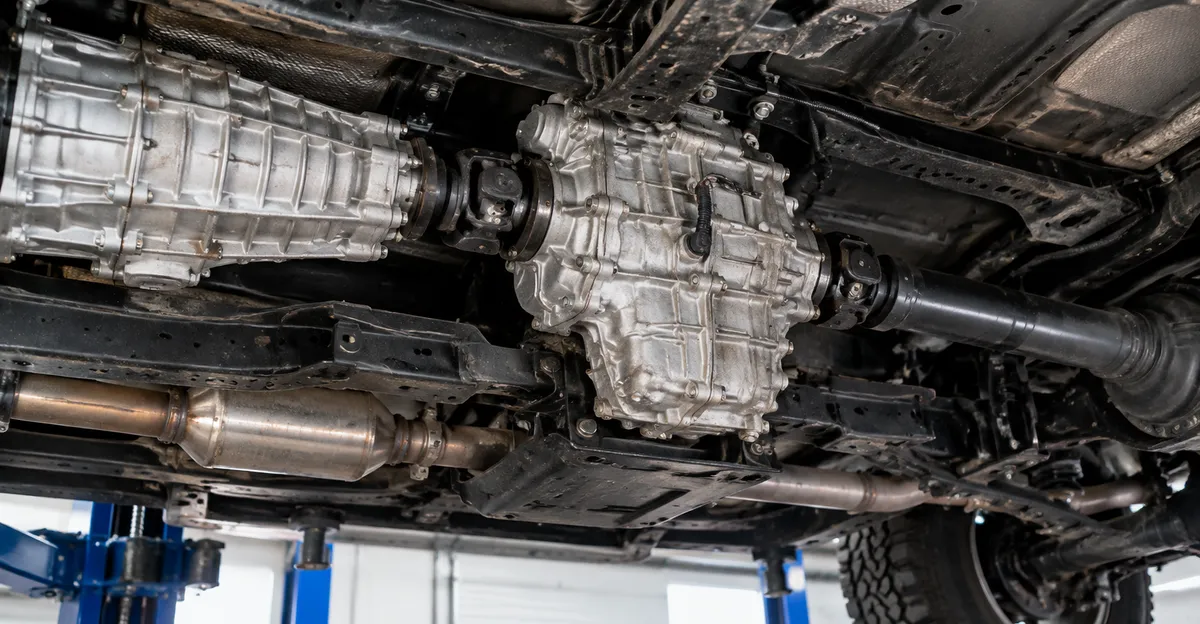
- Crawl under (only on level ground with the parking brake set) and look behind the transmission for a second gearbox with a driveshaft heading forward and another heading aft. CarTreatments describes that married layout as a smaller secondary case bolted to the back of the transmission.
If none of those cues exist, stop shopping for transfer-case fluid. Your problem is elsewhere—perhaps an engine mount, a wheel bearing, or a differential. If the cues exist, keep reading. The rest of this article assumes you drive a 4WD truck, a body-on-frame SUV, or an AWD vehicle that uses a transfer case or a closely related power transfer unit.
| What you see | Likely drivetrain | Transfer case? |
|---|---|---|
| No 4WD/AWD badge, FWD hatch or sedan | Two-wheel drive | No |
| Badge says AWD, no low-range dial | Full-time or on-demand AWD | Often yes, or a PTU doing the same job |
| Dial or lever with 2H / 4H / 4L | Part-time or selectable 4WD | Yes |
| Always-on 4WD with a center differential | Full-time 4WD | Yes |
How the Transfer Case Fits Between the Transmission and the Axles
Wikipedia calls the transfer case part of the drivetrain: it receives power from the transmission and sends it to both front and rear axles, or to just one (usually the rear) when the system is in two-wheel drive. Advance Adapters puts the same idea in shop language: the case transfers engine power and torque from the transmission to the driveshafts, and the driveshafts carry that power to the axles. It can also coordinate front and rear axle rotation so the shafts do not fight each other when speeds differ.
The case is not a second transmission in the everyday sense. Advance Adapters is explicit: the transmission multiplies engine torque into usable output; the transfer case shifts that output toward the axles. Some cases add a low-range gearset that further multiplies torque for crawling, but they still depend on the transmission's output. Think of the transfer case as the splitter after the gearbox, not a replacement for it.
Internal layouts vary. Wikipedia and AMSOIL both describe gear-driven and chain-driven designs. Gear-driven cases are generally stronger and heavier; chain-driven cases are quieter and lighter and show up on many compact and full-size trucks and SUVs. Housing can be married—bolted straight to the transmission—or divorced/independent, sitting farther down the driveline on long-wheelbase trucks. Married cases dominate ordinary US pickups and SUVs you see at the grocery store.
AMSOIL notes a useful AWD versus 4WD bias: many 4WD trucks send extra power to the front axle when you select four-high or four-low, while many AWD vehicles start as front drivers and send power rearward when the system needs it. The badge on the hatch does not change the core job. The transfer case still divides torque between axles so more than one end of the vehicle can pull.
Part-Time, Full-Time, and the Dry-Pavement Decision
The mode labels on your dial are not decoration. They change what is safe on a sunny parking lot.
Wikipedia defines a part-time transfer case as one that can switch between two-wheel and four-wheel drive but lacks a center differential to coordinate axle speeds. That design is common on trucks and trail-ready SUVs. Full-time cases stay locked into AWD or 4WD mode and are built for continuous use. Hybrids of the two also exist: open-center full-time modes plus a locked part-time mode in high and low range.
AMSOIL maps the labels many US trucks still use:
- 2H: typically rear axle only on a traditional truck layout.
- 4H: torque to both axles; some designs still allow axle speed difference.
- 4L (and related low modes): reduction gears for steep grades, uneven ground, and low-traction crawling. AMSOIL warns that locked low modes are not ideal on dry pavement.
Wikipedia's pavement warning is the one that prevents expensive lessons. A transfer case that does not synchronize front and rear wheel speeds for road use can create driveline windup on dry pavement. The tires cannot scrub the speed difference the way they do on gravel or snow. The binding loads the case, the driveshafts, and the axle gears. CarTreatments describes the feel as resisting turns, jerking, or hopping in tight parking-lot turns—driveline binding—and notes that the same sensation can appear if a part-time system stays stuck in 4WD after you try to return to 2WD.
| Situation | Prefer | Avoid |
|---|---|---|
| Dry highway or dry parking lot | 2H or the maker's default AWD auto mode | Locked part-time 4H/4L on dry pavement |
| Packed snow, gravel, mud, sand | 4H (or AWD Lock if the manual allows) | Leaving 4L engaged at highway speed |
| Rock crawling, steep soft climbs | 4L after stopping as the manual requires | Shifting into low range at speed |
| Sudden ice patch on an otherwise dry road | Brief 4H if the maker allows shift-on-the-fly | Staying locked in 4WD for miles of dry asphalt afterward |
Engagement rules also vary. Wikipedia contrasts manual shift-on-the-fly and electronic shift-on-the-fly systems. High-range 4WD may engage while moving at a low speed set by the maker. Low range usually needs a stop and Neutral. AMSOIL notes that some manual systems want transfer-case shifts below about 3 mph. Your owner's manual is the speed limit that matters for your VIN—not a forum post.
If you bought an AWD crossover with no 4L position, you are not missing a broken lever. Wikipedia observes that low-range gearing is often absent on all-wheel-drive cars. Those vehicles still may use a transfer case or PTU, but the driver decision set is different: trust the automatic system, watch for service messages, and keep fluid service on the calendar instead of learning a floor shifter.
Transfer Case, Differential, or Transmission: Sorting the Symptom
Drivers often blame the wrong box. Advance Adapters draws the clean line: the transfer case feeds whole axles; a differential feeds two wheels on the same axle. VehicleBar adds a diagnostic tip: a whine that changes with speed but not with steering angle points toward the transfer case, while a noise that worsens when turning points toward a differential or CV joint. CarTreatments offers a second filter: transfer-case trouble often appears or worsens when 4WD is engaged or when AWD is actively transferring torque; differential noise often stays present in 2WD and 4WD alike.
Use this sort before you authorize parts:
| When it shows up | More likely | First check |
|---|---|---|
| Only after you select 4H/4L | Transfer case, shift motor, front axle actuator | Mode engagement, fluid level, scan for 4WD codes |
| In 2WD and 4WD at similar volume | Rear differential, wheels bearing, tire cupping | Road test in 2WD, listen at each corner |
| During hard turns in a parking lot while supposedly in 2WD | Transfer case stuck engaged, binding | Confirm the dash mode matches what the hubs/case are doing |
| With a Check Engine or reduced-power message and no 4WD light | Powertrain electronics more than the case | Scan modules; see also warning lights guides |
| Clunk when shifting from Park to Drive | Transmission mount or U-joint as often as the case | Visual mounts and driveshaft play |
CarTreatments also warns that electronic shift problems can be a failed shift motor, encoder, module, or wiring—not a destroyed gearset. VehicleBar lists related codes in the P18xx family on many trucks. A battery that will not hold voltage can throw spurious transfer-case codes. Before you approve a reman case, ask the shop to confirm grounds, battery health, and actuator function.
Internal links help you keep scope honest. If the truck also smells like fuel or loses power under load, that may be an engine or fuel issue, not the splitter behind the transmission. If the shake is only under braking, start with the brakes, not the transfer case.
Warning Signs and When to Stop Driving
CarTreatments groups common failure cues into noises, hard or dropped 4WD engagement, fluid leaks, 4WD warning lamps, underbody vibration, binding on turns, and being stuck in 4WD or 4L. Budget Transmission adds grinding or clunking when shifting modes, reddish fluid under the center of the vehicle, highway vibration from worn bearings or a stretched chain, dashboard service lights, and a burnt smell from overheated fluid. VehicleBar ranks a speed-related whine or hum as the most frequently reported symptom and ties it to low fluid or worn bearings.
Treat the list as a triage, not a diagnosis:
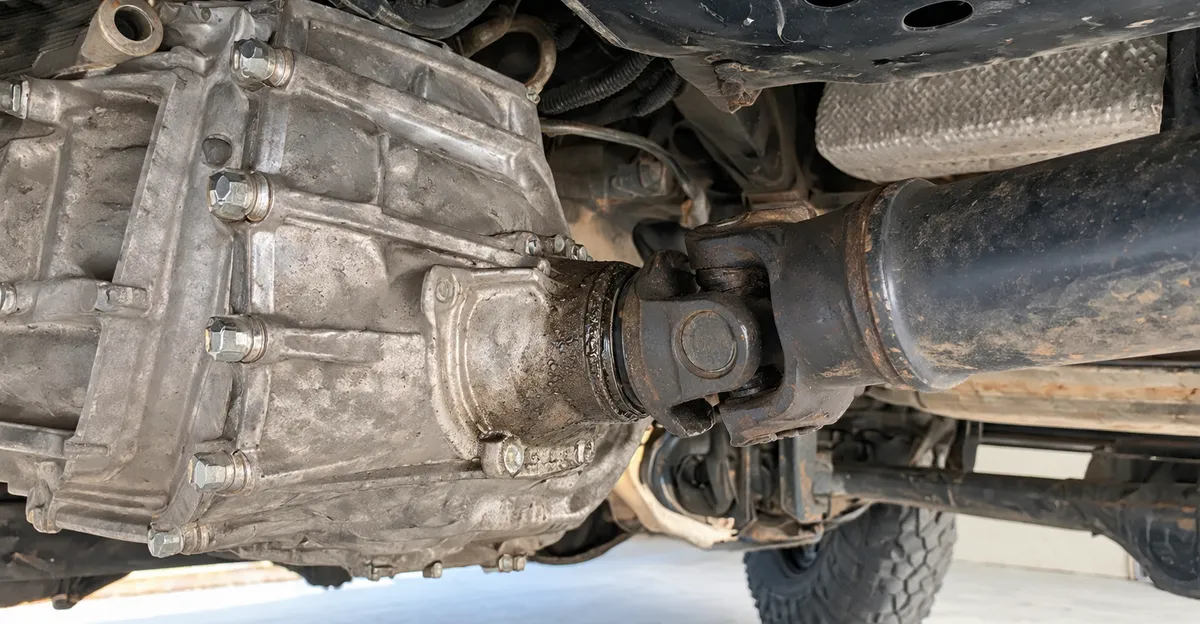
- Leak under the center of the truck. CarTreatments says low fluid is one of the most common reasons transfer cases fail early. Color may be reddish, amber, or brown depending on the fluid spec. A slow seep still needs a near-term appointment. A sudden puddle is a tow decision.
- Noise that grows with speed or load. Whine, hum, grind, or clunk that tracks vehicle speed or 4WD engagement belongs on the shop list this week.
- Mode problems. Refusal to enter 4WD, violent clunks, dropping out of 4WD, or staying stuck in 4L after you select 2H are not quirks to ignore on a snow day.
- Binding after you return to 2WD. If the truck still hops in dry parking lots, the case or actuator may not have released.
- Service 4WD / Service AWD message. CarTreatments treats that lamp as a request for diagnosis, not a light to clear and forget. The system may disable 4WD until the fault is fixed.
CarTreatments draws a hard stop line. Arrange a tow instead of limping home when you see heavy sudden fluid loss, grinding or clunking that worsens quickly, violent binding or unexpected mode changes while moving, or a burning smell from under the vehicle. Continuing can destroy the case and, as CarTreatments notes, can also load the transmission output, driveshafts, or differentials. Milder symptoms—a faint hum, occasional hesitation, a slow seep—usually allow a careful drive to a shop the same day, not a week of highway commuting.
If you are already hearing mechanical distress and watching a temperature or power warning, park and sort the engine and drivetrain risks before the next trip.
Fluid Service: The Check Oil-Change Shops Often Skip
Most owners never see the transfer case until it leaks. That is why fluid schedules get missed. Budget Transmission says many manufacturers recommend service every 30,000 to 60,000 miles under normal driving, and they push the short end—or sooner—for regular off-road use, towing, frequent 4WD, extreme temperatures, and hard urban stop-and-go. For serious trail use, that shop suggests checking fluid around 15,000 miles and changing by 25,000 miles. VehicleBar cites a common change window of 30,000 to 50,000 miles and notes special fluids such as GM Auto-Trak II or Ford Mercon LV on some applications. CarTreatments echoes the 30,000-to-60,000-mile band while stressing that the owner's manual may specify longer intervals, shorter severe-service intervals, or inspection-only rules.
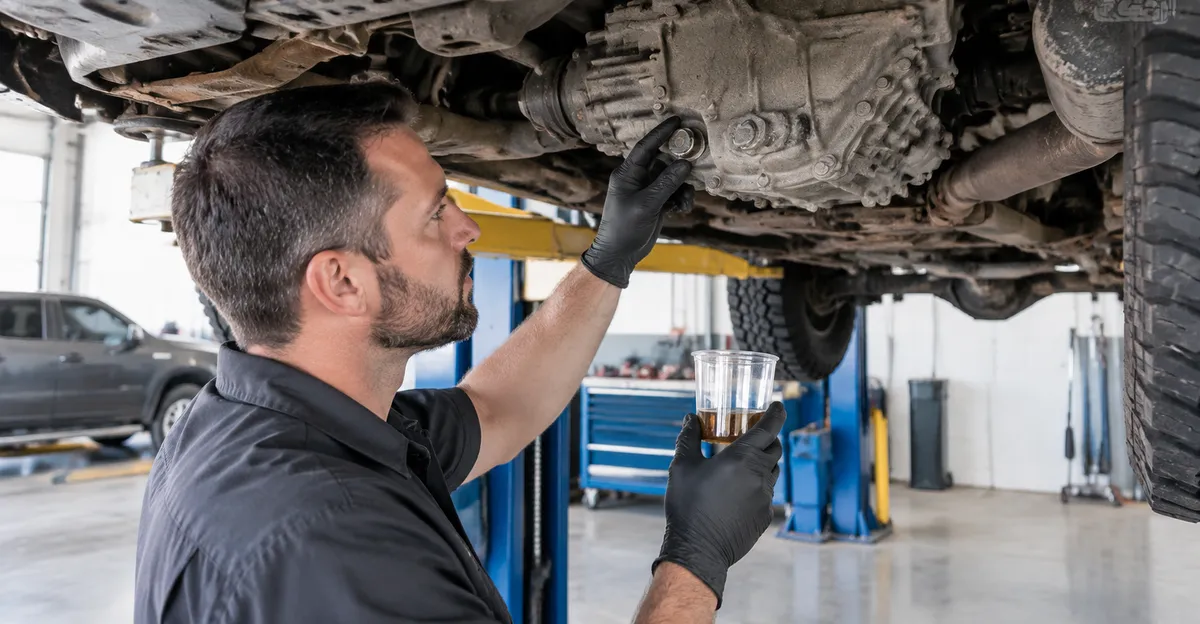
Ask for the service by name. Driving.ca's transfer-case fluid guidance (useful as shop practice even for US drivers) notes that many oil-change outlets do not check transfer-case level by default because most cases have no dipstick and need a plug removed. Put the request on the write-up sheet: inspect transfer-case fluid level and condition, and service per the manual.
Fluid condition cues from CarTreatments and Budget Transmission:
- Healthy fluid is often reddish or light brown and relatively clear.
- Dark, burnt-smelling fluid points to heat and wear.
- Milky fluid suggests water contamination—deep water, a bad vent, or pressure washing aimed at the vent.
- Glitter or heavy metal on the magnetic drain plug means internal wear is already underway. A light dusting of fines can be normal; chunks are not.
AMSOIL stresses that the lubricant must match the hardware: extreme pressure and heat protection for gears and chains, and the right friction characteristics for synchromesh or clutch-style automatic cases. Using the wrong bottle because it was cheaper at the counter is a common way to buy shudder and seal problems. Match the specification in the owner's manual or the OEM fluid label, not the color of the bottle on the shelf.
DIY is possible on older trucks with clear drain and fill plugs. Budget Transmission agrees the drain-and-fill job is mechanically simple, then lists why many owners still use a shop: diagnosis of metal and smell, correct fluid choice, lift access, and a paper trail for warranty or resale. VehicleBar ballparks a shop fluid change around $150 to $300, or roughly $40 to $80 in parts for a careful DIY, with the usual caveat that region, fluid type, and labor rates move those numbers. Treat every dollar figure online as approximate, not a quote for your ZIP code.
If you already track how to check car fluids under the hood, add this underbody item to the same maintenance habit. Oil, coolant, and brake fluid do not replace transfer-case service.
Repair Versus Replace When the Quote Arrives
Once a shop confirms the case is sick, you still have a money decision. CarTreatments separates targeted repairs from overhauls and full replacements. Minor work—output seal, leak repair, shift motor—often lands roughly in the $200 to $600 range depending on the vehicle and labor time, though VehicleBar's seal and actuator ranges can run higher when the case must come down. A full overhaul commonly runs about $1,000 to $2,500. Remanufactured replacement plus labor for many passenger trucks and SUVs often falls near $1,800 to $4,000, with heavy-duty or complex vehicles pushing higher. VehicleBar's 2026-oriented ranges put fluid service near $150 to $300, seal jobs from a few hundred dollars upward, actuators roughly $350 to $900 total, rebuilds about $1,000 to $2,000, and complete replacement commonly $1,700 to $5,000 or more when OEM parts enter the picture.
None of those bands is a promise. Labor rates, parts availability, and whether the transmission must be supported or removed change the invoice. Ask for a written line-item quote that separates diagnosis, fluid, seals, actuator, reman unit, and labor hours.
Decision filters that keep you from paying twice:
- Age and mileage of the rest of the drivetrain. CarTreatments notes that on a high-mileage truck, an overhaul that costs nearly as much as a reman unit is rarely the better value if other internals are equally tired.
- Cause of failure. A single failed shift motor with clean fluid is a different repair from a dry case full of metal. Fixing only the motor after starvation often returns you to the bay.
- Collateral damage. CarTreatments warns that a binding or low-fluid case can stress the transmission output and related parts. If the shop only quotes the case, ask whether they inspected the output seal area, driveshaft yokes, and nearby differentials.
- Warranty on the part. Reman units usually include a parts warranty. DIY fluid top-offs do not. Keep invoices.
If the truck is otherwise sound and you need 4WD for winter or work, replacement with a warrantied reman is often cleaner than stacking small repairs. If you rarely leave pavement and the case only failed because a seal wept, a targeted seal and fluid service may be enough—after the shop proves internals are still quiet and free of heavy debris.
Practical Checklist Before Your Next Trip
Put the decisions in order so the glossary does not bury the action:
- Confirm you actually have 4WD or AWD hardware.
- Learn which modes your manual allows on pavement and which require snow, mud, or a full stop.
- Ask for transfer-case fluid inspection at the next oil change if the mileage is near the manual's interval.
- Treat center-underbody leaks, new whines in 4WD, binding in 2WD, and Service 4WD lamps as shop work—not wait-and-see items.
- Tow when fluid loss is heavy, noise escalates fast, or the driveline binds violently.
- When you get a quote, compare repair scope to reman replacement against the truck's age, not against the cheapest internet number.
A transfer case is not mysterious once you stop treating it like a vague "4x4 box." It is the splitter that makes multi-axle drive possible, the reason a part-time truck must leave locked 4WD on dry asphalt, and one of the easiest expensive parts to neglect because it has no friendly under-hood dipstick. Handle the mode rules and the fluid schedule, and most of the drama never starts. Ignore both, and the first lesson is usually a puddle and a four-figure estimate.
FAQ
what is the transfer case on a car
what is the transfer case on a car, in plain terms, is the gearbox after the transmission that routes torque to the front axle, the rear axle, or both. Wikipedia's definition matches that job on 4WD, AWD, and other multi-axle vehicles. If your car is strictly two-wheel drive, you are looking for a different part.
Does every car have a transfer case?
No. Two-wheel-drive cars without a second driven axle do not use one. Look for 4WD, 4x4, or AWD badging, a mode control, or the underbody case behind the transmission before you buy fluid or authorize transfer-case labor.
Can I drive in 4WD on dry pavement?
Avoid locked part-time 4WD on dry pavement. Wikipedia and AMSOIL both warn that locked or low-range modes that do not allow proper axle speed difference can bind the driveline on dry roads. Use those modes for low-traction surfaces, then return to 2H or the automatic AWD setting the maker intends for pavement.
How often should transfer case fluid be changed?
Follow the owner's manual first. Shop guidance from Budget Transmission commonly cites 30,000 to 60,000 miles for normal use, with shorter intervals for towing and off-road work. VehicleBar's similar 30,000-to-50,000-mile window is a planning range, not a universal rule. Ask the oil-change counter to include the transfer case; many shops skip it unless you request it.
Is a transfer case the same as a differential?
No. The transfer case manages front-to-rear power. Differentials manage left-to-right wheel speed on each axle. Advance Adapters and VehicleBar both use that split when explaining diagnosis. You can have both parts on the same truck, and they fail for different reasons.
Should I keep driving with a transfer case leak or grinding noise?
Not when the leak is heavy, the noise is escalating, the truck binds or jumps modes, or you smell burning underneath—CarTreatments says tow in those cases. Milder symptoms still need prompt diagnosis because low fluid destroys the case from the inside while the dash may stay quiet.