
By Automotive Research TeamUpdated 2026-09-29
Why Is My Car Overheating
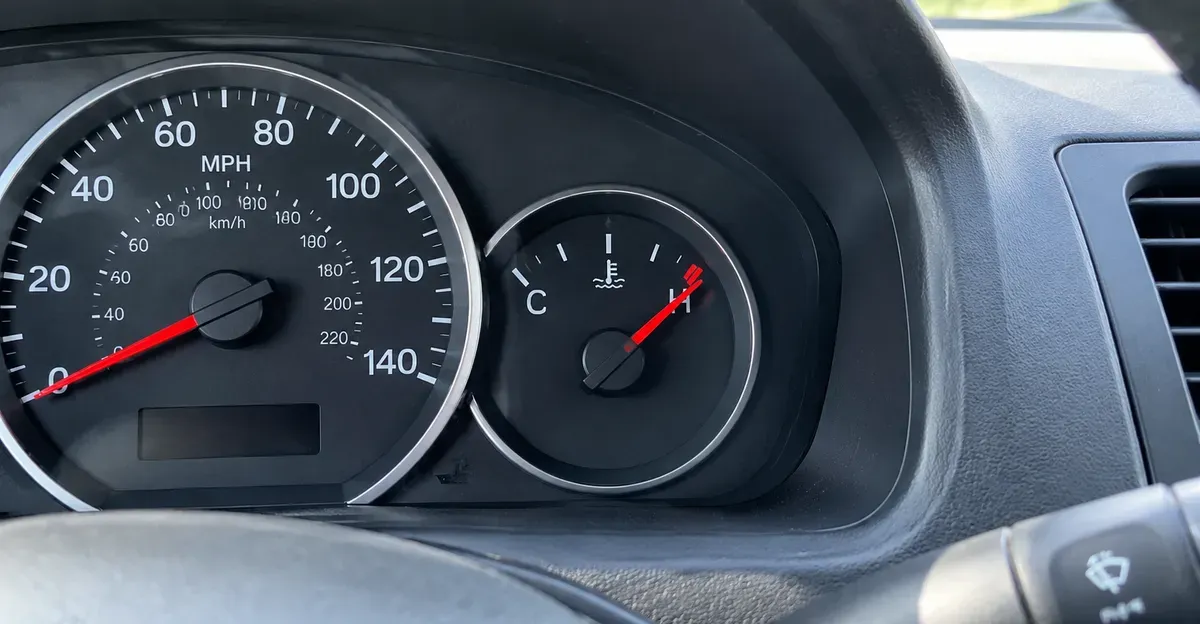
Why is my car overheating is a stop-driving question first and a parts list second. Firestone Complete Auto Care describes the stress of steam under the hood or a temperature gauge creeping into the red, whether you are stuck in traffic or cruising on the highway. Oil Changers frames the same moment as a sudden climb into the red zone with steam starting to escape. The shared advice from those shop pages is the floor of this guide: recognize the signs, protect yourself and the engine in the next few minutes, then sort causes by pattern instead of guessing a single part from a parts-store aisle.
This guide is for US drivers who need a clear next move. It starts from what Firestone, Oil Changers, and Telle Tire already agree on, then answers the decisions those pages usually leave hanging once the gauge is already climbing: stop versus limp, sudden failure versus a slow leak, idle heat versus heat while driving, and a full coolant bottle that still runs hot.
Stop Now or Try to Reach a Shop
The shared floor is blunt. Firestone Complete Auto Care says do not keep driving an overheating engine because continued heat can warp cylinder heads, crack the engine block, and cause irreparable damage. Oil Changers says it is generally unsafe to keep driving and that you should pull over and address the issue immediately. Telle Tire adds the roadside risk: a parked car on a shoulder still needs hazard lights and space from traffic.
Turn the A/C off and set the heater to maximum as soon as the gauge or warning light says the engine is too hot. Firestone and Telle Tire both describe that step as a way to pull heat away from the engine into the cabin until you can stop. It can make the cabin uncomfortable. That discomfort is cheaper than a head gasket or a cracked block. Find a safe place to pull over, shut the engine off, and wait. Firestone wants at least 15 to 30 minutes before you open the hood. Telle Tire notes that some cars need roughly half an hour when the gauge is hard to read with the key off. Do not open the hood into steam. Do not pour cold water on a hot engine; Firestone warns that a sudden temperature shock can crack parts.
The original decision those lists leave open is how far you may drive after a cool-down. Use this rule of thumb, not a guarantee:
| Situation after cool-down | Safer next move | Why |
|---|---|---|
| Gauge returns to normal, no steam, reservoir not empty, shop is a few miles on quiet roads | Short limp with constant gauge watch | Firestone allows a careful restart and a direct drive to a shop if the car is not being towed, with an immediate pull-over if the gauge rises again |
| Gauge climbs again within minutes, steam returns, or you smell sweet coolant strongly | Tow | Oil Changers and Firestone both treat repeated overheating as damage in progress, not a commute to finish |
| Reservoir empty, puddle under the car, or hose visibly split | Tow | Topping off without stopping the leak only resets the clock |
| No tow option, rural highway, gauge stable after a full cool-down | Short limp only if you carry coolant and stop the moment the gauge rises | Telle Tire still prefers a tow when you do not want to risk further damage |
If a warning light for temperature is on with steam, treat that as a stop, not a debate. If power collapses, the Check Engine light flashes, or you smell fuel or burning plastic with the heat, stop when safe and arrange a tow. For power loss that rides along with heat, see why would my car lose power while driving.
When It Happens, What It Usually Means
Firestone Complete Auto Care summarizes overheating as heat that cannot escape the engine compartment because something in the cooling system failed. Its short cause list includes low coolant, a cooling-system leak, a bad radiator fan, a faulty water pump, low engine oil, and thermostat failure. Oil Changers expands that list to ten common reasons: low coolant, faulty thermostat, bad water pump, blocked or leaking radiator, radiator fan issues, broken hoses, clogged coolant pathways, engine oil problems, heavy loads or towing, and extreme weather. Telle Tire adds that overheating with the A/C on often points at a fan, fan switch, fan motor, coolant sensor, overloaded compressor, water pump, or blocked condenser fins.
Those lists are the floor. The original synthesis for a US driver is a pattern table you can use before anyone quotes parts:
| When the heat shows up | Likely direction | First check after a full cool-down |
|---|---|---|
| Gauge climbs after months of ignoring a slow drip | External leak (hose, clamp, radiator, water pump weep) | Look under the car and along hoses for dried coolant trails; check reservoir marks cold |
| Overheats in traffic, improves on the highway | Radiator fan or fan circuit | Listen for the fan with the engine warm and A/C on in Park; no airflow through the radiator at idle is a clue |
| Spikes soon after a cold start of a short drive | Stuck-closed thermostat | Oil Changers notes a quick spike after you start driving as a thermostat pattern |
| Reservoir keeps falling between weeks | Leak or internal path (head gasket / crack) | AAA-style fluid advice in related guides: frequent top-ups mean a shop visit, not another casual fill |
| Full reservoir, brown coolant, floating particles | Contaminated or overdue coolant | Mercury- and AAA-style fluid checks treat dirty coolant as a change and flush candidate, not a top-off |
| Heat plus milky oil or white exhaust smoke that smells sweet | Possible head-gasket or internal leak path | Stop driving; pressure-test and combustion-gas checks belong at a shop (engine repair) |
| Heat mainly while towing or climbing in summer | Load and ambient stress on a marginal system | Oil Changers links heavy loads and hot weather to overheating when the cooling system is already weak |
Do not buy a thermostat, a fan, and a water pump in one cart because a list named all three. Pattern first. Then one test. Firestone’s point about a water pump impeller that no longer moves coolant is useful here: without flow, temperature climbs fast even if the bottle still shows liquid.
Why Is My Car Overheating All of a Sudden
Why is my car overheating all of a sudden usually means a sudden change in coolant flow, coolant volume, or airflow—not a mysterious new thermodynamics problem. Oil Changers opens with the sunny-day scene where the gauge shoots into the red and steam appears. Firestone’s cause list explains how that can happen in one trip: a hose finally splits, a thermostat sticks closed, a water pump impeller fails, a fan stops, or a leak that was slow becomes a puddle.
Ask three questions before you invent a rare cause:
- Did the reservoir drop since the last time you looked? A sudden empty bottle after a drive often means a hose, radiator, or pump seal failed under pressure. Check only when the engine is cold enough that you can touch the radiator tank without pain. Never open a hot radiator cap.
- Did the heat arrive with a new noise? A whining water pump or a silent fan when you expect airflow is more useful than a generic “engine noise” note. Oil Changers lists puddles near the front of the engine and whining among water-pump signs.
- Did the heat arrive with A/C use or stop-and-go traffic? Telle Tire and Oil Changers both point fan issues when idle and traffic heat dominate.
Sudden overheating after a recent coolant flush, hose job, or thermostat replacement deserves a different sentence at the counter: “It started the day after cooling work.” Air trapped in the system, a clamp that was not seated, or a thermostat installed backward can create a sudden return of heat even when the new parts look correct. Say that history out loud. It shortens the diagnostic path.
Sudden heat after months of normal gauges is still an emergency for the engine, even if the car “still runs.” Firestone’s do-not-keep-driving rule does not soften because the failure felt abrupt. Abrupt often means a part finished failing under load. Finish the cool-down, document steam versus smoke, and decide limp versus tow with the table above.
Idle Heat Versus Heat While Driving
Why is my car overheating at idle
Why is my car overheating at idle is the classic radiator-fan pattern when the gauge climbs in traffic, in a drive-through, or at a long light, then settles once you are moving again. Oil Changers states that temperature may rise only when you are not moving and stabilize at higher speeds when the fan is the problem. Telle Tire says the same in plainer words: overheating when idle that seems to cool once you begin moving can be a broken radiator fan, because highway airflow can mask a fan that no longer pulls air through the radiator.
Confirm the pattern before you buy a thermostat. After a full cool-down and a short warm-up in a safe parking lot, set the parking brake, put an automatic in Park, turn the A/C on, and listen for the fan. Many cars command the fan on with A/C. If the radiator stays quiet and the gauge climbs while you sit still, put fan circuit, fan motor, and fan clutch (on older mechanical setups) at the top of the shop list. If the fan is clearly running and the gauge still climbs at idle with a full cold reservoir, look next at restricted airflow through a clogged condenser or radiator, low oil as Firestone lists, or a pump that is not moving coolant even though the bottle looks fine.
Idling with the A/C on in summer heat is a stress test, not a personality flaw. Oil Changers notes that extreme weather pushes a weak cooling system. The decision is whether the fan and coolant loop can reject heat without ram air. If they cannot, stop-and-go commuting will keep repeating the idle spike until the fan or the restriction is fixed.
Why is my car overheating while driving
Why is my car overheating while driving points more often at flow, thermostat, radiator capacity, or a leak that worsens under pressure than at a fan that only fails when stopped. Oil Changers ties a quick temperature spike soon after you start driving to a faulty thermostat that holds coolant back. Firestone’s water-pump and hose sections cover failures that show up once the system is hot and pressurized on the road. A blocked radiator or clogged pathways, which Oil Changers lists separately, can climb under sustained load even when the fan works at idle.
Sort driving heat by load. Heat only on long grades, towing, or with a full cabin of passengers matches Oil Changers’ heavy-load note. Heat on a level highway with light load and a full reservoir points harder at thermostat, pump, or internal restriction. Heat that returns every few miles after each cool-down and top-off is a leak or a failed component, not “summer weather.” Weather can tip a marginal system, but weather alone is not a diagnosis you should accept without a pressure test.
If the gauge climbs while you are already moving and the cabin heater trick does not buy you enough time to reach an exit, pull over. Highway speed does not make Firestone’s warping-and-cracking warning optional. A short limp after a full cool-down is still a gauge-watched decision, not a right to finish a two-hour interstate run.
When the Coolant Bottle Looks Fine
Drivers often search for overheating with a full bottle because the popular advice stops at “check coolant.” Firestone lists low coolant as a leading cause, and that advice is correct when the level is low. Oil Changers’ clogged-pathways item is the follow-up those pages raise and then leave thin: the gauge can climb even when you have enough coolant if circulation is blocked, the thermostat stays closed, the water pump is not moving fluid, or the fan is not removing heat at the radiator.
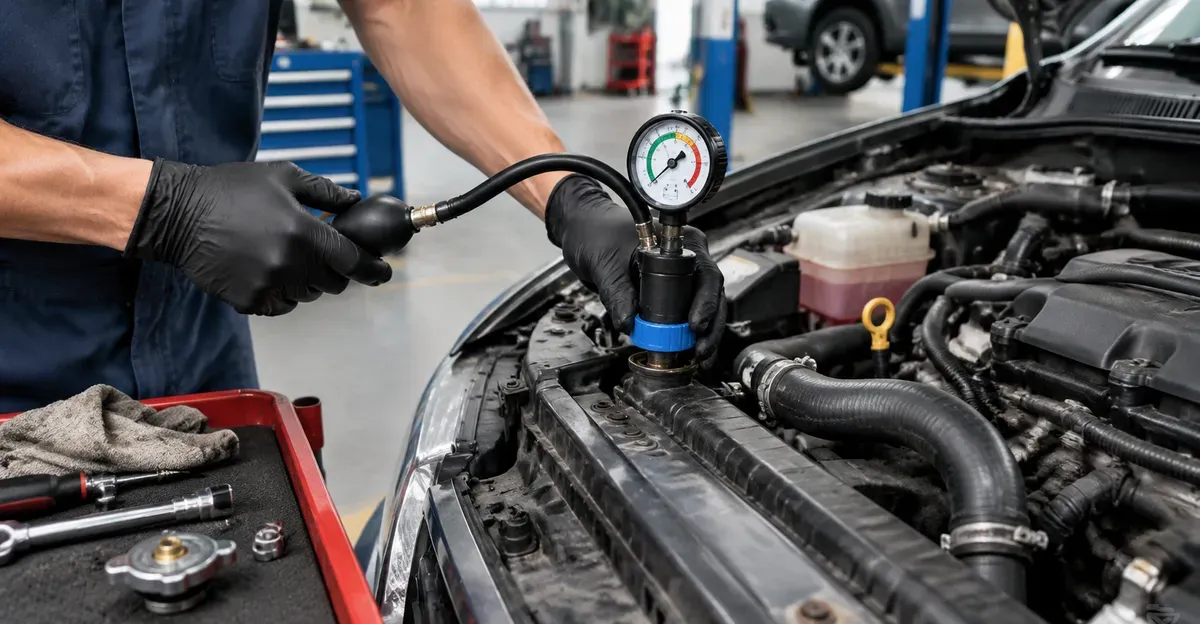
A full cold reservoir does not prove the system holds pressure on a hot drive. Hoses can leak only when hot. A radiator can seep at the tanks. A head gasket can push combustion gas into the cooling system so the bottle looks full while pockets of gas stop circulation. Those are shop tests: cooling-system pressure test, combustion-gas check in the coolant, thermostat operation, pump inspection, and fan command with a scan tool when needed. Adding more fluid to a full bottle does nothing useful and can overflow.
Brown coolant, oily sheen, or particles floating in the reservoir change the job from “top off” to “flush and find why.” Oil Changers links neglected flushes to blockage. Color alone does not name the brand of coolant you must use; the owner’s manual does. Mixing types because the color looked close is a common way to create sludge that then looks like a mystery overheating problem.
If the bottle is full and the oil is milky, or white sweet-smelling exhaust appears with the heat, treat that as an internal path until a shop proves otherwise. That pattern belongs with engine diagnosis, not with another gallon of premix in the trunk. See engine repair for how shops sort gasket and casting failures after overheating evidence shows up.
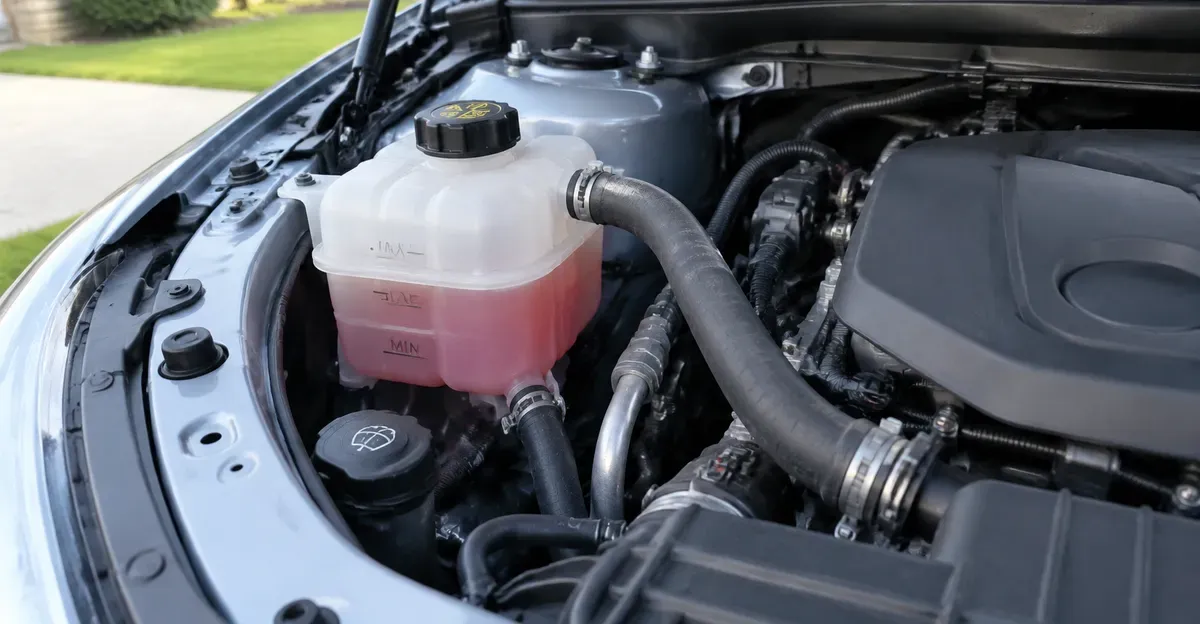
For ordinary level checks between trips, use a cold engine and the translucent reservoir marks the way consumer fluid guides describe. Do not open a pressurized cap to “make sure.” If you need a refresher on cold versus hot checks across under-hood fluids, see how to check car fluids.
Roadside Checks Versus a Required Tow
After the engine has cooled, Firestone allows a visual coolant-reservoir check and a careful top-off only when the gauge shows cool—not merely “normal”—and you have the correct coolant available. Telle Tire likewise says refill antifreeze only after cool-down if the tank is empty or low, and to inspect hoses for leaks or blockages. Both pages still want a root-cause visit; topping off is a bridge, not a repair.
Safe roadside checks when the metal is cool enough to approach:
- Read the translucent reservoir against COLD marks. Photograph the level for the shop.
- Look under the front of the car for bright or crusty coolant trails without touching hot parts.
- Glance at visible upper radiator hoses for splits, wet clamps, or ballooned soft spots.
- Note whether steam smelled sweet (coolant) versus oily or rubber-like (oil or belt), which Firestone lists among smell cues.
Required tow, not another restart:
- The gauge returns to the red within a short drive after cool-down.
- You cannot safely add coolant because everything is still steaming or the cap area is still dangerous.
- Oil is milky, white exhaust is heavy, or the engine is knocking after the heat event.
- You are on a shoulder where restarting and re-entering traffic is more dangerous than waiting for a tow.
Do not ignore the issue because the gauge looks fine after a gallon of water from a gas station. Firestone says an overheating problem will not resolve itself even if it seems fixed after you add a little coolant. Water can be an emergency bridge in some manuals’ guidance for a short limp, but it is not a substitute for the correct mix, and it does not close a leak. Get the car on a rack.
What the Shop Will Test and What It May Cost
Expect the shop to start with the pattern you write down: idle versus highway, sudden versus gradual, A/C on or off, towing or not, and whether the reservoir was empty. A competent cooling diagnosis usually includes a cold visual inspection, a pressure test of the cooling system, a check of fan operation, thermostat behavior, and, when internal failure is suspected, a test for combustion gases in the coolant. Firestone’s Complete Vehicle Inspection pitch is marketing, but the underlying idea matches the need: find the root cause instead of repeating top-offs.
Approximate US retail ranges vary widely by vehicle, region, and whether the job is a clamp or a head gasket. Treat these as order-of-magnitude planning numbers, not quotes:
| Repair direction | Rough parts-and-labor ballpark | Notes |
|---|---|---|
| Thermostat | Often a few hundred dollars on many passenger cars | Oil Changers calls it relatively simple compared with pump or radiator work; complexity still depends on packaging |
| Radiator fan or fan motor | Often a few hundred to around a thousand dollars | Electrical diagnosis may add diagnostic time |
| Water pump | Often several hundred to well over a thousand dollars | Timing-belt engines can bundle pump with belt service |
| Radiator or major hose set | Often several hundred to around fifteen hundred dollars | Plastic-tank radiators crack; labor rises with bumper or condenser access |
| Head gasket or cracked casting after severe overheat | Often thousands of dollars | This is why Firestone and Oil Changers treat continued driving as expensive |
Ask for the failed test in writing: “Failed pressure test at upper hose,” “No fan command with A/C on,” “Combustion gas positive in coolant.” A finding sentence is how you avoid paying for three guesses. If the shop only wants to “try a thermostat” with no test plan on a car that overheats only at idle with a silent fan, ask why the fan circuit is not first.
Maintenance that reduces repeat events is ordinary: correct coolant at the interval the manual names, hose and clamp inspection, oil at the correct level, and respect for towing limits. Oil Changers and Telle Tire both push routine cooling and oil checks before summer heat and long trips. That prevention list is shared industry advice. The decision you still own after an event is whether the next drive is a short limp to that inspection or a tow that protects the block.
FAQ
why is my car overheating when i have coolant
Oil Changers notes that clogged coolant pathways can make the temperature gauge climb even when the reservoir looks full, and a stuck thermostat or failed water pump can do the same. Firestone Complete Auto Care lists low coolant as one cause, not the only one. A shop pressure-tests for leaks you cannot see and checks fan, thermostat, and pump before you keep topping off.
Can I keep driving if the temperature gauge is in the red?
Firestone Complete Auto Care says not to keep driving while the engine is overheating, because continued heat can warp cylinder heads, crack the block, and cause irreparable damage. Oil Changers gives the same rule: pull over and address the issue instead of finishing the trip. Tow when the gauge returns to the red after a cool-down.
Why does my car overheat in traffic but cool down on the highway?
Oil Changers ties that pattern to radiator fan problems: temperature rises when you are not moving and stabilizes at higher speeds. Telle Tire makes the same point for overheating at idle that improves once you are moving. Have the fan, fan relay, and fan motor checked before you assume the thermostat is the only fault.
How long should I wait before opening the hood?
Firestone Complete Auto Care recommends waiting at least 15 to 30 minutes after you shut the engine off, and watching the temperature gauge settle before you open the hood. Telle Tire says some cars need up to about 30 minutes if the gauge is hard to read with the key off. Never remove a radiator cap on a hot engine.
Should I turn the heater on when the engine is overheating?
Yes, as a short bridge to a safe pull-over. Firestone and Telle Tire both advise turning the A/C off and setting the cabin heat to maximum so heat moves away from the engine bay into the cabin until you can stop. It is not a repair. Once you are parked, shut the engine off and let it cool.