
By Zeng FengMyCarWhy EditorialUpdated 2026-10-03
How Do You Open a Car Bonnet (Hood Latch)
How do you open a car bonnet when the panel will not move is a sorting job before it is a pull-the-lever job. In U.S. English the same panel is the hood. Bonnet and hood are the same front cover. The decisions that matter are whether you have a normal engine bay or a powered front trunk, whether the cabin release made a clean pop, whether the secondary safety catch is the part that is stuck, how you will hold the panel open without burning your hand on a hot prop rod, and when a silent lever means a broken cable instead of a sticky latch.
You should leave with a first check for the car you are standing next to, not a single universal diagram. Model differences are real. Kia’s U.S. owner manuals show a cabin release, a secondary lever at the front, and a support rod. Ryan’s Auto Care describes the same two-step latch on most passenger cars. T P Auto Repair adds the stuck cases: slack cable, iced seal, grille access, and electric releases that need low-voltage power. Nothing below replaces the hood chapter in your owner’s manual for latch direction, prop-rod hole location, or an emergency power procedure.
Sort What Front Cover You Actually Have
Start by naming the panel. On most gasoline and diesel cars sold in the United States, the front cover is a mechanical hood over the engine. You open it to check oil, coolant, the air filter, or the battery. On many battery-electric cars the front cover is a front trunk, often called a frunk. The screen or key fob may open it. A dead 12-volt system can lock that panel shut even when the high-voltage pack still has charge.
Ask three questions before you hunt for a lever under the dash.
| What you see | Likely cover type | First check |
|---|---|---|
| Cabin pull handle, metal latch at the grille, prop rod or gas struts | Conventional hood | Pull the cabin lever, then the front safety catch |
| Touchscreen Open control for the front trunk, no cable feel in a lever | Powered frunk | Use the app or screen; if dead, find the manual’s emergency 12V steps |
| Engine is in the rear and the front bay holds cargo or a charge port area | Front trunk or service cover | Follow that model’s frunk chapter, not a generic under-dash pull |
| After a crash the leading edge is crushed into the grille | Damaged latch area | Stop DIY; body damage can trap the latch |
If you only need washer fluid or a jump start and you cannot open the panel, the next decision is whether a shop, mobile tech, or body shop should trip the latch. Ordinary roadside lockout help is built for doors, not hoods. A tech who can reach the latch through the grille without creasing paint is safer than forcing a bent panel after a curb strike.
Do not assume a European brand’s “bonnet” chapter changes U.S. latch physics. The wording changes. The two-step catch usually does not. Kia’s English manuals use both bonnet and hood labels depending on the market file; the hardware sequence stays cabin release, secondary catch, then lift.
Find the Interior Release Before You Guess
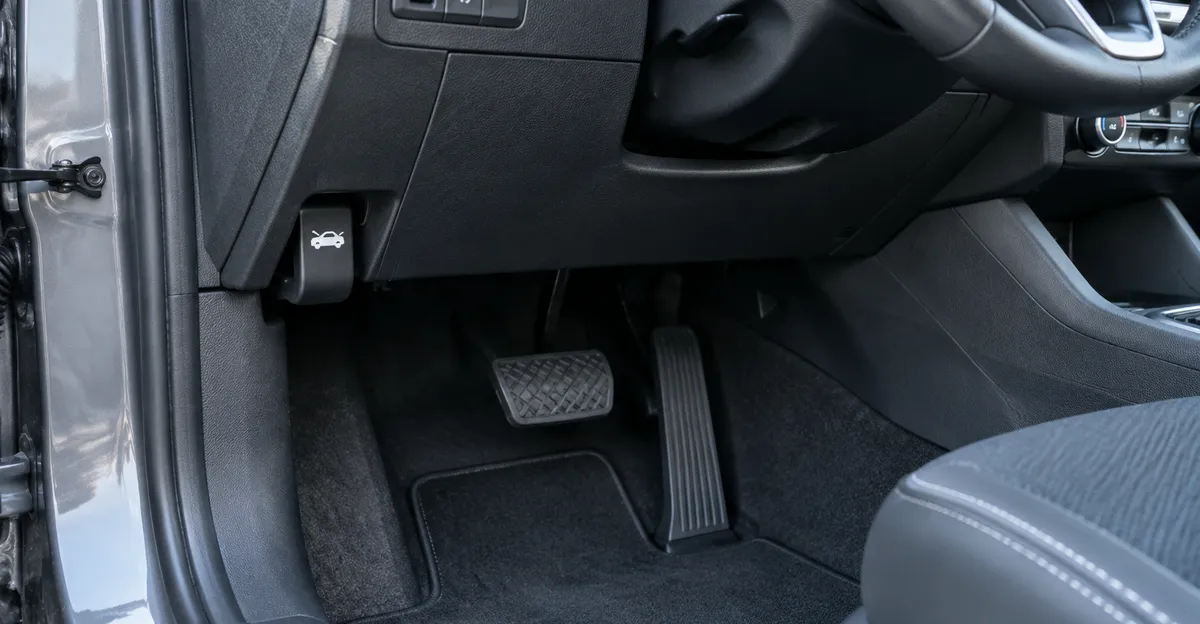
Ryan’s Auto Care places the typical interior release under the dash near the driver’s footwell or toward the left of the steering column. That is the first place to look on most U.S. passenger cars. The handle is often plastic, sometimes marked with a small hood outline, and it pulls toward you rather than up like a parking-brake lever.
If that corner is empty, do not invent a second pull on a random fuse-panel tab. Open the owner’s manual index to Hood, Engine compartment, or Opening and closing. Some cars hide the release farther toward the center stack. Some trucks put a cable handle near the kick panel. A few dual-pull systems use one cabin handle twice so you never fish for a front lever with your fingers.
Work in this order so you do not strip a cable for no reason:
- Confirm Park, parking brake, and a level surface. Kia’s bonnet warnings say to open only after the vehicle is off, in Park, with the parking brake set.
- Clear the driver’s left footwell so your knee is not blocking the handle travel.
- Pull firmly once and listen. A clean pop means the primary latch moved.
- If the handle feels rubbery and bottoms out with no pop, stop guessing at the grille. That feel often means cable stretch or a disconnected end, which T P Auto Repair treats as a different job from a sticky latch.
- If the handle is rock-hard and the hood does not move, the latch may be binding under panel pressure. That is the helper-and-palm-press case in the stuck section below.
Never yank until the handle snaps. A broken inner cable leaves you with a floppy lever and a hood that still will not rise. Replacing that cable after you open the panel from the grille is a normal repair. Breaking the handle end first just adds trim work.
If you rented the car or just bought it, the release location is also a documentation check. A previous owner can relocate a broken handle into a temporary loop of cable. That is not a factory layout. Treat anything that looks homemade as a reason to open the manual before you pull hard.
Did the Latch Pop? Read the Feel
The sound and the handle feel tell you which decision comes next. Treat them as a short diagnostic table, not as personality of the car.
| Cabin feel | What you see at the front | Next move |
|---|---|---|
| Firm pull, sharp pop, leading edge rises a little | Primary latch open, safety catch holding | Reach under the front edge for the secondary lever |
| Firm pull, no pop, edge stays flush | Sticky primary latch or misaligned bump stops | Helper holds the lever; you press the hood center down, then release |
| Soft, long travel, no pop | Stretched or slipped cable | Check the handle end, then grille or under-body access |
| Two distinct pulls on one handle, then free lift | Dual-pull cabin system | Skip fishing for a front catch unless the manual still shows one |
| No lever movement at all | Seized handle pivot or seized latch | Do not force; plan grille access or a shop |
T P Auto Repair notes that some BMW, VW, and Mercedes layouts use two pulls of the interior handle to clear both catches. On those cars, a second pull is not “trying harder.” It is the designed sequence. One hard yank that stops short of the second detent can leave you thinking the latch failed when you simply did not finish the travel.
Ryan’s Auto Care expects a pop before you walk to the front. If you never heard it, standing at the grille and prying the leading edge is the wrong next step. Go back to the handle feel. A hood that never unhooks from the primary latch will not give you a finger gap for the safety catch.
Pressure on the panel matters. Weatherstrip load and collapsed rubber bump stops can keep a worn latch from releasing even when the cable moves. T P Auto Repair’s down-then-up palm cycle is built for that case: press the front center, release, and try the cabin lever again. You are unloading the hook, not beating the paint.
Release the Safety Catch Without Bending the Panel
Once the primary latch pops, the hood should rise only a short distance. The secondary safety catch keeps the panel from flying into the windshield if the primary latch fails on the road. You must move that catch on purpose.
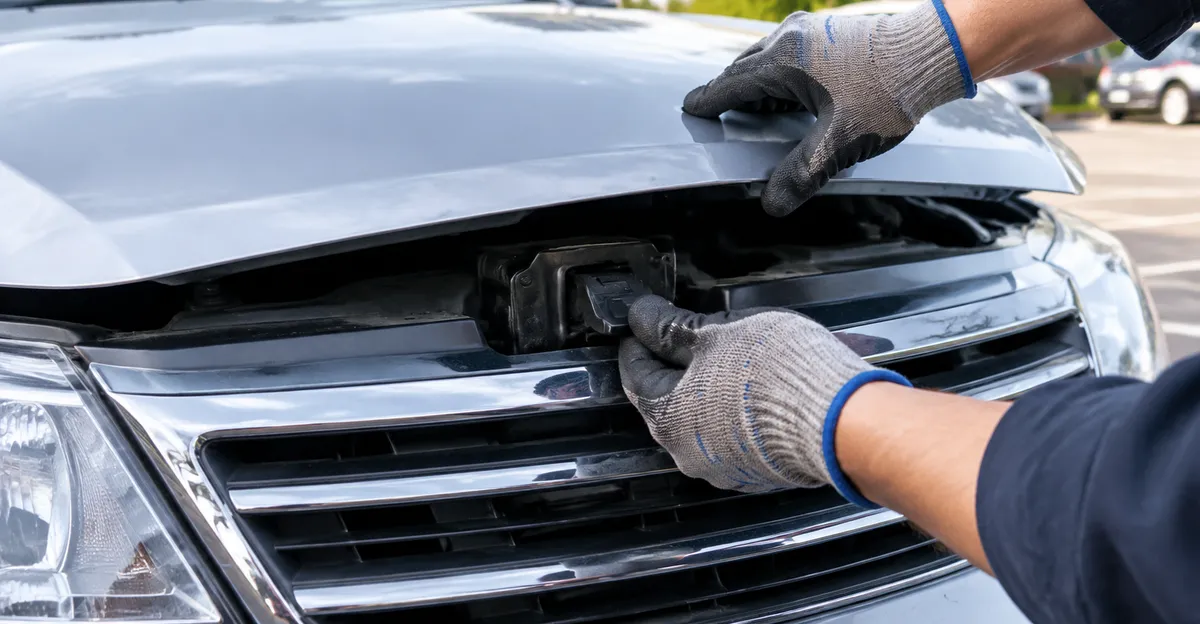
Kia’s U.S. hood chapter for one crossover is concrete: raise the hood slightly, push the secondary hood release lever to the left, then lift. Other cars use a lever you lift toward the sky, or a sliding tab you pull toward the passenger side. The common rule is to feel for a moving piece under the center of the leading edge, or slightly offset toward one headlamp, after the pop.
Stand square to the grille. Slide your fingers under the raised lip. Do not jam a screwdriver into the paint gap as your first move. Ryan’s Auto Care describes one hand on the catch and the other guiding the panel up. If the gap is too small for fingers, a plastic trim tool is kinder than steel.
If the safety catch will not slide:
- Confirm the primary latch is still open. Have a helper hold the cabin release out while you work the front lever.
- Press the hood down slightly to unload the catch, then move the lever again.
- Once open, clean grit from the catch and apply the lubricant your manual allows. Ryan’s Auto Care points to silicone spray or light white lithium grease during routine service.
Do not drive with the hood resting on the safety catch alone. That catch is a backstop, not a closed latch. Kia warns that an incompletely closed bonnet can open while driving and wipe out forward visibility. The same physics applies to a U.S. hood.
After a front-end parking bump, the catch can sit out of line with the grille opening. If the leading edge is wrinkled or the gap is uneven left to right, stop. A body shop can open and align the panel without adding a crease you will pay for later.
Prop Rod or Gas Struts: Hold It Open Safely
Lifting the panel is only half the job. You still need a plan for what holds it while you work.
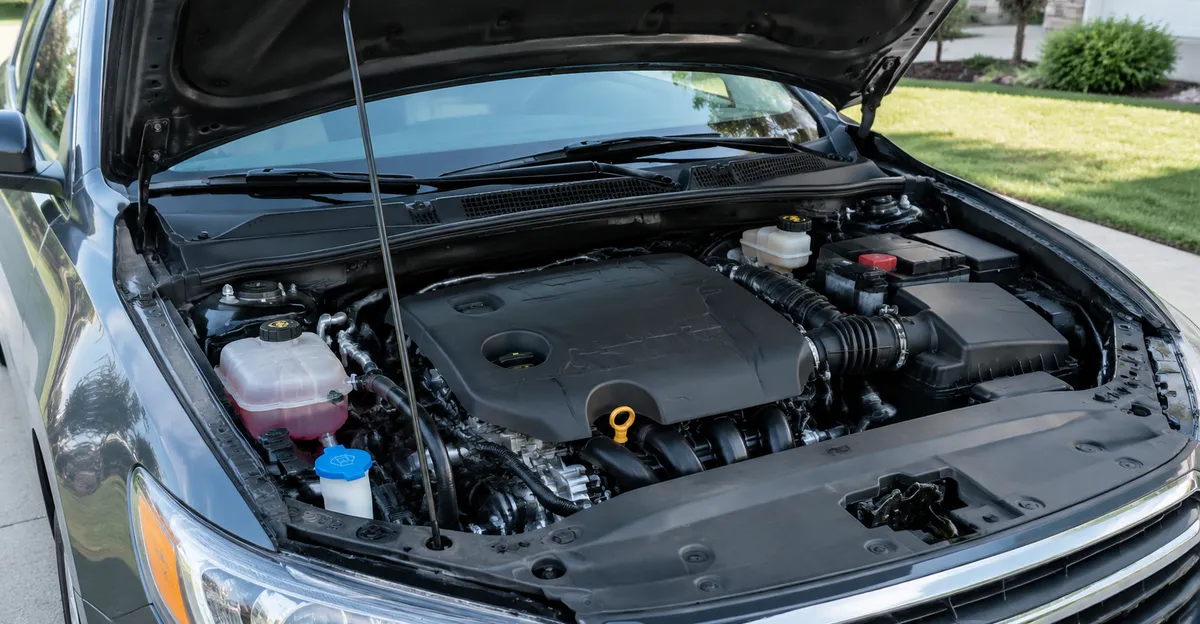
Kia’s support-rod warning is blunt. After you drive, the engine bay and the rod can be hot. Grasp the rubber-wrapped section. Seat the rod fully in the hole provided whenever you inspect the bay. A rod that only rests in the hole can slip and drop the panel on your wrists.
Gas struts change the decision. If your car uses struts, the hood should stay up on its own once past the strut’s lift curve. If it sinks, the strut is weak. Do not trust a sinking hood while you lean into the bay. Prop it with a wood stick only as a temporary shop habit if you know the load path; the safer consumer move is to finish the fluid check quickly or open the panel at a shop that can replace the strut.
Before you close, do the checklist Kia prints for the motor compartment: every filler cap back on, no gloves or rags left on the engine, support rod returned to its clip so it cannot rattle. Combustible cloth left on a hot manifold is a fire path, not a minor mess.
If you opened the hood to chase a smell, a hot radiator, or a battery that will not crank, keep sleeves, jewelry, and loose hair clear of belts and the electric fan. Fans can run after the key is off on many modern cars. Ryan’s Auto Care flags heat at the radiator and exhaust manifold right after a drive. Wait until you can touch nearby plastic without pain before you dig deep.
When the Hood Will Not Open
A stuck hood is several different problems that share one symptom. Sort them before you pry.
Primary latch sticky, cable still firm. Helper holds the interior release. You press the front center with an open palm, then lift. T P Auto Repair repeats a few gentle down-then-up cycles. Once open, clean and lubricate the latch, then check rubber bump stops so the panel still pops a few millimeters on the next release.
Safety catch sticky after a good pop. The gap is there but the lever will not slide. Hold the cabin release out, work the front lever, and plan penetrating oil through the grille if you can aim it at the catch without soaking the air filter. Wait the ten to fifteen minutes T P Auto Repair describes before you force anything.
Interior lever slack. Expect a stretched, slipped, or broken cable. T P Auto Repair’s path is handle-end inspection, then a light through the grille to trip the latch pawl with a long screwdriver or hook tool, then under-vehicle access through the splash shield if the grille is closed. Unbolting the latch is a last resort and needs the hood supported so the panel does not fold.
Ice on the seal. Start the cabin, run defrost, and use de-icer or high-percentage isopropyl along the gap. T P Auto Repair warns against boiling water that can refreeze or hurt paint. Plastic tools along the edge beat metal pry bars.
Powered frunk with a dead 12-volt system. T P Auto Repair notes that many EVs, including Tesla Model 3 and Model Y examples, expose low-voltage jump posts behind a tow-eye cover so a portable booster can release the front latches. Polarity and the exact cover location are model facts. Follow that car’s emergency chapter. Do not invent a cable pull that the car never had.
What not to do. Do not crease the leading edge with a crowbar. Do not pound with a fist. Do not yank the cabin handle until it snaps. Do not reach past a live cooling fan. Do not use open flame to melt ice. Those mistakes turn a latch job into a panel and condenser job.
After a collision that pushed the grille into the latch, roadside or a body shop is the rational call. The latch may be fine and still unreachable without removing bumper covers. Forcing paint gaps on a crushed nose usually makes the repair estimate worse.
Close and Verify Before You Drive
Closing is where drivers create the next emergency. An almost-latched hood can rise at speed and block the windshield. Kia states that risk directly and adds that some models limit speed if the hood switch still sees an open panel.
Use a closing sequence you can repeat:
- Clear tools, caps, and rags from the bay.
- Stow the prop rod in its clip, or confirm gas struts are clear of hands.
- Lower the hood to about 12 inches (30 cm) above the closed position and let it drop under its own weight, matching Kia’s and Ford’s published drop heights in their owner content.
- Try to lift the front edge. If it rises, open and close again with a little more force.
- Look at the gaps left to right. A high corner means the latch on that side did not catch.
Do not slam from shoulder height. You can bend the panel or shock the latch. Do not push only one rear corner and assume the front hooks caught. The verify-by-lift step is the cheap insurance.
If a dash message or chime still says the hood is open after a solid close, believe the switch until you prove it wrong. A misadjusted striker or a failed hood switch can light a warning even when the panel feels shut. That is a shop alignment job, not a reason to ignore the light on a highway entrance.
When you opened the hood to add coolant or oil, close only after the bottles are capped and the funnel is out. Leaving a bottle tip under the strut path is how panels get scratched on the way down.
When to Stop DIY and Call Help
Call roadside assistance or a shop when any of these are true:
- You cannot see the latch clearly through the grille and you are not set up to raise the car safely on stands.
- The cabin handle is dead slack and grille access would require prying painted edges.
- The vehicle uses a powered front latch and the 12-volt system is dark.
- Ice, flood mud, or crash damage has closed the leading-edge gap.
- You need the bay open for a no-start or overheating emergency and every gentle method already failed.
T P Auto Repair’s threshold matches that list: unclear latch, unreachable broken cable, or a complex power latch. A mobile tech with panel-safe tools costs less than a creased hood and a radiator support.
If you got the hood open after a fight, do not close it and drive away without a plan. Lubricate the latch. Confirm the cable end is seated. Book a cable or latch replacement if the handle still feels soft. A hood that barely opens today is a hood that may not open in a parking lot when the battery is dead tomorrow.
Owners who only open the hood twice a year should still treat latch care as part of seasonal service. Ryan’s Auto Care lists cleaning leaves and road grit, then lubricating on the same cadence as other under-hood checks. That habit is what keeps the next “how do you open a car bonnet” search from becoming a tow.
For related under-hood work once the panel is up and propped, use the fluid and filter guides on this site rather than guessing bottle chemistry. Opening and latch issues live under the hood hub; what you do after the bay is open lives under engine.
FAQ
how do you open a car bonnet
Park on level ground, shift to Park, set the parking brake, and shut the engine off. Pull the interior hood release until you hear a pop, then stand at the front, raise the leading edge slightly, move the secondary safety catch, and lift. Kia’s owner manuals describe the same two-step latch and warn you to prop a support rod fully in its hole before working under the panel.
Where is the hood release lever usually located?
Ryan’s Auto Care places most interior hood releases under the dash near the driver’s footwell or toward the left of the steering column. Some German brands use a two-pull cabin handle instead of a separate front safety catch. If the lever is missing on that side, check the owner’s manual index for Hood or Engine compartment before you pry anything.
What if the hood pops but will not lift?
That pattern usually means the primary latch released and the secondary safety catch is still holding. T P Auto Repair tells drivers to have a helper hold the interior release out, press the front center of the hood down with an open palm, then lift and slide the safety lever. Lubricate the catch once the hood is open so the bind does not return.
How do I know the hood is closed before I drive?
Kia’s closing procedure is to lower the panel to about 12 inches (30 cm) above the closed position, let it drop, then try to lift the front edge slightly. If it rises, it is not latched. Open it and close with a bit more force. Kia also warns that an unlatched hood can open while driving and block your view.