
By Automotive Research TeamUpdated 2026-09-28
What Does the Exclamation Mark Mean on a Car
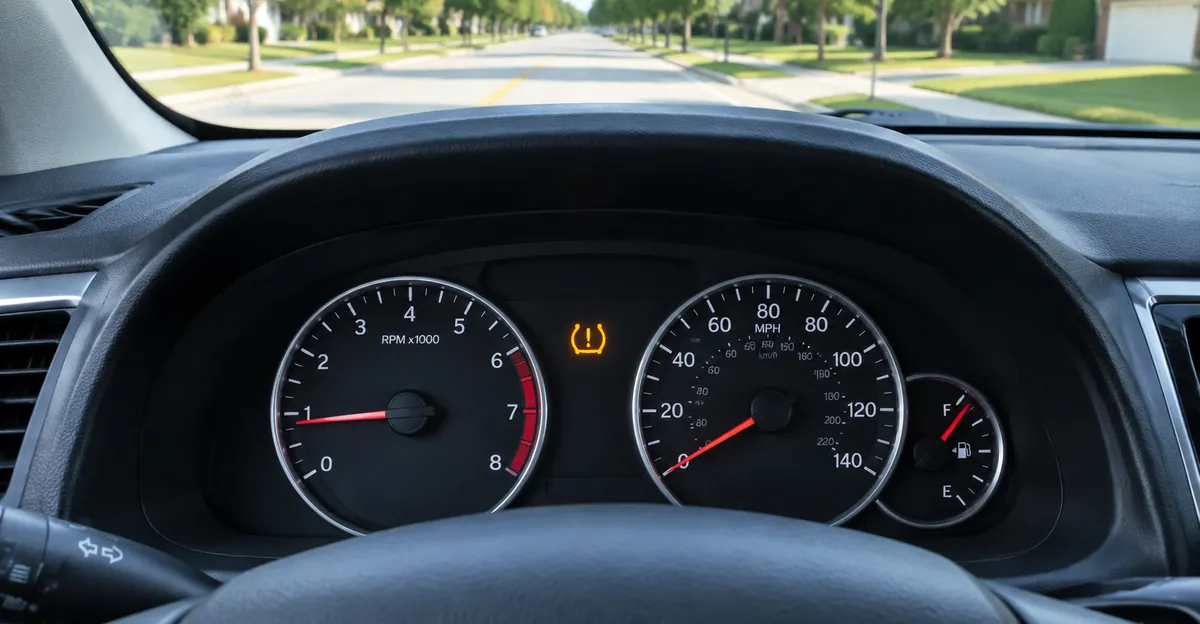
What does the exclamation mark mean on a car is not a single-lamp question. The outline around the mark is the system. A yellow horseshoe is tire pressure. A red circle is the brake circuit or the parking brake. A triangle is a master warning that points at a message. Drivers also type what does the exclamation mark on a car mean when those three shapes sit in the same cluster and look alike from the seat.
You should leave with three decisions: which outline you are looking at, whether this minute is a stop or a short drive to air or a shop, and what to check so you do not buy sensors, brake fluid, or a scan for the wrong lamp. Nothing here replaces the lamp map in your owner’s manual. Approximate pressure and distance figures below come from NHTSA, Continental, Firestone, YourMechanic, Toyota, and dealer service pages, not from a test of your car.
Which exclamation mark you are actually seeing
Ranking pages each pick one meaning and stop. Olson Chevrolet’s TPMS article treats the yellow mark inside parentheses as tire pressure. Firestone’s brake-light article treats a circle with a “P” or a “!” as brakes. Toyota’s warning-light index treats a flashing triangle plus a buzzer as the master warning. The original job from the driver’s seat is to separate those three in about ten seconds before you inflate a tire, pump a pedal, or ignore a triangle.
Look at the outline, not only the “!”.
| Outline you see | Usual name | Color you are most likely to get | First read |
|---|---|---|---|
| Tire cross-section or U-shaped horseshoe with “!” inside | TPMS / tire-pressure warning | Yellow or amber | Low pressure or a TPMS fault |
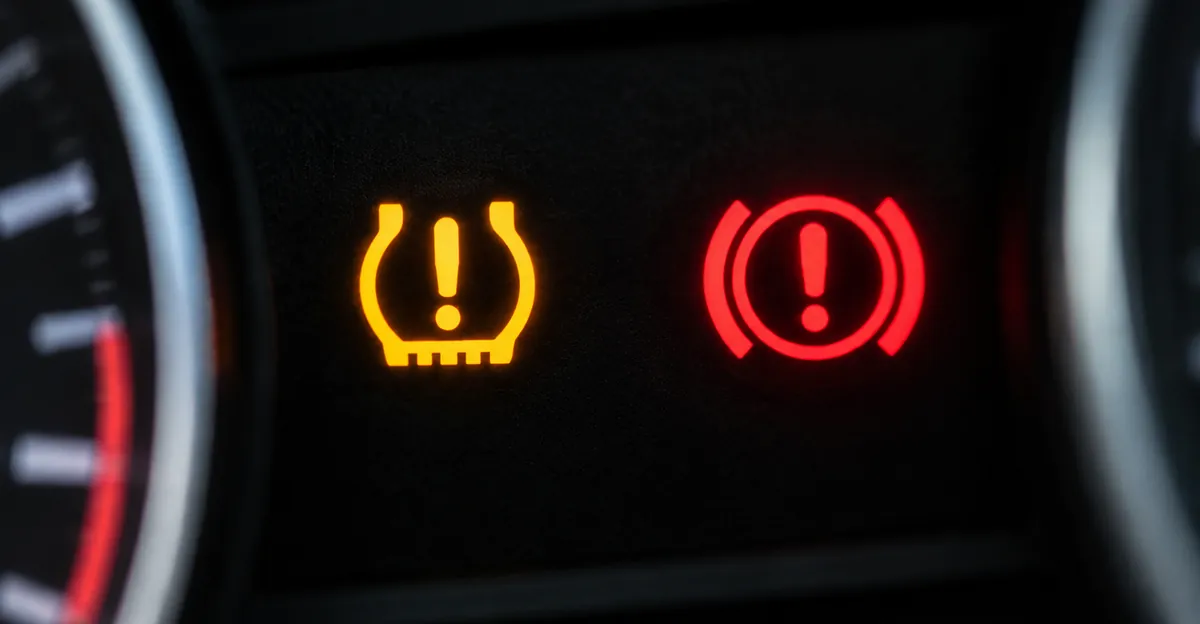
| Circle, often with parentheses, “P”, or the word BRAKE | Brake / parking-brake warning | Usually red; Firestone also describes a yellow circle for low fluid on some cars | Parking brake, low fluid, or a hydraulic fault |
| Triangle with “!” inside, often with a buzzer or a text line | Master / central warning | Amber or red | Read the paired message; do not guess a part |
| Hazard switch on the dash, a physical red triangle you press | Hazard-lamp button | Not a warning lamp | That button turns flashers on. It is not the cluster triangle |
NHTSA’s TireWise TPMS FAQ allows two official low-tire telltales: a tire cross-section with an exclamation mark, or a top view of a car with all four tires shown. Either one means significant underinflation when it stays on. If your lamp is a tiny car from above with four dark tires, it is still TPMS. It is not a master warning.
Toyota’s owner warning-light page adds two nearby lamps that also use punctuation or a similar panic feel. The tire-pressure warning light means low inflation or a malfunction in the tire-pressure warning system. The electric power-steering lamp is a steering-wheel outline, not a bare “!”. If the mark sits inside a wheel, you are in the steering-assist path, not the tire-pressure path. The charging-system lamp is its own symbol. A triangle that names charging in the message is still a master warning pointing at that system, not a reason to ignore a separate battery-shaped lamp on the warning lights page.
The hazard button is the mix-up the triangle pages never close. Many U.S. cars put a red triangle with an exclamation mark on the center stack. That is a switch. The cluster triangle is a telltale. If the flashers are blinking outside the car, you pressed the switch. If the cluster triangle is on with the flashers off, you have a warning. Do not hold the hazard button to “reset” a cluster lamp.
Color is the second sort. Toyota’s same page says yellow icons flag something important that is not always an emergency, and red icons need immediate attention. OBD Advisor uses the same split for the triangle: amber usually allows a short drive if the car feels normal; red, or a triangle next to a brake, coolant, oil-pressure, or charging warning, is a stop. Firestone treats a red brake circle as the dangerous case and a yellow circle as low fluid that still needs a shop soon. Do not treat yellow as optional. Treat it as “this system is already outside its window.”
| What you notice in ten seconds | Likely lamp | Do not do |
|---|---|---|
| Yellow U with “!” and tires that still look round | TPMS | Do not assume the engine is failing |
| Red circle with “!” or BRAKE, parking-brake handle still up | Brake telltale doing its job | Do not drive with the parking brake set |
| Red circle after the parking brake is down, pedal feels soft | Brake hydraulic path | Do not finish the commute “to see if it clears” |
| Triangle plus a readable message | Master warning | Do not buy a part named in a forum thread |
| Triangle, no readable text, car feels normal | Master warning with a missed message | Do not clear it by disconnecting the battery |
If two outlines are on at once, treat the red circle first, then a red triangle, then the yellow horseshoe. A TPMS lamp next to a triangle often means the master warning is repeating the tire message. That pairing is common on Toyota, Nissan, Hyundai, and Kia clusters in OBD Advisor’s make table. It is still a tire check, not two unrelated failures, until a scan says otherwise.
What to do in the first few minutes
The shared advice on those pages is “identify the light, then act by color.” The hanging decision is where you are on a U.S. road when it happens.
If you are in a travel lane, get out of it before you diagnose. Signal, move right, and use a shoulder, exit, or parking lot. Do not stop in a live lane to stare at the cluster.
Then run this order. It is the same three outlines, forced into a sequence so you do not skip the brake lamp because the yellow horseshoe is more familiar.
- Name the outline. Horseshoe, circle, or triangle. Say the color out loud. If you have a passenger, have them read any text line while you keep your eyes on traffic.
- If it is a red circle, check the parking brake before anything else. Firestone says a set parking brake turns that lamp on, and driving against it damages pads and rotors. YourMechanic says a cable that does not fully release can keep the lamp on even after the handle is down, and that constant drag is a tow case for the drivetrain, not a “it will burn off” case.
- If the parking brake is down and the red circle is still on, feel the pedal. A firm pedal with a lamp is still a warning. A pedal that sinks, feels spongy, or needs a long travel is the severe-leak case YourMechanic describes, where the foot brake may not stop the car quickly. That is a stop-and-tow, not a fluid top-off on the shoulder unless the owner’s manual tells you the reservoir is safe to open and you can see a leak-free level between MIN and MAX.
- If it is a yellow horseshoe, look at the wheels before you reset anything. A tire that is already on the rim is not a “drive to the station” case. Continental says pull over immediately for a visibly flat tire, thumping, very heavy steering, burning-rubber smell, or other warning lights with the TPMS lamp. If the tires still look round, a short, low-speed trip to a gauge and an air hose is the path Continental allows.
- If it is a triangle, read the message before you pick a part. Toyota says a buzzer and a flashing master warning mean the master warning system detected a malfunction. OBD Advisor says there is no reset button; the lamp is not an oil-life reminder. If you cannot read the message, do not invent one. Use the later section on an unreadable display.
Highway versus surface street changes the TPMS case more than the brake case. Continental’s TPMS driving note is a short trip under about five miles at low speed, avoiding highway speeds and hard braking, in dry weather, with no visible damage. That is a gas-station hop, not an interstate remaining commute. A red brake circle does not get a five-mile exception. YourMechanic’s rule is to pull out of traffic and check the parking brake and fluid. If you cannot explain the lamp, you do not keep driving on a guess.
A yellow triangle with a washer-fluid or door-ajar line can wait until the next safe stop. A red triangle with a brake, temperature, or charging line cannot. OBD Advisor is explicit on that pairing. Treat the paired lamp as the real urgency, and treat the triangle as the pointer.
Do not disconnect the battery to kill a lamp. That move wipes radio codes and other memory on many cars, and it does not fix underinflation, a leak, or a stored master-warning condition.
The yellow horseshoe: tire pressure, not the engine
The yellow horseshoe is the lamp most U.S. drivers meet first. Olson Chevrolet’s Redwood Falls service desk calls the yellow exclamation mark inside parentheses the Tire Pressure Monitoring System warning. Continental describes the same horseshoe or U as a tire cross-section seen from the front. NHTSA requires TPMS on all passenger cars, light trucks, and vans for model year 2008 and newer, with some 2006 and 2007 vehicles also equipped. Check the manual if the car is that old.
A solid lamp means at least one tire is significantly underinflated. NHTSA tells you to inspect the tires and check pressure as soon as possible, and says the symbol should go out after the tires are properly inflated. Continental and Olson both describe the common trigger as a drop of about 25 percent from the placard: Continental’s example is a 35 psi tire lighting around 26 psi. NHTSA’s public FAQ does not print that percentage. It says “significantly underinflated.” Use the placard, not a forum target.
A lamp that flashes for 60 to 90 seconds at key-on and then stays solid is not the same complaint. NHTSA says 2008 and newer TPMS must warn when the system is not working, and that this flash-then-solid pattern repeats at every start until the malfunction is repaired. Olson describes about a minute of blinking after startup, then a solid lamp, as a sensor or system problem. Continental lists dead sensor batteries, damaged sensors, and electronic faults. Adding air will not clear a malfunction telltale. Do not keep topping a tire that is already at placard pressure because the lamp still flashed at start.
NHTSA also covers the on-and-off pattern that makes people ignore the lamp. On cold mornings the symbol may light briefly and then go out because pressure dipped overnight and rose as the tires warmed. The agency still says you should inspect the tires and check pressure, and that the lamp should not illuminate when the tires are properly inflated. Continental puts the temperature swing at about 1 psi per 10°F. Olson uses about 1 to 2 psi per 10°F. A 40°F overnight drop can move several psi. That is enough to trip a tire that was already a little low in October.
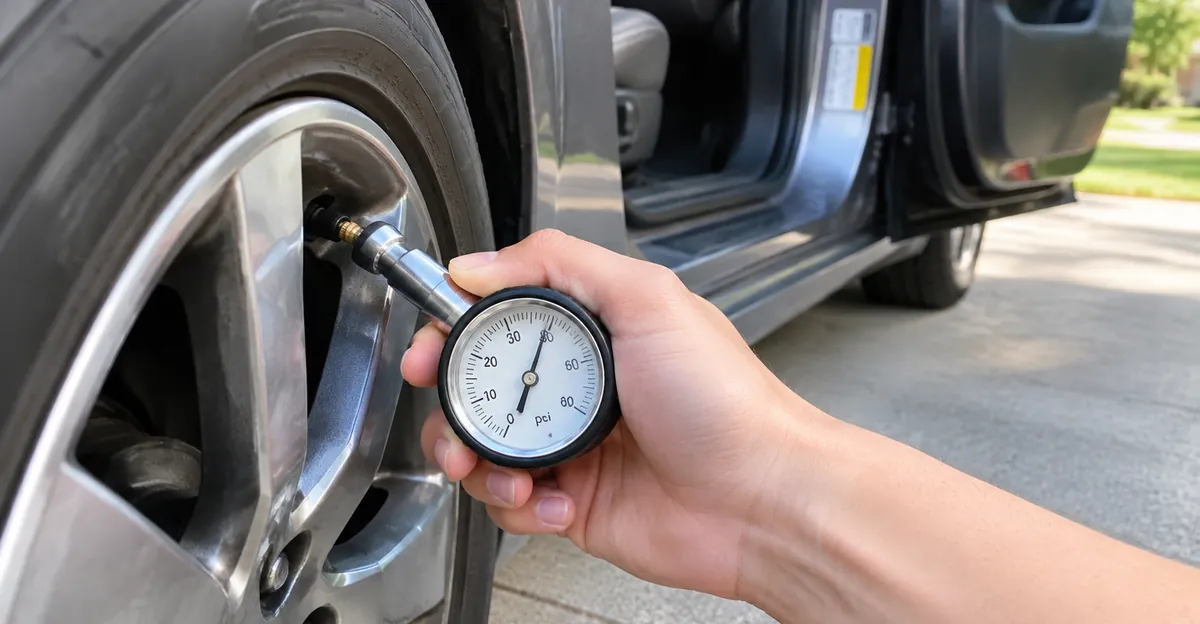
Set pressure from the Tire and Loading Information label on the driver’s door edge or door post, or from the manual. NHTSA is blunt: the correct pressure is what the vehicle manufacturer lists, not the maximum on the tire sidewall. Check cold tires. NHTSA defines cold as not driven for at least three hours. If you already drove and the tire looks low, NHTSA says filling to the cold placard number is still safer than staying significantly low, then rechecking when the tire is cold.
Check all four road tires and the spare. NHTSA’s pressure steps include the spare. Continental notes that some cars monitor the spare, and a forgotten spare that is far below spec can light TPMS even when the four tires you drive on are fine. That is one reason a “mystery” lamp after you just aired the corners still needs a fifth valve stem.
| TPMS pattern | What the fetched pages treat it as | First move |
|---|---|---|
| Solid yellow horseshoe, tires look round | Significant underinflation (NHTSA; Continental’s ~25% example) | Cold gauge; fill to door-jamb psi |
| Lights on a cold start, then goes out | Marginal overnight drop (NHTSA) | Still set cold pressure; do not wait for spring |
| Flashes 60–90 seconds, then stays on, repeats next start | System malfunction (NHTSA) | Do not chase air; plan a sensor or module check |
| Comes back every few days after you add air | Slow leak, puncture, or porous tire (Continental, Olson) | Find the leak; do not only reset |
| After rotation or new tires | Relearn not finished, or a sensor disturbed (Continental, Olson) | Drive the relearn, or use the menu/button the manual names |
Direct TPMS uses a sensor in each wheel. Indirect TPMS infers a low tire from ABS wheel-speed differences. Continental’s distinction matters for what a shop can show you: a direct system can name a corner; an indirect system often cannot. Either way, NHTSA says underinflation is hard to see by eye, monthly gauge checks are the real maintenance, and TPMS is not a substitute for that habit.
A low tire is a wheels problem that happens to use a dashboard telltale. It is not a reason to ignore a separate red brake circle. If both are on, the brake lamp still goes first.
The red circle: parking brake, fluid, or a hydraulic fault
The red circle is the lamp ranking TPMS pages skip and brake pages treat as non-negotiable. Firestone says the brake warning often looks like a red or yellow circle with a “P” or an exclamation mark in the middle. YourMechanic splits two families: a “P” for parking brake engaged, and a “!” for a system issue, then notes that many makers combine them into one lamp, often with the word BRAKE.
Release the parking brake fully. Wait a second. If the lamp goes out, you had the simple case. Firestone says do not keep driving with that brake set. If the lamp stays on, YourMechanic’s next check is the brake-fluid reservoir, a small translucent tank under the hood with MIN and MAX marks. The reservoir has a level sensor. Pad wear moves fluid into the calipers and lowers the level. A leak also lowers the level. Either trip can light the lamp. Low fluid is not a personality of the car. It is a volume problem.
Firestone adds a color split some clusters use: a yellow circle with “!” for low fluid while the system may still work, and red as the reason to see a professional as soon as possible. A red lamp that flashes, in Firestone’s language, can mean fluid that is almost gone or a serious hydraulic issue. A lamp that comes on and stays on is the path they tie to possible brake failure. That is the stop case, even if the pedal still feels familiar.
YourMechanic’s safety note is the one TPMS-style “drive a few miles” advice must not overwrite. If the leak is severe, the pedal may not stop the car quickly, and using the parking brake to slow down is a poor substitute. If the parking brake is not fully disengaging, they recommend a tow because the drag is hard on the drivetrain. Those two sentences are how you sort “lamp on, pedal fine, parking brake down” from “do not roll.”
| Pedal and lamp after the parking brake is down | What it usually is | Drive or tow |
|---|---|---|
| Lamp off | Parking brake was the cause (Firestone) | Drive |
| Lamp on, pedal firm, fluid between MIN and MAX | Switch, cable adjustment, or a fault you cannot see (YourMechanic) | Short, slow trip to a shop if the car still stops normally; otherwise tow |
| Lamp on, fluid below MIN, no visible puddle | Worn pads or a slow leak | Do not top off as a repair. Have pads and lines inspected |
| Lamp on, fluid low or empty, pedal spongy or to the floor | Hydraulic leak (YourMechanic) | Tow. Do not finish the trip |
| Lamp on plus a separate ABS lamp | Firestone treats ABS as its own “ABS” telltale | The foundation brakes still need a check; ABS off means you may lock a wheel in a panic stop |
Firestone’s fourth brake-light cause is easy to miss: some vehicles light the dash brake warning if a rear brake bulb is dim or burned out. That is a lighting complaint, not a hydraulic one. Confirm it with a second person behind the car while you press the pedal. If both tail brake lamps are bright and the dash circle is still on, you are back on fluid, the parking-brake switch, or a hydraulic fault.
Do not treat a yellow “add brake fluid” habit as a maintenance item the way you add washer fluid. If the level dropped, the fluid went somewhere: into worn calipers as pads thinned, or onto the ground. YourMechanic’s instruction is to inspect pads and lines for leaks or worn parts, not to chase the lamp with a bottle.
ABS is not the same lamp. Firestone says the anti-lock system usually says “ABS,” and the causes include electrical faults and a dirty or broken wheel-speed sensor. You can often still stop in a straight, dry panic without ABS. You cannot treat a red circle with “!” as “only ABS.” If both lamps are on, say so at the shop. The pedal-feel row in the table above still decides whether you drive there.
The triangle: read the message, then decide
The triangle is the lamp TPMS and brake articles compress into “check the display.” Toyota’s warning-light index is short: a buzzer sounds and the master warning light flashes when the master warning system has detected a malfunction. That sentence is the whole official meaning. The useful work is in the paired message.
OBD Advisor’s triangle guide is the ranking page that actually maps makes. On Toyota, Lexus, Nissan, Infiniti, Hyundai, Kia, Mazda, Subaru, and the German brands, the triangle is usually a catch-all. It rarely appears alone. A text line or a second symbol names the real complaint: a door, a loose fuel cap, washer fluid, tire pressure, a driver-assist camera, or a brake or charging fault. Honda and Acura more often tie the triangle to Vehicle Stability Assist: blinking while VSA is working on a slick road, solid for a VSA, brake, or hill-start fault. BMW and Mini use a yellow triangle as a stored Check Control message, with a separate stability triangle that flashes while DSC is regulating.
The original follow-up those pages create is what you do when you cannot read the message. Sun glare, a dim multi-information display, a message that already scrolled off, or an older cluster with no text line all leave you with a triangle and no noun.
Do this before you guess:
- Cycle the display. Use the steering-wheel arrows or the menu button on the cluster until a warning page appears. Many cars hide the current message behind a trip-odometer screen.
- Park, set the parking brake, and look again. A message that is unreadable at 70 mph on a bright interstate is often readable at a stop.
- Listen. Toyota’s master warning is supposed to come with a buzzer. A triangle with a chime and no text is still a stored warning, not a decoration.
- Look for a second lamp. A triangle plus the horseshoe is a tire message you already know how to check. A triangle plus a red temperature or oil lamp is a stop. A triangle plus a charging complaint belongs with the charging path on the battery part page, not with a TPMS reset.
- If there is still no text, write down color, whether it flashes or sits solid, whether it came on at start or at speed, and whether the car pulls, overheats, or loses power. That note is what a scan is for. OBD Advisor’s point is that the triangle often stores the fault in a module other than the engine, so a cheap engine-only code reader can miss it.
| Triangle behavior | What fetched pages treat it as | Your next move |
|---|---|---|
| Amber, message names washer, door, or fuel cap | Minor master-warning trigger (OBD Advisor) | Fix that item; lamp should clear on a later drive cycle |
| Amber, message names tire pressure | TPMS repeated through the master lamp | Follow the horseshoe section |
| Flashing only on a slick road or hard launch, then off | Stability or traction working (OBD Advisor; Honda VSA) | Normal. Solid after the event is the fault case |
| Red, or amber plus a brake / temperature / charging lamp | Stop-now pairing (OBD Advisor) | Park safe. Do not keep the interstate |
| On, no message you can read, car feels normal | Unreadable or missed Check Control / master line | Get the display in view, then scan if it returns |
| Returns after you “cleared” it | Stored fault; clearing without a fix brings it back (OBD Advisor) | Repair, then confirm it stays out |
OBD Advisor is also clear about what will not work. There is no master-warning reset button. Fix the trigger. Simple items clear on the next drive cycle. Stored faults need a scan after the repair. Clearing a code on a safety system such as ABS or stability control without a repair only opens a window where that system is dark.
Hyundai and Kia use the triangle heavily for driver-assist faults. OBD Advisor lists blocked cameras and radar from dirt or ice as common, cheap triggers. Clean the emblems and the windshield camera area before you approve an ADAS calibration. That is a next decision the “read the message” floor creates when the message names Lane Keep or Forward Collision and the glass is filthy.
The light stayed on after you added air or released the parking brake
This is the section the ranking pages open and then leave. Continental tells you to inflate, then reset, then see a shop. Olson tells Chevy drivers the light often goes out after a few miles. NHTSA says the TPMS symbol extinguishes after proper inflation, and separately that a malfunction lamp repeats at start. Firestone says the brake lamp should go out when the parking brake is released, and if it does not, something else is going on. The driver still needs an order of checks so the next dollar is not four new sensors or a random fluid bottle.
For a horseshoe that survived a correct fill:
- Confirm the number. Use a gauge you trust. Fill to the door-jamb cold spec, including different front and rear numbers if the label splits them. Recheck after the tire cools if you filled it hot.
- Use the next key-on as a test. Watch the lamp from the moment you switch the ignition on, before you drive. If it flashes for about a minute and then stays on, NHTSA’s malfunction definition just happened in front of you. Stop adding air. That is a system inspection, not a compressor problem.
- If it stays solid with no flash, check the spare and look for a nail, a damaged valve stem, or a tire that is still low on one corner. Continental’s slow-leak and spare notes belong here.
- Then do the relearn the manual names. Continental splits three owner methods: a TPMS button (often Toyota, Nissan, Honda), a settings menu (often Ford, GM, Chrysler), or an automatic relearn by driving. Olson’s Chevy note is a Tire Pressure Reset item in the touchscreen after the pressures are correct. Continental’s automatic example is driving around 50 mph for 10 to 15 minutes on some cars. Do not mix those procedures. The wrong button does nothing.
- If the lamp is still on after a correct fill, a watched key-on with no malfunction flash, a spare check, and the specified relearn, you are in Continental’s professional-service list: diagnosis, a dead sensor battery on a seven-to-ten-year-old sensor, or a module fault. Continental’s published shop ranges are approximate and vary by vehicle and location. Use them as a conversation starter, not as an invoice.
For a red circle that survived a released parking brake:
- Confirm the handle, pedal, or electronic switch is fully off. Try setting and releasing it once. YourMechanic’s out-of-adjustment cable can mimic a system fault.
- Check fluid at MIN/MAX with the car on level ground. Do not open a cap you cannot reseal if you are on a dusty shoulder and the level is already in range.
- Check rear brake lamps if Firestone’s bulb note is plausible on your car.
- If fluid is low, you are not done. The fluid left the reservoir for a reason. Ask for a pad and leak inspection, not only a top-off.
- If fluid is in range, the pedal is firm, and the lamp is still on, you need a switch, cable, or hydraulic diagnosis. That is a shop visit. It is not a reason to keep commuting because the pedal still feels “okay.” YourMechanic’s remaining risk is a leak that has not emptied the pedal yet.
For a triangle that survived a closed door and a tightened fuel cap: OBD Advisor’s sequence is read or scan, fix the named trigger, then let it clear or clear the code after the repair. If the triangle returns in a few miles, a stored fault is still driving it. Do not buy a TPMS relearn tool for a triangle that was naming a camera.
What to ask for at the shop so you leave with the right test
The shared closer on ranking pages is “have it inspected.” The hanging decision is which inspection, in which order, so a tire shop and a brake shop do not each sell you their favorite part.
Say the outline, the color, and whether it flashed at key-on. Bring the cold psi you measured on each tire, including the spare. Say whether the parking brake was up when the circle appeared. Say whether the pedal sank. Say the exact cluster message if you had one. That paragraph is worth more than “the exclamation light is on.”
Ask for results, not a vibe:
- For a horseshoe: measured pressure versus the placard, a leak check if a tire is down again, and a TPMS scan that says low-pressure versus malfunction. If sensors are old, ask which corners failed to transmit, not a quote to replace all four until the scan names them.
- For a circle: parking-brake switch operation, fluid level and condition, a visual for leaks at lines, hoses, calipers, and the master cylinder, pad thickness, and whether a rear bulb is out. If ABS is also on, ask for a wheel-speed-sensor check as a separate line, the way Firestone separates that lamp.
- For a triangle: a full-system scan, not engine-only. OBD Advisor’s reason is that the triangle often stores the fault in ABS, body, or driver-assist modules. Ask for the module name and the code, then the repair that matches that code.
Do not approve a brake-fluid flush as the answer to a red circle until someone has explained where the old fluid went. Do not approve four TPMS sensors because the lamp stayed on after a fill until someone watched the key-on flash pattern. Do not approve an ADAS calibration for a triangle until the camera glass is clean and the code still returns.
A short drive to the shop is reasonable for a yellow horseshoe with round-looking tires and a nearby station already used, or for an amber triangle with a minor message and a car that tracks straight. Tow when the red circle has a soft pedal, when Firestone’s flashing-red hydraulic warning is the one you have, when YourMechanic’s parking brake will not release, or when a red triangle is paired with temperature, oil pressure, or a charging failure that is already dimming the dash.
After the visit, the proof is a dark lamp on the next cold start, not a cleared screen in the bay. NHTSA’s malfunction sequence repeats at start-up until the fault is gone. A TPMS “reset” that only lasts until morning is still a leak or a sensor. A brake lamp that returns at the first stop sign is still a hydraulic or switch fault.
FAQ
what does the exclamation mark on a car mean
It depends on the outline around the mark. NHTSA’s TireWise page treats a tire cross-section with an exclamation mark as the TPMS telltale for significant underinflation. Firestone treats a circle with a P or an exclamation mark as a brake or parking-brake lamp. Toyota’s owner warning-light guide treats a flashing triangle with a buzzer as the master warning, which points at a cluster message rather than naming one part.
Can I keep driving with the exclamation mark on?
Sort by shape and color first. Continental says a TPMS light allows a short, low-speed trip to add air if the tire is not visibly flat, and to pull over if the car pulls, vibrates, or smells like burning rubber. OBD Advisor says an amber triangle can usually go a short distance if no red lamp is on, and a red triangle paired with a brake, temperature, or charging warning is a stop. YourMechanic says a red brake lamp needs a parking-brake and fluid check before you decide, and a leak severe enough to empty the pedal is a reason not to keep rolling.
What does a flashing tire-pressure light mean?
NHTSA says a TPMS lamp that flashes for 60 to 90 seconds and then stays on is a system-malfunction warning required on 2008 and newer vehicles, and that the same flash-then-solid pattern repeats at each start until the fault is repaired. Olson Chevrolet describes the same pattern as about a minute of blinking after startup, then a solid lamp, which points at a sensor or system problem rather than only low air.
Why does the yellow exclamation mark come on after a cold night?
NHTSA says a TPMS lamp that comes on briefly on a cold morning and then goes out often means pressure dipped under the warning threshold overnight and rose as the tires warmed. Continental puts the temperature effect at about 1 psi for every 10°F drop. Olson Chevrolet’s service desk uses about 1 to 2 psi per 10°F. Both still tell you to set cold pressure to the door-jamb placard, not to wait for the next warm afternoon.
Is the triangle on the dash the same as the hazard-light button?
No. The hazard control is a switch, often a red triangle you press on the center stack, and it turns the exterior flashers on. The cluster triangle is a warning telltale. Toyota describes that telltale as the master warning: a buzzer and a flashing lamp when the master warning system has detected a malfunction. OBD Advisor says you read the paired message; you do not press the hazard switch to clear it.
Why is the brake exclamation light still on after I released the parking brake?
Firestone says the lamp should go off after you release the parking brake, and if it does not, the brake may not be fully released or another problem is present. YourMechanic’s next checks are the fluid-level sensor and a parking-brake cable that can stay applied even with the handle down. Low fluid from worn pads or a leak still needs an inspection of pads and lines, not a bottle of fluid as the repair.