
By Automotive Research TeamUpdated 2026-09-28
What Do I Need to Register My Car in Missouri
What do I need to register my car in Missouri? In practice you are assembling a packet for a Missouri Department of Revenue license office: a signed Application for Missouri Title and License (Form 108), proof of ownership, proof of insurance, proof that personal property taxes are paid or that you were not assessed, and a safety or emissions certificate when your vehicle and county require one. You also pay state sales tax of 4.225 percent plus local tax on the purchase price after trade-in, an $8.50 title fee, registration fees based on taxable horsepower or weight, and the processing fees posted on DOR forms. This page is general educational information for United States drivers. It is not legal, tax, or insurance advice for your VIN, county, or purchase contract. When a clerk or your renewal notice differs from a secondary summary, follow the official Missouri DOR instruction for your transaction.
Ranking explainers and license-office FAQs already agree on that floor. The harder part is deciding which path you are on—dealer temporary permit, plate transfer, private-party title assignment, new resident with an out-of-state title, or a renewal that still needs a property-tax receipt in the right name—and what to do when one document is missing inside the 30-day clock.
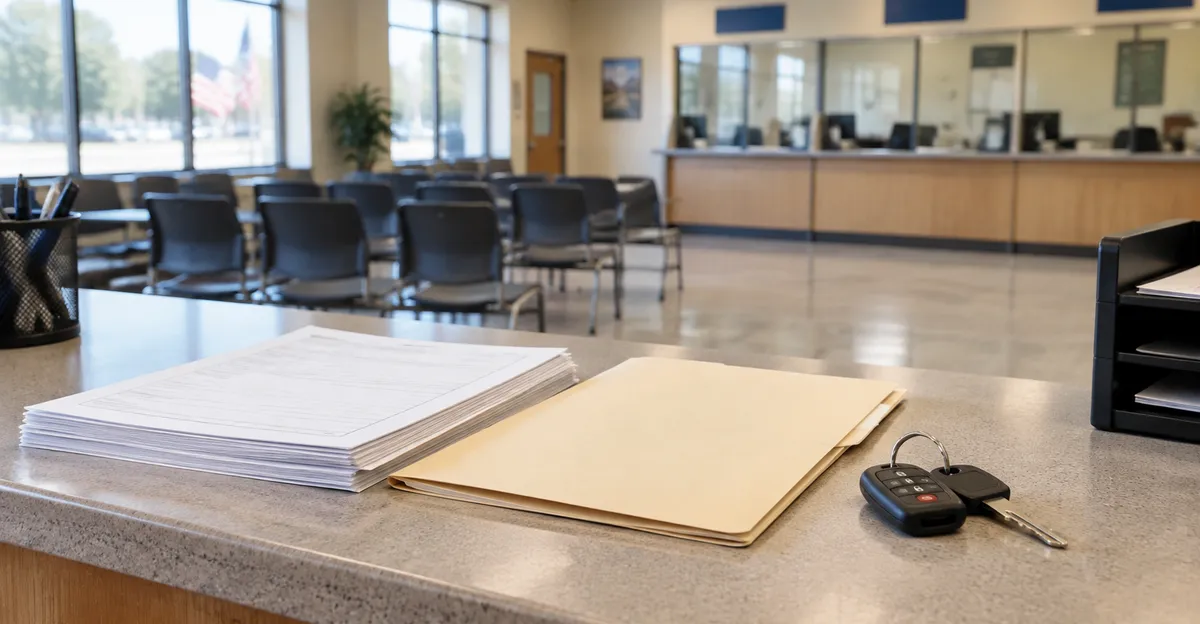
The Document Checklist Most Guides Share
Missouri does not treat “registration” as a separate mystery from title when you just bought the car. DOR’s buying and titling materials treat title application, sales tax, and plates as one license-office visit for most buyers. Form 108 is the core application. Form 184 is the license application used when you obtain, renew, or transfer plates without a full new-title event.
Bring these items unless an exemption clearly applies to your case:
| Item | What “good” looks like | Common fail |
|---|---|---|
| Form 108 | Signed application for Missouri title and license | Blank fields, wrong owner name spelling |
| Ownership | Title assigned to you, or MSO for a new vehicle | Seller did not sign; odometer block empty |
| Insurance | Current card or other DOR-accepted proof | Policy not yet bound to the new VIN |
| Property tax | Paid receipt stamped PAID, or non-assessment | Receipt in a spouse’s or old-county name only |
| Safety inspection | Certificate ≤60 days old when required | Expired certificate; assumed “new car” wrongly |
| Emissions | Report ≤60 days old in listed St. Louis-area counties | Wrong county assumption; diesel/GVWR exemption missed |
| ID/OD | Out-of-state title VIN/odometer inspection ≤60 days | Skipped because “I already have a title” |
| Payment | Cash, money order, or office-accepted card/check | Assumed every office takes the same cards |
DOR’s additional-help page states that most title applications can be completed by printing Form 108 and submitting it at a local license office. You can also pick up a copy at the office or order one by mail. Consumer sites such as DMV.com emphasize that a first-time Missouri registration is an in-person license-office process, not a fully online upload. Renewals are a different product: Form 184 can be used at the office, and DOR notes mail renewal to [email protected] when you are temporarily living out of state.
Proof of ownership is not “a bill of sale alone” for a normal used Missouri title. Paris License Office’s FAQ, which restates DOR buyer guidance, says a used Missouri purchase needs a properly assigned title from the seller. A dealer may also hand you a completed title application. If the prior title is out of state, you need an identification number and odometer inspection at an authorized Missouri inspection station. A Missouri safety inspection can satisfy that ID/OD requirement per DOR’s out-of-state titling notes. New cars use a Manufacturer’s Statement of Origin instead of a prior title.
Odometer rules matter on the assignment. DOR’s additional-help page states that effective January 1, 2021, model year 2011 and newer vehicles require mileage disclosure at transfer until the vehicle is twenty years old. Buyer and seller print and sign. If the title has no space, use Odometer Disclosure Statement (Form 3019). Trailers and ATVs are exempt from mileage disclosure. Gross vehicle weight rating over 16,000 pounds is also listed as exempt.
Insurance is not optional for a plated motor vehicle. DOR requires a current insurance identification card or other proof of financial responsibility and a certification that you will maintain coverage during the registration period. Electronic cards are acceptable if legible. For a newly acquired vehicle, DOR also accepts a paid insurance receipt with policy information, proof of insurance on another passenger vehicle you own if the new car was purchased within 30 days of registration, or an insurer statement covering a commercial purchase for 30 days. Title-only applications and trailers follow the exemptions DOR lists. If you are still sorting why liability coverage is required at all, see why car insurance is required under the Ownership & more guides.
Personal property tax is the document that surprises buyers who moved from another state. To obtain plates, DOR wants a paid personal property tax receipt from the previous year for a one-year registration, or two years of receipts for a two-year registration. Photocopies, faxes, and internet confirmation screens are acceptable if they meet the content rules. The receipt must be in an owner’s name, list each vehicle owned, and be stamped PAID. If you did not owe tax, get a Statement of Non-Assessment from the county assessor (or City of St. Louis). Military members who do not claim Missouri residence may submit a recent Leave and Earnings Statement showing state of residence instead of non-assessment, per DOR’s resident titling guidance.
Title Assignment Mistakes That Stop Registration
The shared checklist assumes the title is already assignable. Private-party deals fail here more than at the fee window.
A properly assigned used title, as described in Missouri license-office FAQs that mirror DOR buyer guides, includes the purchaser’s name and address, odometer reading, sale price, sale date, any lienholder, and printed names and signatures of all sellers and the purchaser. If any seller is missing, or if the odometer block is blank on a vehicle that still requires disclosure, the clerk cannot invent the missing line. Do not white-out a wrong price. Do not leave the buyer’s printed name blank because “the signature is enough.”
Dealer purchases are cleaner when the dealer completes Form 108 or hands you an MSO path. DMV.com’s Missouri registration guide notes that licensed Missouri dealers often submit paperwork for new cars and can sell temporary permits so you can drive while plates are processed. That does not remove your duty to confirm the VIN, purchase price, trade allowance, and lienholder names match what you signed. Wrong ZIP codes for local tax and wrong VINs are classic rework triggers on purchase day; the same data errors appear again at the license office if you self-file a private sale.
If a lien still sits on the seller’s title, you need a release. DOR’s additional-help page explains Notice of Lien, Lien Release, or Authorization to Add/Remove Name from Title (Form 4809). If the lender will not use Form 4809, it must give a notarized statement on letterhead releasing the lien. Buying a car “as soon as the bank mails the title” without a written timeline is how buyers burn the first half of the 30-day window.
Out-of-state titles with a lienholder in possession of the paper are a special path. DOR describes Form 5834 so you can request the original title or have the lienholder notarize the form’s bottom section with acceptable proof of lien. Start that request the week you buy the car, not the week the temporary tag expires.
Lost titles force a duplicate before a clean sale in many cases. DOR guidance summarized by license offices: complete Form 108 (or Form 93 for boats), mark duplicate, notarize as required, pay the $8.50 duplicate title fee and $9 processing fee, and surrender a mutilated title when that is the reason. If a lien remains, the duplicate will still show the lienholder unless you submit a notarized release. Plan days for mail, not minutes.
| Situation | First ownership document | Extra step before Form 108 works |
|---|---|---|
| Private Missouri sale | Assigned Missouri title | Complete odometer disclosure |
| Missouri dealer used car | Assigned title or dealer-prepared Form 108 | Confirm dealer inspection dates |
| Brand-new from dealer | MSO | Confirm MSO names match buyers |
| Out-of-state title in hand | Out-of-state title + ID/OD | Authorized Missouri inspection station |
| Out-of-state title at bank | Form 5834 package | Lienholder release or notarized proof |
| Paid-off loan, title missing | Duplicate title process | Notarized Form 108 / Form 93 path |
Temporary Permit, Plate Transfer, or New Plates
After you buy, DOR’s buying-vehicle guidance says you may obtain a temporary permit, transfer plates from a vehicle you already own, or purchase new plates. That choice changes which fees you pay and which inspections you must stage first.
Temporary permits bridge the gap when you have no plates to transfer. Paris License Office’s FAQ, restating DOR temporary-permit rules, says temporary permits may run 30 days from purchase, or 60 days from qualifying dealers under specific sale conditions. Fees on DOR’s buying page include a $5 permit fee and a $9 processing fee if processed at a license office. Place the permit on the rear where a plate belongs, visible and unobscured. Temporary permits are not valid after you have applied for title. You cannot stack a second temp permit as a lifestyle plan.
Plate transfer is often cheaper than a brand-new plate set when you already own a Missouri registration you can move. DOR’s fee lists for transfers include state and local sales tax on the new purchase, the $8.50 title fee, a $2 transfer fee, registration fees if you renew during the transfer, $9 title processing, $9 registration processing for the transfer, and $9 or $18 registration processing for a one- or two-year registration when applicable. Seller plates do not travel with a complete change of ownership. The buyer cannot keep driving on the seller’s metal.
New plates are the default when you have nothing to transfer. Registration fees still follow taxable horsepower or vehicle weight. Processing fees on Form 108 are $9 for title processing and $9 or $18 for one- or two-year registration processing. Specialty or personalized plates can add wait time; standard plates are often available at the counter when the packet clears.
Dealer temporary tags are common on purchase day. That convenience does not mean the dealer finished your permanent title. Ask whether the dealer is filing Form 108 for you, what deadline they are using, and whether you still owe a personal appearance for anything. Private-party buyers usually own the entire license-office trip. For how purchase-day timing collides with insurance binders and temporary tags more generally, see how long it takes to buy a car.
| Choice | When it fits | Watch-out |
|---|---|---|
| Temporary permit | No transferable Missouri plates | Expires; invalid after title application |
| Plate transfer | You already have eligible Missouri plates | Seller’s plates never transfer to buyer |
| New plates | First Missouri registration or no transfer option | Budget horsepower/weight fees + processing |
| Dealer files packet | Licensed Missouri dealer handles title work | Confirm who pays tax and who holds lien title |

Safety and Emissions: Do You Actually Need Them?
Checklist pages say “bring a safety inspection.” Missouri’s exemption rules are why many people still get turned away—or waste a trip to an inspection lane.
DOR’s additional-help page requires a Certificate of Inspection and Approval from an authorized Missouri inspection station when a safety inspection is required. The certificate is valid for 60 days from the inspection date for ordinary applications. When you buy from a Missouri dealer and the dealer’s certificate shows the inspection was completed within 60 days before purchase, the certificate can be valid for 90 days from the inspection date. Present it when you apply for title and license or for renewal unless exempt.
The large modern exemption: effective August 28, 2019, motor vehicles in the first ten years following the model year of manufacture with fewer than 150,000 miles are exempt from the safety inspection. DOR’s example treats a 2015 vehicle under 150,000 miles as exempt through 2025. Crossing 150,000 miles removes the exemption even if the car is still within the ten-year window. Model-year parity also matters when ownership does not change: even model years inspect in even calendar years; odd model years inspect in odd calendar years, unless another exemption applies. Trailers, historic plates, dealer-to-dealer sales, junk/salvage sales, interstate MoDOT-registered vehicles, and low-speed vehicles have separate exemption lists on the same DOR page.
Emissions are geographic. Form 108 and Form 184 require an emissions inspection not more than 60 days old for residents of St. Louis City and Franklin, Jefferson, St. Charles, and St. Louis counties, for certain passenger vehicles and trucks with manufacturer’s GVWR of 8,500 pounds or less. DOR does not operate the emissions program; the Gateway Vehicle Inspection Program is administered by the Department of Natural Resources and the Missouri State Highway Patrol. Many exemptions exist—older model years, high GVWR, many electric and plug-in vehicles, mileage-based waivers with DNR paperwork, out-of-area waivers, and more. An asterisk in DOR’s emissions exemption list notes that an inspection is required regardless of model year if the vehicle is sold. Do not assume a renewal exemption covers a purchase transaction.
Out-of-state at renewal or registration: DOR allows an exemption path when the vehicle has been out of state for at least 60 days, with inspection required within 10 days of return and a General Affidavit (Form 768) stating the out-of-state period when inspection would otherwise be required. That is a narrow travel fact pattern, not a way to skip St. Louis-area emissions forever.
| Question | If yes | If no |
|---|---|---|
| Is the car within 10 model years and under 150,000 miles? | Safety inspection often exempt | Plan a 60-day certificate |
| Is this a purchase (ownership change)? | Emissions may be required even when renewal would skip a year | Check model-year parity rules |
| Do you garage in St. Louis City or Franklin, Jefferson, St. Charles, or St. Louis County? | Budget Gateway emissions when Form 108 applies | Emissions usually not required for that address |
| Is the title from another state? | Get ID/OD (safety inspection can satisfy) | Standard Missouri assignment path |
| Did a Missouri dealer inspect within 60 days before sale? | 90-day certificate window may apply | Use the ordinary 60-day window |
Sales Tax, Fees, and the 30-Day Clock
Money questions are where secondary sites drift. Prefer DOR’s published rates and Form 108’s fee lines.
State sales tax is 4.225 percent plus local tax for the city or county where you live, not where you bought the car, according to Missouri license-office FAQs that restate DOR tax guidance. Tax is based on net purchase price after rebates and trade-ins. DOR points buyers to its online sales tax calculator for estimates. Out-of-state tax already paid is credited; you pay any Missouri shortfall and must prove the other state’s payment. If the vehicle was titled in your name in another state for more than 90 days, those FAQs state no Missouri sales tax will be assessed on the move-in titling path DOR describes for residents who already owned and operated the vehicle out of state for at least 90 days.
Fixed fees that appear repeatedly on DOR Form 108 and buying guidance include an $8.50 title fee, $9 title processing fee, and $9 or $18 registration processing for one- or two-year registration. Plate transfer adds a $2 transfer fee and its own processing lines. Temporary permits add the $5 permit fee plus processing when done at a license office. Registration (plate) fees still vary by taxable horsepower or weight; look up the current DOR fee tables rather than memorizing a single “plate price” from an old blog.
The deadline is the part that converts a forgetful week into a penalty. DOR states you have 30 days from purchase to title and pay sales tax. The title penalty is $25 on the 31st day and another $25 for every additional 30 days late, capped at $200. Late renewal of plates is a separate $5 penalty for failing to renew before the end of the expiration month, per DOR’s additional-help penalties section. Form 5687 notes a 60-day title application window when a qualifying dealer executed Form 5830 for delayed delivery of the certificate of ownership. If you are late, you still title the vehicle; you do not wait for the penalty to “max out” as a strategy. The meter stops when you apply, not when you feel ready.
Payment methods vary by office. License-office FAQs state cash or money order are accepted at DOR license offices; personal checks and certain credit or debit cards (Discover, American Express, and Mastercard are the brands those FAQs list) are accepted at some offices only. Call the office before you queue if you are not carrying cash. Personal checks payable to the Missouri Department of Revenue may need driver license number, date of birth, and daytime phone on the check.
Sales-tax allowances exist beyond a same-day trade-in. License-office FAQs describe a tax allowance when you sell one vehicle and buy another within 180 days, with a bill of sale or Notice of Sale (Form 5049). They also describe total-loss replacement credits within 180 days of the insurance payment, with a notarized or agent-certified insurer statement. Those paths are easy to miss if you only read “pay 4.225 percent.”
Montana LLC registration schemes are a different problem from Missouri’s ordinary resident paperwork. If someone is pitching out-of-state plates to dodge tax while the car lives in Missouri, that is not a Missouri registration checklist item—see why people register cars in Montana for how use tax and home-state enforcement work in that pattern.
New Residents and Out-of-State Titles
Moving into Missouri with a car you already own is not the same packet as buying from a St. Louis private seller.
DOR’s titling guidance gives new residents 30 days from becoming a Missouri resident to title the vehicle. You still complete Form 108. You still present insurance. You typically need a statement of non-assessment if you have not yet paid Missouri personal property tax for a prior year. Out-of-state titles need the ID/OD inspection path. Safety and emissions rules follow your new Missouri address and the exemption tables above.
Tax is the resident-specific fork. If you owned and operated the vehicle in another state for at least 90 days before Missouri titling and registering, DOR states no additional sales tax is due. If ownership was under 90 days and the other state’s tax was lower than Missouri state plus local tax, show proof of what you paid and pay the difference at Missouri rates of 4.225 percent state plus local on the purchase price less trade-in. Bring the out-of-state title, proof of tax paid if claiming credit, and the inspection certificates your county needs.
Military members have additional document swaps. DOR allows a Leave and Earnings Statement showing state of residence in place of a Missouri non-assessment statement when Missouri is not claimed as residence. Consumer guides also describe extended renewal timing for some active-duty situations; verify the current military rule with DOR rather than assuming a civilian 30-day clock.
Do not confuse “I got a Missouri driver license” with “my car is registered.” Address changes for motor vehicle records can use DOR’s Online Address Change Request or Form 5805, per license-office FAQs, but changing a mailing address does not by itself retitle an out-of-state vehicle.
| New-resident fact | DOR / license-office rule of thumb | Your next action |
|---|---|---|
| Deadline | 30 days from becoming a resident | Book license office inside that window |
| Tax if owned ≥90 days out of state | No additional Missouri sales tax | Bring proof of prior ownership/operation |
| Tax if owned <90 days | Pay Missouri shortfall vs tax already paid | Bring other-state tax proof |
| Ownership document | Out-of-state title | Schedule ID/OD inspection |
| Property tax | Often non-assessment at first visit | Visit county assessor before the office |
Personal Property Tax Receipts That Get Rejected
Insurance and title get the attention. Property-tax paperwork is what sends people home from the counter.
DOR’s additional-help page is strict about names. The paid receipt or non-assessment must be in an owner’s name. If the vehicle owner is a corporation or company, the receipt must be in that entity’s name. For a leased vehicle, the receipt must be in the leasing company’s name. A receipt that lists only one spouse when the title is in the other spouse’s name alone can fail. A receipt from the county you left in March does not automatically satisfy the county where you lived on January 1 of the prior year—DOR ties the receipt to the county (or City of St. Louis) where you resided on January 1 of the previous year for Form 108’s property-tax line.
One-year versus two-year registration changes how many years of receipts you need. Lost receipts are recoverable from the county collector; some counties let license offices look up paid records, but DOR says a Statement of Non-Assessment cannot be verified online. Do not assume a verbal “you’re fine” from a friend at the assessor’s office replaces the paper or printout the clerk will keep in the file.
If you just moved to Missouri, non-assessment is normal. Get it before you stand in the title line. If you own multiple vehicles, confirm the receipt lists the vehicles the collector expects. Corporate and leased titles are where private buyers and small businesses most often bring the wrong name.
| Problem | Why the clerk rejects it | Fix |
|---|---|---|
| Wrong person’s name | Must match an owner (or lessor/entity rules) | Correct assessor/collector document |
| Wrong year count | Two-year plate needs two years of receipts | Collect the missing year |
| Unpaid stamp | Must show PAID | Pay collector, bring new receipt |
| Assumed online non-assessment | DOR says non-assessment is not online-verifiable | Visit assessor for the statement |
| Leased car, personal receipt | Lease requires leasing company name | Ask lessor for compliant proof |
Bring backups. A phone photo of an insurance card can work if legible; a phone photo of a crumpled receipt that cuts off the PAID stamp may not. Print what you can. Arrive with Form 108 filled, inspections dated inside the window, and a payment method your specific office accepts.
Missouri registration is paperwork sequencing more than mechanical diagnosis. Sort ownership, insurance, tax proof, and inspections before you care about plate style. When collision damage or ownership paperwork after a crash is the real problem, start from the Ownership & more guides rather than this title checklist.
FAQ
What do I need to register my car in Missouri?
At a Missouri license office you generally need a signed Application for Missouri Title and License (Form 108), proof of ownership such as a properly assigned title or Manufacturer’s Statement of Origin, current proof of financial responsibility, a paid personal property tax receipt or statement of non-assessment, and a safety inspection certificate when required. Residents of St. Louis City and Franklin, Jefferson, St. Charles, or St. Louis counties may also need an emissions inspection. Out-of-state titles usually need an identification number and odometer (ID/OD) inspection. Bring payment for state and local sales tax plus title and registration fees.
How long do I have to title a newly purchased vehicle in Missouri?
The Missouri Department of Revenue states you have 30 days from the purchase date to title and pay sales tax. On the 31st day a title penalty of $25 begins. The penalty increases another $25 for every 30 days you are late, up to a maximum of $200. Form 5687 notes a 60-day window can apply when you bought from a qualifying dealer that executed an Agreement for Delayed Delivery of Certificate of Ownership (Form 5830).
Do I need a Missouri safety inspection every year?
Not always. Missouri DOR’s additional-help guidance says a Certificate of Inspection and Approval is generally valid for 60 days (or 90 days in the dealer-purchase scenario it describes). Effective August 28, 2019, motor vehicles in the first ten years following the model year with under 150,000 miles are exempt from the safety inspection. When ownership does not change, even model years are inspected in even calendar years and odd model years in odd calendar years, unless another exemption applies. Your renewal notice is the practical cue for whether you need one this cycle.
Which Missouri counties require an emissions inspection?
Missouri DOR Form 108 and Form 184 list St. Louis City and Franklin, Jefferson, St. Charles, and St. Louis counties for emissions inspections on certain passenger vehicles and trucks with a manufacturer’s gross weight rating of 8,500 pounds or less. The inspection is generally not more than 60 days old when you apply. The Gateway Vehicle Inspection Program is run by the Department of Natural Resources and the Missouri State Highway Patrol, not by DOR itself. Confirm against your renewal notice and current DOR guidance for your address.
What happens if I move to Missouri with a car already titled in my name?
DOR’s titling page states you have 30 days from becoming a Missouri resident to title the vehicle. If the vehicle has been owned and operated in another state for at least 90 days before Missouri titling, no additional Missouri sales tax is due. If you owned it less than 90 days and paid less tax elsewhere than Missouri state and local tax, you show proof of the other state’s tax and pay the difference. You still need Form 108, insurance proof, a statement of non-assessment when you do not owe personal property tax yet, and inspections when required, including ID/OD for an out-of-state title.
Can I register a car online in Missouri?
Initial title and plate issuance for a newly purchased vehicle is handled at a Missouri license office with your documents in hand. Consumer guides such as DMV.com note that new Missouri registration is not an online self-serve process the way some states allow. Renewals can be different: DOR allows Form 184 renewals by mail in some situations, and some counties participate in online or phone renewal paths. Use the DOR license office locator for the office that serves you, and ask that office which renewal channels it offers.
What proof of insurance does Missouri accept for registration?
DOR’s additional-help page requires every motor vehicle owner to present a current insurance identification card (original, copy, or electronic if legible) or other proof of financial responsibility, and to certify that coverage will be maintained. Acceptable proof includes a card with insurer name and address, insured name, policy number, effective dates, and vehicle description; a liability policy or binder; a paid insurance receipt with policy details; proof of financial responsibility filed with DOR; or a DOR certificate of self-insurance. Trailers and title-only applications have the exemptions DOR lists. Coverage minimums and why states require liability insurance are broader ownership questions covered elsewhere on this site.
What if the seller’s bank still holds the out-of-state title?
DOR’s out-of-state titling guidance describes using Owner Out-of-State Title Request (Form 5834). Complete the owner and vehicle sections, then send the form to the lienholder so the lender can release the original title or complete and notarize the bottom section with acceptable proof of lien. Until you have the title or that accepted proof package, the license office cannot finish a normal Missouri title application. Start that request early inside the 30-day purchase window.