
By Automotive Research TeamUpdated 2026-09-20
Why Does My Car Smell Like Rotten Eggs
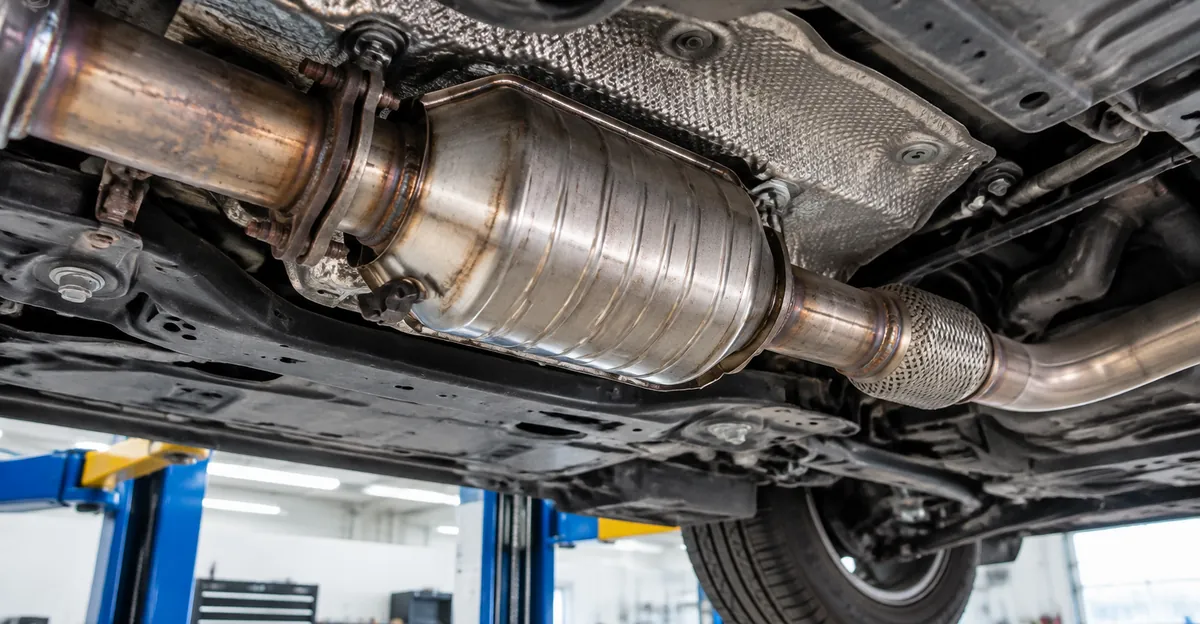
Why does my car smell like rotten eggs is almost always sulfur leaving the exhaust as hydrogen sulfide, the gas your nose reads as rotten eggs. A healthy catalytic converter is supposed to turn sulfur compounds from the fuel into forms you do not notice. When you notice them, the fuel was high in sulfur, the converter is being flooded with extra fuel, or the converter itself is no longer doing that job. A hot battery under the hood can imitate the same smell. It is not the same fault.
Raw fuel is a different page. If the odor is sharp solvent rather than sulfur, use the raw-fuel smell guide. Stay here when the comparison that comes to mind is eggs, matches, or a sewer, not a filling station.

Rotten Egg Smell in Car
A rotten egg smell in car shows up in a few repeatable moments, and those moments are the diagnosis. A bulletin on sulfur odor archived by NHTSA is blunt about the pattern. Drivers notice it after a cold start, at a fast idle, after sitting and idling, or on a full-throttle acceleration. The bulletin says this smell is not, by itself, proof that the engine is failing, and it will not by itself reduce the life of the engine or its emissions parts.
The cause it names is sulfur in the fuel. Refining removes most of it. How much is allowed still varies. Burn that fuel and the catalytic converter oxidizes the sulfur. The odor is the result of that reaction. As the converter ages and accumulates miles, the bulletin says the odor tends to drop. That is why the first experiment is not a new converter.
The bulletin's caution is the part shops skip. Replacing the catalytic converter will not eliminate a sulfur smell that is coming from the fuel. A fresh converter only stretches out the break-in period before the smell settles. The steps it gives are ordinary and they are the right order:
- Switch to another brand of fuel and drive at least 100 miles. Note whether the odor falls or rises.
- Do not add a fuel additive. The bulletin says an additive can add sulfur and make the smell worse.
- Cut back on long strings of short trips and on hard acceleration. Those are the conditions that make the odor obvious.
- Ask local stations which fuel is lower in sulfur, and prefer that one.
If the odor fades after a tank from a different station, you have your answer. If it does not, the converter and the mixture that feeds it are next, not another additive.
Car Smells Like Rotten Eggs
A car smells like rotten eggs while it is moving is the exhaust case. People also say the car smells of rotten eggs, or they shorten it to an egg smell in car. Same odor. The useful split is where your nose finds it, because a tailpipe and a battery vent the same family of sulfur compounds for unrelated reasons.
Severson Auto Service describes the exhaust version cleanly. Fuel contains sulfur compounds. A converter that is at the right temperature, with the right oxygen, turns most of them into something you never smell. When the engine runs richer than it should, extra fuel hits the converter and more hydrogen sulfide gets through. A converter that is already damaged or contaminated does the same thing from the other direction: it cannot finish the reaction, so the sulfur smell leaves the tailpipe. Severson is also clear that the converter does not invent the sulfur. It reacts to what the engine sends.
Rich running has ordinary causes. Severson names a dirty mass-airflow sensor, a lazy oxygen sensor, leaking injectors, and a fuel-pressure problem. Any of those can push the mixture rich, overload the converter, and shorten its life. Replacing the converter while the engine is still rich repeats the failure. That is the same moral as the NHTSA bulletin, from the mixture side instead of the fuel-brand side. Fix what is feeding the converter before you price the converter.
Clues that the converter is actually hurt, not just annoyed by a tank of fuel:
- The smell stays after you have burned through a tank from a different station and driven those 100 miles.
- A check-engine light is on. Read it before you approve exhaust parts. See warning lights.
- The car is down on power, especially on a hill, or the converter rattle is new.
- Fuel use jumped and the tailpipe smells sharp under load, which fits the rich-mixture list above.
Clues that it is still the fuel:
- It showed up after one station, and it is worst on cold starts and hard throttle, matching the bulletin.
- There is no light, no power loss, and no rattle.
- Another brand quiets it.
| What you notice | Lean toward | Do not do first |
|---|---|---|
| Cold start, hard throttle, no light, one station | Sulfur in that fuel | A new converter |
| Light on, poor mileage, smell under load | Rich mixture overloading the converter | An additive |
| Smell only with the hood up, slow cranking | Battery or charging | Exhaust parts |
| Strong odor inside the cabin plus a headache | Fumes getting in, possibly an exhaust leak | Idling in a closed garage to "confirm" it |
When the Converter Is Overwhelmed
The catalytic converter on a healthy car runs hot enough to finish chemical work you never see. Short trips keep it below that temperature. Severson notes that a converter which rarely gets fully hot can smell stronger, because it does not burn off deposits or settle its reactions. The NHTSA bulletin says the same thing in driver language: avoid stacks of short trips. A five-minute hop to the store, repeated all week, is a good way to notice a sulfur odor that a highway drive would have covered. The converter is not "broken" because Tuesday morning smelled worse than a Sunday highway run. It may simply never have stayed hot.
A useful week, if the car is otherwise normal, is one tank from a different station and at least one drive long enough to get the exhaust fully hot. The bulletin's 100 miles is the minimum for the fuel test, not a suggestion to sprint them. If the odor is gone at the end of that tank and stays gone on the next, stop. You do not need a converter to confirm a station. If the odor returns the day you go back to the old station, you have repeated the experiment. Use the station that stayed quiet.
Aggressive acceleration does the opposite thermal job and still smells. A sudden load dumps more exhaust, and more sulfur compounds, through the brick at once. If your only complaint is "it smells when I floor it, then it fades," you are describing the bulletin's full-throttle case. Drive it gently for a tank on a different brand before you diagnose a failed converter.
A converter that is truly failing usually adds something besides smell. Power falls off. Fuel economy falls off. A rattle means the brick inside is loose. The light comes on because the oxygen sensors before and after the converter no longer show the switch the computer expects. None of that is diagnosed by the nose alone. A shop should look at fuel trims and the sensors Severson lists, on the engine, before the exhaust invoice. An oxygen sensor or a mass-airflow sensor is a smaller repair than a converter, and it is the repair that keeps the next converter alive.
Ask the shop to say which of those they ruled out. A quote that starts with "converter" and never mentions fuel trims, the sensors, or the brand of fuel you have been buying is the quote the bulletin is warning you about. You can approve a converter after that list is clean. Approving it as the first guess pays for a part that will smell the same way if the mixture is still rich or the fuel is still high in sulfur.
Do not punch the converter or pour a cleaner through it because a video said the smell would stop. The bulletin already forbids additives that add sulfur. A cleaner you cannot name on the invoice is how a marginal converter becomes a clogged one.
The Battery Under the Hood
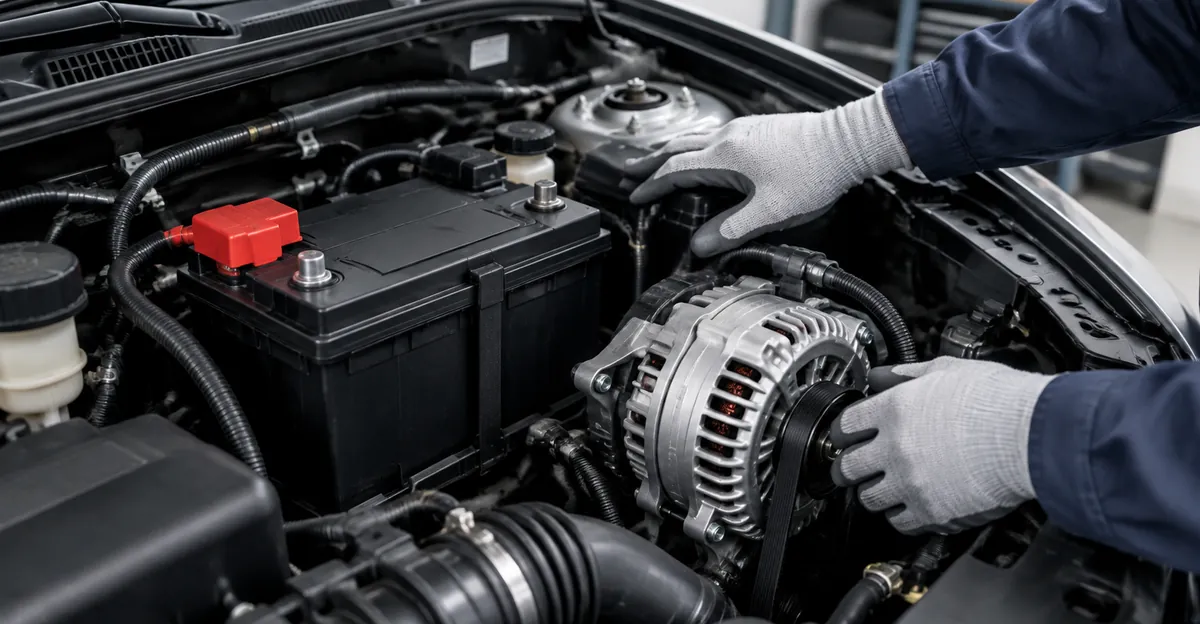
Not every sulfur odor is the tailpipe. Severson says a failing battery can produce a sulfur smell that drifts into the cabin at idle or when the hood is open. It is strongest near the battery, not behind the car, and it often shows up with slow cranking or other electrical trouble.
A lead-acid battery holds sulfuric acid. When it is overcharged or a cell is failing, it vents gas that your nose files under rotten eggs. The usual charging fault is the voltage regulator in the alternator, not the exhaust. You do not fix that by changing fuel brands, and the 100-mile test will not touch it.
Park, hood up, and compare.
- Strongest in the face when you open the hood, weak at the tailpipe: battery.
- Battery case hot, swollen, wet, or crusty on top: stop. Do not keep charging it and do not lean in with a spark near the posts.
- Slow cranking, dim lights, or a battery warning, with no change in exhaust sound: charging system, not the converter.
- Smell only while driving, nothing special under the hood: go back to the exhaust section.
A battery that is venting is not a "drive it until Saturday" smell. Hydrogen that comes off with the sulfur odor can ignite at the terminals. If the case is hot or bulging, shut the car off, leave the hood open once you are clear of traffic, and have it towed. Testing the battery and the charging voltage is a shop job with a meter, not a guess from the odor alone.
Do not wash the top of a crusty battery with the posts connected and the engine running. Corrosion and a wet case are evidence, not a detailing job. A shop can load-test the battery and measure what the alternator is putting out with the engine running and with electrical loads on. If the regulator is stuck high, a new battery will cook the same way. If a cell is shorted, a new alternator will not make that battery take a charge. The meter decides which part failed. The smell only decides that you are in this section and not the tailpipe section.
What to Check Before You Keep Driving
Sort the odor once. Then stop experimenting.
- Place. Tailpipe and under load, or hood and at a standstill. Write which.
- Fuel. If it is the tailpipe and there is no warning light, buy one tank from a different station and drive at least 100 miles, as the bulletin says. No additive.
- Light and power. A warning light, a loss of power, or a new rattle means scan and inspect before a converter quote.
- Battery. Hood open, case touched carefully with the engine off. Hot, swollen, or crusty goes on a tow truck.
- Cabin. If the smell is thick inside the car and anyone feels ill, get out. An exhaust leak can feed the cabin fumes that include carbon monoxide. Do not "air it out" by idling in a garage.
The sentence you give the shop matters. "It started after I filled up at a new station, it is worst on a cold start, and there is no light" is the bulletin's case. "It smells under the hood, the battery is hot, and it cranks slow" is the battery case. "The light is on and it smells when I climb hills" is a mixture and converter case, in that order.
One more pass before you pay. Ask whether they checked fuel trims and the sensors, or whether the quote assumes the converter is the first part. Ask which fuel you were told to try, and whether anyone suggested an additive. A shop that follows the bulletin will talk about a brand change and those 100 miles before it talks about a converter. A shop that leads with the converter has skipped the step the bulletin says will not work. You can still approve the converter later. You should not approve it in place of the fuel test and the mixture test.
If the odor is only in the cabin and the exhaust sounds new, say that too. A leak ahead of the muffler can pull sulfur odor inside even when the converter is only doing what high-sulfur fuel makes it do. That leak is an exhaust repair. It is not proof the brick is dead, and it is not something you confirm by idling in a garage. Open windows, pull over, and have the leak found on a lift. A cabin full of exhaust is the stop-driving case even when the sulfur itself came from the fuel. Do not keep the blower on fresh air to "see if it clears" while you finish the commute. Fresh air is how an underbody leak gets a second path into the seats.
FAQ
Will a new catalytic converter stop a sulfur smell?
Not when the fuel is the reason. The NHTSA-archived bulletin says a new converter will not remove a sulfur odor from high-sulfur fuel. It only delays the aging that normally reduces the smell. Change brands, drive at least 100 miles, and skip additives. Replace the converter after the mixture and the fuel have been ruled out, not before.
Is the smell dangerous if it stays outside the car?
The bulletin treats a tailpipe sulfur smell on a cold start, a long idle, or a hard acceleration as a fuel-sulfur issue, not as proof the engine is damaged. It becomes urgent when the odor fills the cabin, someone feels sick, the car overheats, or power drops. Those are stop-driving signs.
How do I tell a battery apart from the exhaust?
Nose at the hood versus nose at the tailpipe. Severson puts a battery smell at the battery, often with slow cranking, and the exhaust smell behind the car while you drive. A hot or swollen battery case is the version you do not jump-start or keep charging.
Should I pour in a fuel additive?
No. The bulletin says an additive can add sulfur and increase the odor. Another fuel brand is the test. A bottle from the pump shelf is how people make this smell worse and then blame the converter.